Intermittent Fasting works. End of 12th week.

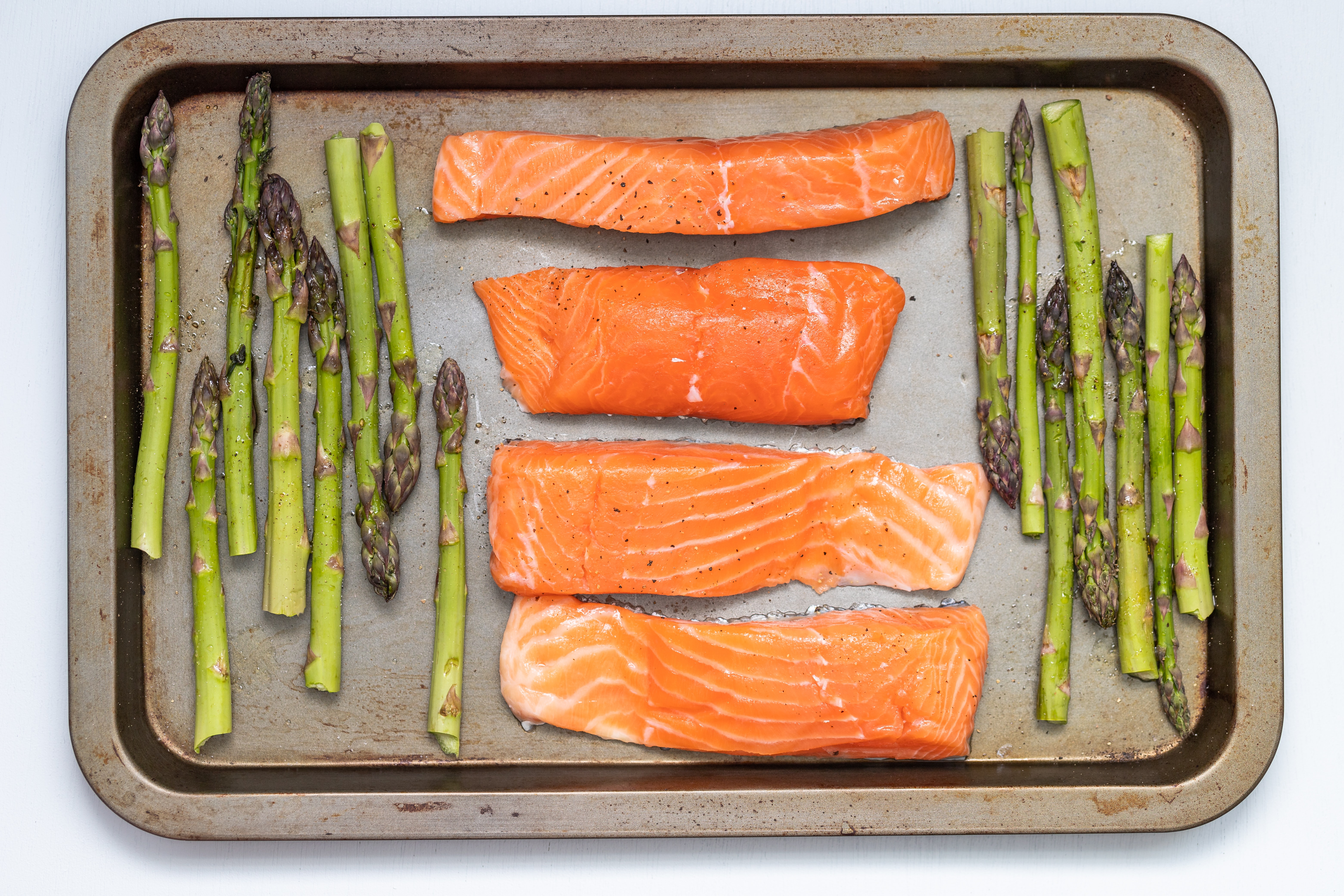
Photo by Clay Banks on Unsplash

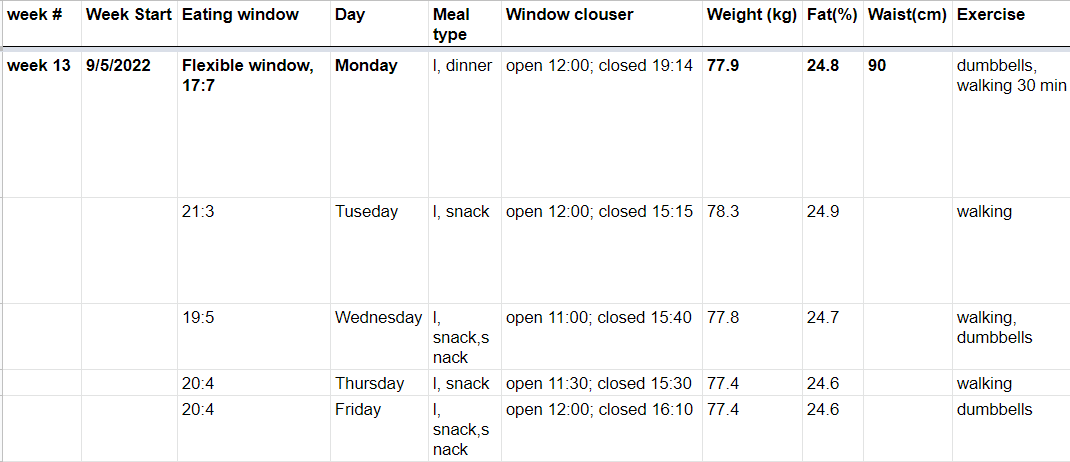
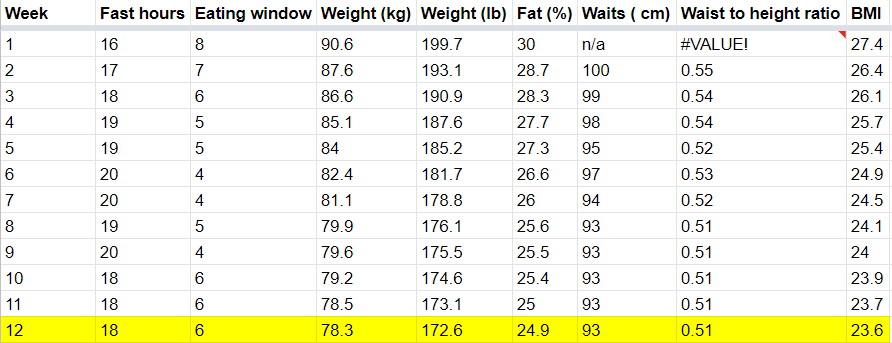
Up to date results

This post is a continuation of the posts where I wrote about my progress following Intermittent Fasting eating pattern. I remind you that my end goal is a body fat of 15 %. Today I will provide a status update at the end of the 12th week.

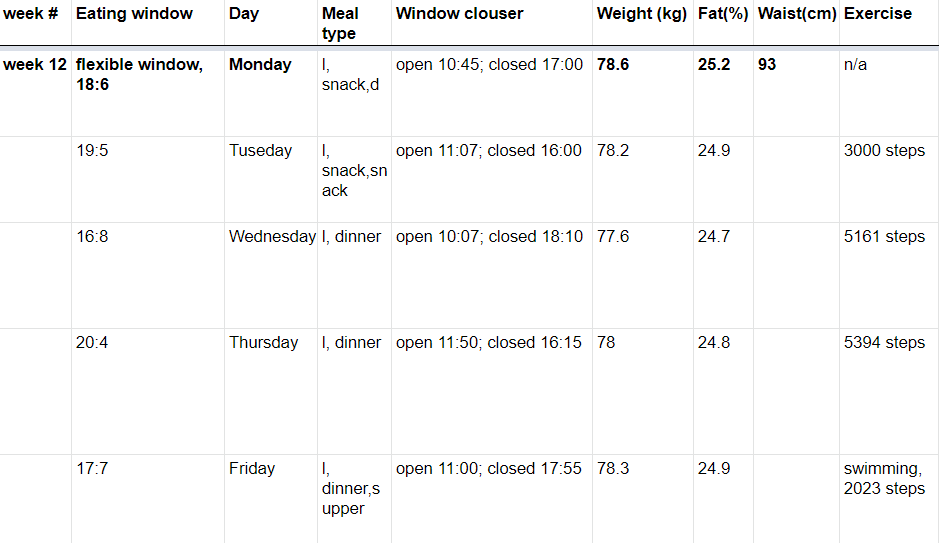
This week I had a flexible eating window, which on average was 6 hours long. And on average I ate two meals in that eating window.

My current weight as of 2022-09-02 is 78.3 kg (172.6 lb) and body fat 24.9 %.

Legend

  • Fast Hours stands for how many hours I do not eat anything except for drinking water, black coffee (no milk or sugar) or tea (no milk or sugar).
  • Eating window hours stands for the hours where I have two meals. I try, quite successfully, not to have any snacks between the meals.

Same information as a chart

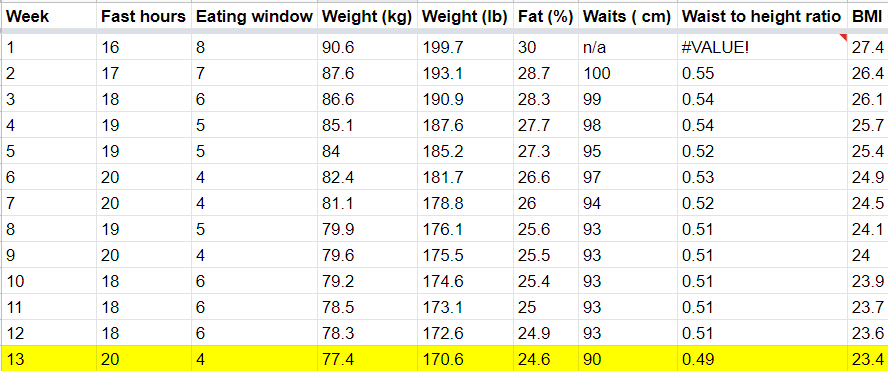
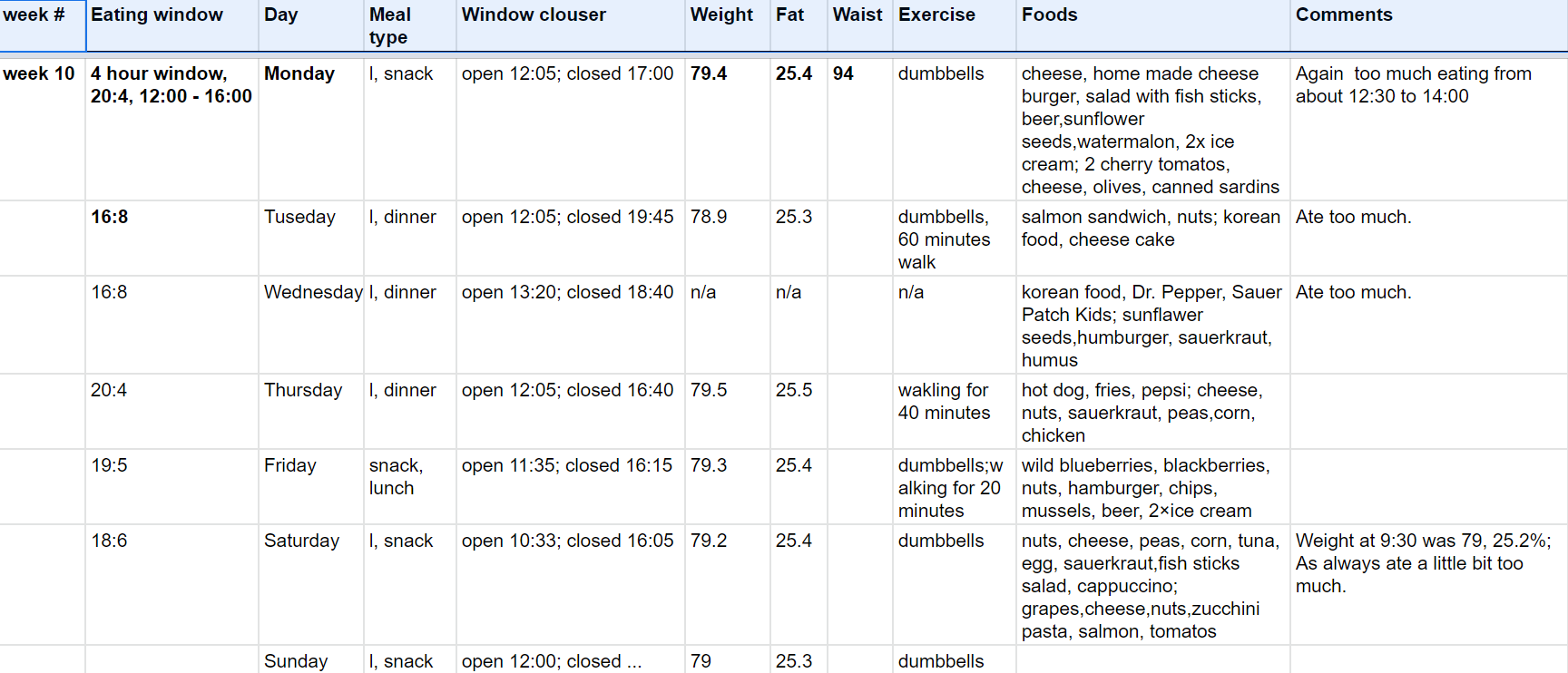
Detailed weekly regimen

  • Here comes this 12th week statistics. As you can see weight fluctuates during the week, which is expected.
  • What’s important that week over week there is a tendency for weight to decrease.

Legend

  • l – lunch

Useful references

Books

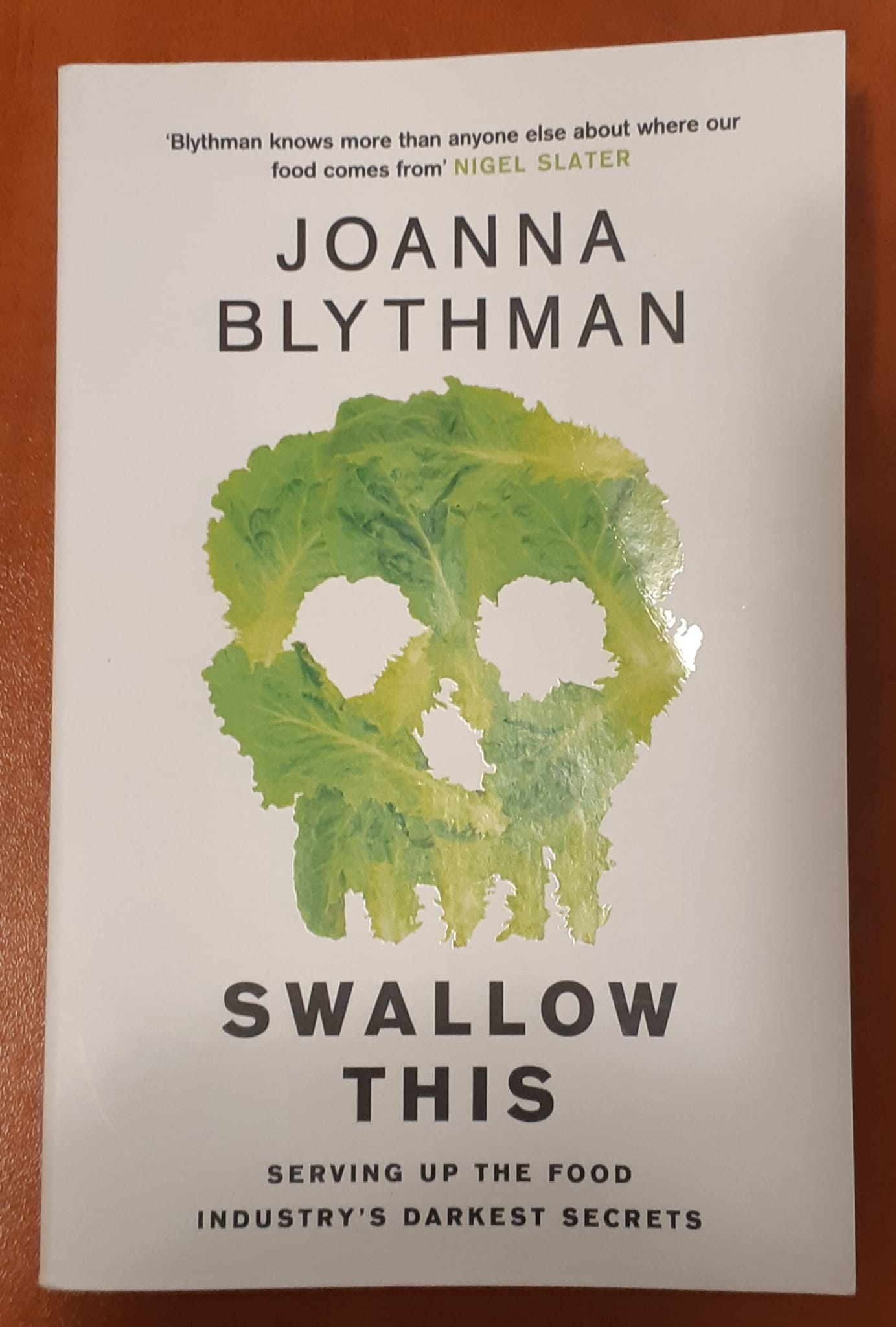
Swallow This book by Joanna Blythman is about processed food industry and its secrets.

Video

The Case For Keto with Gary Taubes

Intermittent Fasting works. End of 11th week.

Up to date results

This post is a continuation of the posts where I wrote about my progress following Intermittent Fasting eating pattern. I remind you that my end goal is a body fat of 15 %. Today I will provide a status update at the end of the 11th week.

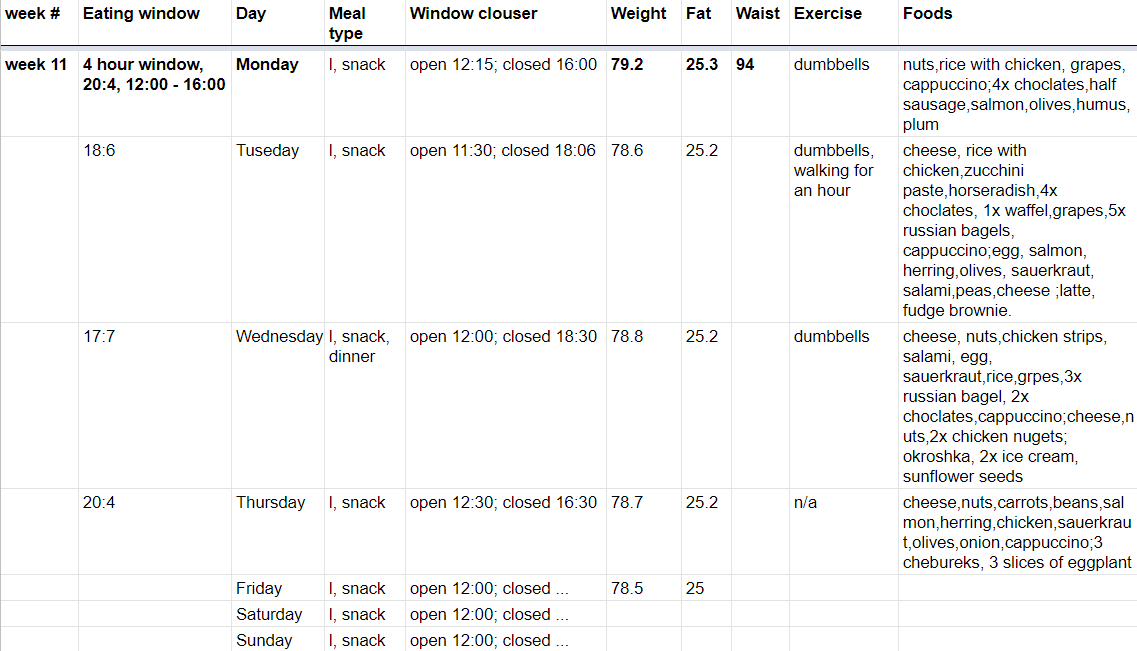
This week I had a flexible eating window, which on average was of 6 hours. And on average I ate two meals in that eating window.

My current weight as of 2022-08-26 is 78.5 kg (173.0 lb) and body fat 25.0 %.

WeekFast hoursEating windowWeightFat percentageWaitsWaist to height ratioBMI
116890.6 kg (199.7 lb)30.0 %N/AN/A27
217787.6 kg (191.8 lb)28.7 %100 cm0.5526.4
318686.6 kg (190.9 lb)28.3 %99 cm0.5426.1
419585.1 kg (187.6 lb)27.7 %98 cm0.5425.7
519584.0 kg (185.2 lb)27.3 %95 cm0.5225.4
620482.4 kg (181.7lb)26.6 %97 cmN/AN/A
720481.1 kg (178.8 lb)26.0 %94 cmN/AN/A
819579.9 kg (176.1lb)25.6 %N/AN/AN/A
920479.6 kg (175.5 lb)25.5 %N/AN/AN/A
1018679.2 kg (174.6 lb)25.4 %N/AN/AN/A
11
2020-08-26
18678.5 kg (173.0 lb)25.0 %N/AN/AN/A

Legend

  • Fast Hours stands for how many hours I do not eat anything except for drinking water, black coffee (no milk or sugar) or tea (no milk or sugar).
  • Eating window hours stands for the hours where I have two meals. I try, quite successfully, not to have any snacks between the meals.

Detailed weekly regimen

  • Here comes this 11th week statistics. As you can see weight fluctuates during the week, which is expected.
  • What’s important that week over week there is a tendency for weight to decrease.

Legend

  • l – lunch

Useful references

Books

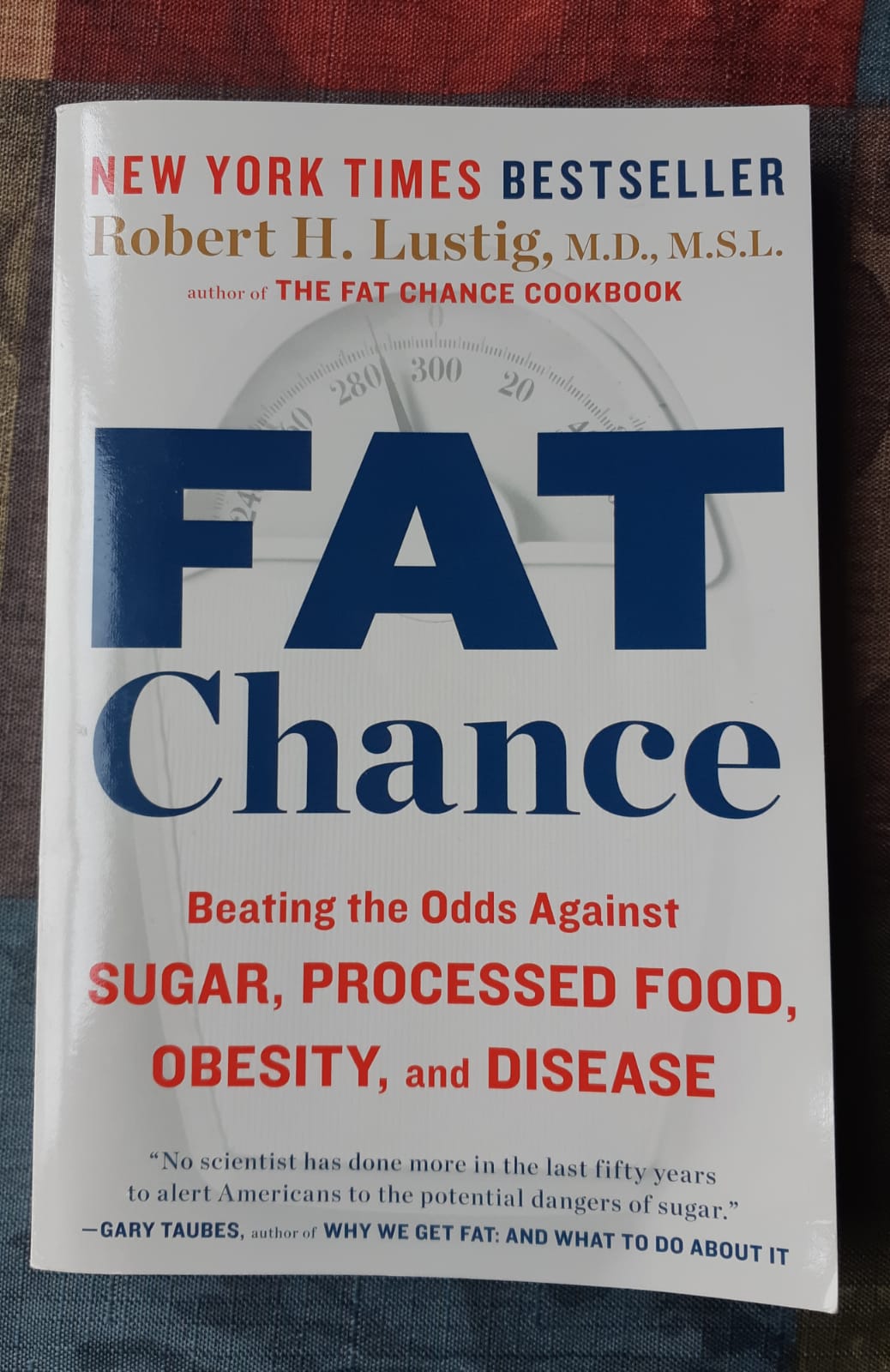
Fat Chance is a book by Robert Lustig, M.D., M.S.L. This book is somewhat similar to the Metabolical, but it focuses mostly on the dangers of sugar and processed food consumption.

Video

This good video features Dr Sarah Hallberg, who passed away recently. RIP.

Reversing Type 2 diabetes starts with ignoring the guidelines | Sarah Hallberg | TEDxPurdueU

Intermittent Fasting works. End of 10th week.

Photo by Jana on Unsplash

Up to date results

This post is a continuation of the posts where I wrote about my progress following Intermittent Fasting eating pattern. I remind you that my end goal is a body fat of 15 %. Today I will provide a status update at the end of the 10th week.

This week I had a flexible eating window, which on average was of 6 hours, since this week it was a vacation week. And on average I ate two meals in that eating window.

My current weight as of 2022-08-20 is 79.2 kg (174.6 lb) and body fat 25.4 %.

WeekFast hoursEating windowWeightFat percentageWaitsWaist to height ratioBMI
116890.6 kg (199.7 lb)30.0 %N/AN/A27
217787.6 kg (191.8 lb)28.7 %100 cm0.5526.4
318686.6 kg (190.9 lb)28.3 %99 cm0.5426.1
419585.1 kg (187.6 lb)27.7 %98 cm0.5425.7
519584.0 kg (185.2 lb)27.3 %95 cm0.5225.4
620482.4 kg (181.7lb)26.6 %97 cmN/AN/A
720481.1 kg (178.8 lb)26.0 %94 cmN/AN/A
819579.9 kg (176.1lb)25.6 %N/AN/AN/A
9
20479.6 kg (175.5 lb)25.5 %N/AN/AN/A
10
2020-08-20
18679.2 kg (174.6 lb)25.4 %N/AN/AN/A

Legend

  • Fast Hours stands for how many hours I do not eat anything except for drinking water, black coffee (no milk or sugar) or tea (no milk or sugar).
  • Eating window hours stands for the hours where I have two meals. I try, quite successfully, not to have any snacks between the meals.

Detailed weekly regimen

  • Here comes this 10th week statistics. As you can see weight fluctuates during the week, which is expected.
  • What’s important that week over week there is a tendency for weight to decrease.
  • Also, you may notice that I do eat processed food. This week especially, since it was a vacation week.

Useful references

Video

  • Jeremy Ethier has an interesting channel about fitness advice. His advice below about losing belly fat is useful, but since he has a dogmatic education he reiterates Calories In – Calories Out theory, which is wrong. But apart from this it’s worth watching.

  • The Goal Guys, who are Canadians have this interesting video about what to eat. Again there is this Calories In vs Calories Out hypothesis. But if you ignore it the advice in this video is aligned with Intermittent Fasting suggestions about what to it in the eating window.

Intermittent Fasting works. End of 9th week.

Up to date results

This post is a continuation of the posts where I wrote about my progress following Intermittent Fasting eating pattern. I remind you that my end goal is a body fat of 20 %. Today I will provide a status update at the end of the 9th week.

This week I switched back to 20 hours fast and 4 hours eating window, since I already get used to and have no problem doing it. And on average I ate one and a half meal in that eating window.

My current weight as of 2022-08-12 is 79.6 kg (175.5 lb) and body fat 25.5 %.

WeekFast hoursEating windowWeightFat percentageWaitsWaist to height ratioBMI
116890.6 kg (199.7 lb)30.0 %N/AN/A27
217787.6 kg (191.8 lb)28.7 %100 cm0.5526.4
318686.6 kg (190.9 lb)28.3 %99 cm0.5426.1
419585.1 kg (187.6 lb)27.7 %98 cm0.5425.7
519584.0 kg (185.2 lb)27.3 %95 cm0.5225.4
620482.4 kg (181.7lb)26.6 %97 cmN/AN/A
720481.1 kg (178.8 lb)26.0 %94 cmN/AN/A
8
19579.9 kg (176.1lb)25.6 %N/AN/AN/A
9
2022-08-12
20479.6 kg (175.5 lb)25.5 %N/AN/AN/A

Legend

  • Fast Hours stands for how many hours I do not eat anything except for drinking water, black coffee (no milk or sugar) or tea (no milk or sugar).
  • Eating window hours stands for the hours where I have two meals. I try, quite successfully, not to have any snacks between the meals.

Some resources to reference

Books

I’ve just finished reading The Every Other Day Diet book by Dr Krista Varady. This books is about Alternate Day Modified Fasting where you eat 500 calories on a fast day and eat whatever and how much you want on a feast day.
Overall, if you ignore all the wrong stuff about Calorie In – Calorie Out theory and an advice to eat low-fat food sprinkled throughout the book, the book has plenty of sound scientific advice rooted in research papers.

Also, this fasting regimen works as good as a usual Intermittent Fasting. It just happened that even though Krista Varady has no clue how fasting really works by mere chance she found a regimen that causes weight loss and other health benefits.

To get a proper scientific explanation why such fasting regimen and others work watch a couple of videos by Dr Jason Fung. Also check scientific papers by Prof Mark Mattson on Intermittent Metabolic Switching in which he explains the workings of Intermittent Fasting on a cellular level.

You Tube video

  • An interview with Dr Jason Fung about Intermittent Fasting and more.

Do it yourself. Write your own book.

Photo by Eugen Str on Unsplash

Quite frequently, I find myself curious why there aren’t that many books that will be interesting for me to read. Books that will be captivating, informative and inspiring. If you have the same feeling from time to time, then I think I have an answer for you.

Have you ever considered writing such a book yourself? Do you think that it’s even possible? It seems to me that it’s not only possible, but actually doable. In this post I’ll describe a couple of ways it can be done.

First of all, I’ve never written a book. So you may be thinking do I even entitled to give an advice about writing a book. Well, it’s a good question. Even though I haven’t written a book yet, I have this blog from 2013 and since then written a number of posts. So I have some understanding about what amount of effort will be required to work on an actual book.

Before describing how you can write your first book I’d like to emphasize that the type of book I envision is not a fictional book. I think it’s much easier to write a technically oriented book, which will be used by readers as a kind of manual. I have three examples to give you. I was personally involved in two of the examples.

Since writing a technical book is the easiest way of writing your first book, in my opinion, that’s talk about such book types.

Back in 2011 after I graduated I started to work as a software testing engineer at HP Indigo Division company. Working with software developers I realized that I want to write code instead of testing it. To make that transition possible I started to work through programming courses at Pluralsight online learning website. Actually, I took more than two dozens of courses there. C++, C#, JavaScript, Android development there were quite a few good courses at Pluralsight. One of the authors at Pluralsight that stood out to me was John Sonmez. Thanks to his courses I was able to get some very important advices that are still useful to me until this day.

Well, why I write that much about Pluralsight and John? It’s because John Sonmez not only had the most courses at Pluralsight at the time he also had a very popular blog called Simple Programmer. There he wrote a number of blog posts a week about software programming related topics. Lo and behold John’s first book Soft Skills: The software developer’s life manual was a compilation of the blog posts he wrote for Simple Programmer. Do you see where I am heading here? That’s right. Having a blog where you write your thoughts in a form of a post can be a springboard to your own first book.

Now that I write this, I recall that actually, my first encounter with this approach to writing a book happened in 2012 when I searched for books about C++ programming and by a mere chance I came across Alex Allain’s website about C++, Cprogramming.com. This website contains a number of tutorials about C and C++ programming. But in addition to this Alex wrote a book that was based on the tutorials from the website and the book is Jumping Into C++.

There is an interesting story about that book that I can’t help but tell you. When I started to read that e-book and do all the exercises in it I noticed that there were a number of spelling mistakes and also bugs in the code. So I decided to contact Alex and notify him about the issues. Also I suggested him that I can provide him with all the errata that I find along the way. Well, thanks to this I was able to establish a working relationship with Alex and was mentioned as one of the contributors to the overall quality of the book. This is how thanks to Alex’s helpful book I started on a road of becoming a DIY technical editor.

Returning to the main topic of the post, first Alex Allain wrote a number of helpful tutorials about C and C++, later he used them to write his first book on C++ programming. John Sonmez used his blog posts from Simple Programmer to write his first book on soft skills in software development.

And now, we come to the third example, in which I was involved quite a lot. This example, you guessed, follows the same type of an approach where first you write blog posts on a technical subject before starting to write a book on that same subject.

This time we are talking about Machine Learning Mastery website. In 2016 I started to get interested in Deep Learning, which is a subset of Machine Learning. Back in 2016 a new hype cycle about Machine learning revolution started. This time, as I’ve mentioned, it was a Deep Learning flavor. While looking for a resources on the subject I came across a blog post at Machine Learning Mastery website. The main author and the owner back then was Jason Brownlee who is an expert in Machine Learning.

The first e-book I bought from Jason was Deep Learning With Python which I found very helpful and straightforward. I bought a number of other books from the same website. As with the Alex’s book on C++, Jason’s book had a number of spelling and programming mistakes that got me thinking. So as previously, I contacted Jason and provided him with a list of issues I found. Jason was happy with my suggestions and as a consequence I became one of the technical reviewers/ editors for Machine Learning Mastery books. Since then I’ve reviewed more than 10 books on the subject for MLM.

Again, John’s, Alex’s and Jason’s approach to writing first and consecutive books was to write blog posts first and then compile them into a whole blown book. Since it was a technical subject that they wrote about, the book in essence was a collection of tutorials, which was much easier to write than a fictional book. Fiction or non-fiction for that matter is much more difficult to write in comparison to a manual about programming in my opinion.

One more, thing. To be able to write a blog post not mentioning a book, there has to be a topic that is close to your heart. A topic that excites you and makes you want to share your excitement with other readers. Otherwise, I hardly doubt there will be any good in attempting to write anything at all. I can tell it by looking at the most read posts at this blog. The most viewed posts were the ones that I cared a lot, the ones in which I shared useful and helpful information, the ones that described things I was personally involved in.

Now, the main question is shall you write a book?

Also, should I write a book myself?

Take care.

Intermittent Fasting works. Beginning of 8th week.

Photo by Georg Niggli on Unsplash

Up to date results

This post is a continuation of the posts where I wrote about my progress following Intermittent Fasting eating pattern. Today I will provide a status update at the beginning of the 8th week.

The projected weight and body fat for the 7th week were

  • 80.7 kg (178.35 lb), and 25.9 % respectively. What actually happened check in the table below.

My current weight as of 2022-08-03 is 79.9 kg (176.1 lb) and body fat 25.6 %.

WeekFast hoursEating windowWeightFat percentageWaitsWaist to height ratioBMI
116890.6 kg (199.7 lb)30.0 %N/AN/A27
217787.6 kg (191.8 lb)28.7 %100 cm0.5526.4
318686.6 kg (190.9 lb)28.3 %99 cm0.5426.1
419585.1 kg (187.6 lb)27.7 %98 cm0.5425.7
519584.0 kg (185.2 lb)27.3 %95 cm0.5225.4
6
20482.4 kg (181.7lb)26.6 %97 cmN/AN/A
720481.1 kg (178.8 lb)26.0 %94 cmN/AN/A
8
2022-08-03
19
579.9 kg (176.1lb)25.6 %N/AN/AN/A

Legend

  • Fast Hours stands for how many hours I do not eat anything except for drinking water, black coffee (no milk or sugar) or tea (no milk or sugar).
  • Eating window hours stands for the hours where I have two meals. I try, quite successfully, not to have any snacks between the meals.

Some resources to reference

YouTube Video

The Root Cause: In Search Of A Core Explanation


Photo by Tamara Gak on Unsplash

© Andrey Cheremskoy, 2022-07-30

What did cause this?

Not once when faced with a problem we tend to come to a superficial conclusions that may be far away from the underling causes of the issue. This can be seen in almost any human endeavor, particularly in scientific research, in engineering, such as software programming or electronics, in medicine etc. Hence, comes the need for finding a root cause of the problem which allows to come up with a core explanation of the phenomenon at play.

There are a number of ways to uncover a root cause of the problem, for example there is a Root Cause Analysis (RCA) techniques that provide heuristics of how to search for a possible root cause or causes of the issue at hand. Ishikawa diagrams also known as fishbone diagrams is one such example of using root cause analysis that is used to uncover potential causes of certain events and it is used in industry for quality control.

Some examples

As it was mentioned root cause analysis is very useful in engineering, such as hardware development and software programming. In these fields it’s rarely the case that a systems that was implemented works for the first time it is used. Probably, you’ve heard about the phrase Smoke Testing, which is used in IT world, but it comes from electrical engineering. And it is not a coincidence that it mentions smoke, since it’s almost always the case that a system will behave in an erratic manner when used for the first time.

For example, software programmers are known to use Debugging Tools in search for defects in software, which are informally known as bugs. And Quality Control engineers, or software testers find and report these bugs as a way of living. The same is true about hardware, where even a small part, such as resistor that goes awry can cause a whole module to fail in unexpected manner.

When root cause can be misleading?

It is then reasonable to ask whether the existing root cause is the only one possible to explain the issue? This is a good question. It happens that sometimes due to an existing status quo among experts we may tend to think that the root cause is known very well and there is no need to look for it any longer. This is a dangerous situation and it happened a lot throughout human history when experts insisted that there is no other root cause and hence there is no need to search for one.

For example, physicists in the end of 19th century believed that there is nothing new left to discover in physics and what’s left are small unresolved phenomena, but then came the mystery of the black body radiation which was a door into quantum mechanics physics of 20th century.

Another example is from medicine. It was long accepted that the root causes of obesity were the larger number of consumed calories over expanded ones and a lack of exercises, while we now know that a true root cause was a high level of insulin hormone, which was caused by frequent meals and high consumption of processed food, particularly sugar.

Conclusion

In summary, it is important not only to strive to find the root cause of an issue it is also important to check whether an existing explanation of the phenomenon is the one that explains all available evidence in the best possible way.

Books that make you healthier

Reading is healthy

So far I’ve read 5 books on the subject of Intermittent Fasting and one about dangers of sugar. Here comes my short summary of each one of them.

Gin Stephen’s books

First two books I read were by Gin Stephens.

  • Delay, Don’t Deny was her first book on Intermittent Fasting from 2106. What’s interesting about it that it brings Gin’s personal side of things when it comes to fasting.
  • Fast. Feast. Repeat was, actually, the first book I read on Intermittent Fasting and it was this book that got me interested in trying this approach. This book is quite recent, it’s from 2020. This book is a little bit different from her first book. It’s less personal and provides more details about the science of why intermittent fasting works. Also this book contains 28 Days FAST Start approach to Intermittent Fasting that Gin came up with.

Dr. Jason Fung’s books

Two other books were by Dr. Jason Fung

  • The Obesity Code is from 2016, but it’s still relevant and has a detailed explanation about how we get obese and what to do about it. In comparison to Gin’s informal writing style, Jason’s style is a little bit more dry. But it could be because it’s was written by a doctor. Anyway, I liked it too.
  • The Complete Guide to Fasting was also published in 2016, and this book has very similar content to The Obesity Code, but there are a number of very important differences, which makes it the best of all the books I’ve read so far. First, this book is visually appealing, having lots of colorful diagrams and graphs that help better understand why Fasting works. Second, even though the content is similar to the previous book, it has a better balance between scientific details and user friendly explanations. Third, this book has personal stories of people who used Intermittent Fasting and were able to reverse their Type 2 Diabetes and obesity.

Science can be good for you

The 5th book I read was the book by Prof. Mark Mattson, who is the neuroscientist and biologist. He’s the leading researcher in the field of Intermittent Fasting.

  • The book is The Intermittent Fasting Revolution from 2022. This book is the most scientific out of all previously mentioned, but actually, it wasn’t a dry reading. I liked it very much especially the evolutionary biology explanation of why animals and humans are evolutionary adapted to Intermittent Fasting. Also, Mark himself is practicing Intermittent Fasting and doing 16:8 fasting for decades now and provides his personal advice on the subject.

But not sugar

The last book I finished reading today was a book by journalist Gary Taubes.

  • The book is The Case Against Sugar, it’s from 2016, but it’s relevant as ever. In it Gary Taubes describes the history of how sugar became such a commodity in our diet and how its consumption that grew to worrisome proportions was a root cause of all diseases related to Metabolic Syndrome. Back in 2016 it was still a hypothesis that sugar is a culprit. Now, it’s proven. Sugar is a poison that works in the long run.

Intermittent Fasting works, 7th week in a row

Photo by Toa Heftiba on Unsplash

A status update after 46 days of fasting (7th week)

  • Since the beginning of the fasting on June 13th, I’ve lost 21.6 lb (9.8 kg) and 4.1 % of body fat following Intermittent Fasting eating pattern.
    Weight changed from 200 lb -> 178 lb (90.6 kg -> 80.8 kg), body fat from 30 % -> 25.9 %.
  • Average fat loss speed 0.5 lb a day.
  • Overall feeling is of lightness and agility.

Now, think for yourself, whether Intermittent Fasting works or not

Resources

I recommend you to check these two video clips about Gin Stephens. Thanks to her book I discovered about Intermittent Fasting.

Video

A short video about Gin Stephens and her Intermittent Fasting story. Actually, she wrote a couple of books about her personal experience with fasting.

This video is from 2018, since then Gin wrote two additional books. I recommend you to read FAST. FEAST. REPEAT. It is actually, quite cheap at Amazon.

A recent interview with Gin Stephens

Intermittent Fasting results. End of 6th week.

Photo by Nathan Dumlao on Unsplash

Up to date results

This post is a continuation of the first post where I talked about how intermittent fasting can help reduce weight and reported about my progress. Today I will provide some status updates.

The projected weight and body fat for the 5th week were

  • 84.1 kg (185.4 lb), and 27 % respectively. What actually happened check in the table below.

My current weight as of 2022-07-22 is 81.3 kg (179.2 lb) and body fat 26.2 %.

The projected weight and body fat for the beginning of 7th week are

  • 80.7 kg (178.35 lb), and 25.9 % respectively.

WeekFast hoursEating window hoursWeightFat percentageWaitsWaist to height ratioBMI
116890.6 kg (199.7 lb)30 %N/AN/A27
217787.6 kg (191.8 lb)28.7 %100 cm0.5526.4
318686.6 kg (190.9 lb)28.3 %99 cm0.5426.1
419585.1 kg (187.6 lb)27.7 %98 cm0.5425.7
519584 kg (185.2 lb)27.3 %95 cm0.5225.4
6
Jul 22
204Current weight
81.3 kg (179.2 lb)
26.2 %
720480.7 kg (178.4 lb)25.9 %

Some math

By the way, in accordance with the book The Complete Guide to Fasting by Dr. Jason Fung the average daily body fat loss is about 1/2 pound, which is about 0.23 kg. I see exactly this thing happening.

What I observe is

  • The slope of the fat loss line is – 0.5 pound/day.
  • Also 0.1 % of body fat loss a day corresponds to 0.5 pound loss a day. This is how I was able to project the values of weight and body fat loss.

Good resources to reference

Books

Since the beginning of the fasting I’ve finished reading all the books I recommended in this post, except for The Case Against Sugar.

Meanwhile, I bought another one on the subject. The book is Metabolical by Dr. Robert Lustig, which I recommend.

Videos

Practical Fasting: The Use of Therapeutic Fasting in a Clinical Setting by Megan Ramos.

The BITTER TRUTH About Sugar & How It’s DESTROYING Your Health by Dr. Robert Lustig.