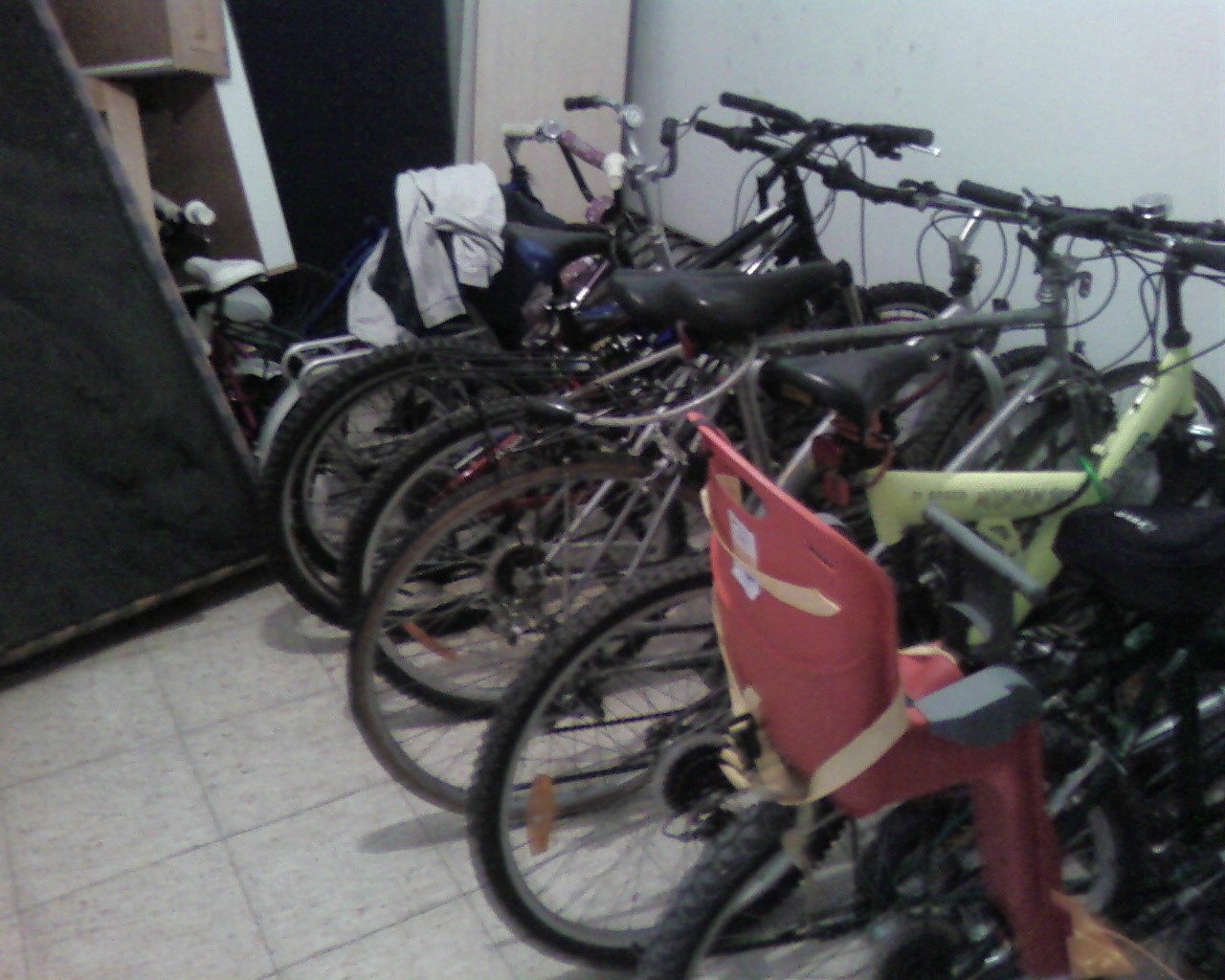
Real examples of inventions. Inventions are all around us.

Some definitions

This post is another one in the series of posts about Inventions and Theory of Inventive Problem Solving (abbreviated in Russian as TRIZ). First, I’d like to call it Inventiveness Theory for short and I’ll use it interchangeably with TRIZ. Because I find it very strange that the Russian acronym ТРИЗ was translated into English as TRIZ and used throughout. Also the Theory of Inventive Problem Solving sounds very cryptic and confusing to an English speaker to say the least.

Why do I write these posts?

The main urge to right these posts is to share the excitement I have about how Inventiveness Theory can help ordinary people to fell like they have tools to be creative in ways that they could hardly imagine, since inventions and inventors are covered with the mythology of divine inspirations and thousands of trial and error attempts before being able to come up with an invention. Inventiveness Theory shows that it’s not exactly the case and its tools and methodology can direct you to invention using algorithmic approach.

Inventiveness is in every engineering field

In the previous post I provided examples of how Inventiveness Theory uses standard solutions to problems that have similar structure. In this post I’d like to show inventiveness is used in every human endeavor. For example, it’s difficult to think of any progress in engineering, physics, mathematics, chemistry without engineers and scientist constantly resolving contradictions and this way making inventions. If you recall Inventiveness Theory defines invention as a resolution of a contradiction that the problem presents.

When Genrikh Altshuller and Rafael Shapiro first wrote about TRIZ in 1956 article1 most of the examples they provided for the applications of this approach were from mechanical engineering. Later Altshuller and his students worked on more advanced version of Inventiveness Theory which was applied to electrical engineering, chemistry and other fields. Only in recent decades TRIZ was applied to electronics, software engineering and other disciplines.

Since, I have an experience in software development and software testing I’d like to provide most of my examples from these fields. But, I’ll also provide examples from electronics, physics and mathematics. It turns out there could be no science or engineering as we know it without creativity.

Computer Science

Hardware

If we look at Computer Science history we’ll see that it evolved from invention to invention. First, there were mechanical calculators, then came electro-mechanical ones using relays, then electronic computers using lamps. Then with an advent of the semiconductors computers were made with hundreds of transistors later to be replaced with microchips having billions of transistors in one single microcircuit.

Software

Software too had an interesting evolution moving from machine language programming to invention of compilers that allowed a more abstract approach to programming to high level programming languages like Java, Python etc. that allowed programmers to reason almost in a human language while righting programs.

Each of these evolutions wouldn’t be possible without a chain of inventions that scientist and engineers made along the way. For example, let’s take Data Structures and Algorithms topics that any programmer learns to some degree. Sorting algorithms like bubble sort or merge sort are an example of inventions when a problem of sorting data is resolved by various creatives ways, like swapping as in bubble sort or divide and conquer as in merge sort approaches.

What is interesting is that in TRIZ there are a number of ways to resolve a physical contradiction2 which are

  • In space
  • In time
  • In structure
  • By condition

And in Computer Science computational complexity is also measured in space by memory storage requirements and in time it takes for an algorithm to run.

Real example

One concrete example of a contradiction in software engineering is how to be able to update software without the need to rebuild it which requires extensive resources and procedures once it is deployed in production. The contradiction here is that software should have certain parameters to function, but there is a need for these parameters to be changed when required. This particular problem was resolved in structure by extracting parameter values into a dedicated configuration file. This file is loaded by the main program on start up and can be even reloaded on the fly. This approach allows to update the parameters as required without a need to invest additional development time and rebuilding the software.

References

  1. Altshuller, Genrikh, Shapiro, Rafael. “On Psychology of Inventive Creativity”. Questions of Psychology, no. 6, 1956, p. 37-49.
  2. Petrov, Vadimir. TRIZ Basics: Theory of Inventive Problem Solving. Self publishing, Kindle edition 2019, p. 368.

The same trick used all over again. Using standard solutions.

In this post I continue to talk about how the methods from the Theory of Inventive Problem Solving (abbreviated as TRIZ in Russian) can be used by anyone to solve day to day challenges.

This time, again we’ll look at the problem I had in my house and how it was resolved using inventive approach.

Inventive situation

The door lock handle that you see at the top of this post is a typical one that is used across North America, particularly, in Canada. The side of the lock that has a handle resides inside the house. The main issue I had with it was that it was very difficult if not impossible to understand what position handle was in. Is it locked or unlocked, especially in evenings when the lighting conditions are poor. Just look at the image below and tell me whether you can see the handle at all?

As you saw the handle blends with the circular base it attached to and is hardly visible if at all.

As in the previous post where there issue was to find who had stolen a tire valve cap the contradiction is that a cap and in this case a handle has the same color as the base of the lock and is poorly discernable to understand what the sate of the lock is.

You possibly guessed that as in the previous case we possibly can play with the shape of the handle, its color or something else. Again, Ideal Final Result in this inventive situation is for the handle to notify by itself that it’s locked or unlocked. And as you, probably, guessed correctly we can use the same solution as before, namely, we can color it in a white color with wite-out.

And this is what I did at first as can be seen in the image below

This wasn’t a bad idea, but I thought I can do even better, especially at night, since the white color doesn’t glow in the dark. But a luminous tape does. So that was what I did, I used such a tape. When the lights are on it absorbs light and later it emits it and this way the tape glows. This allows you to see at a glance whether the door is locked or unlocked as can be seen below

As you’ve noticed the solution to this problem looks very much like the one before. And actually, in TRIZ there are typical problems and non-typical problems. When you see that a problem at hand is a typical problem it means that there are already existing solutions that you can use out of the box to solve it. In TRIZ one such toolbox is Standard Inventive Solutions also known as Standards. This can be seen in the diagram taken from Vladimir Petrov’s book TRIZ Basics.

Petrov, Vladimir. TRIZ Basics: Theory of Inventive Problem Solving, 2018

Ideal Final Result. Or how to solve it?

What is it all about?

As I mentioned in the previous post I’d like to share with you how anyone can be an inventor and solve everyday problems from simpler to not so using the methodology from the Theory Of Inventive Problem Solving (aka TRIZ in Russian).

Today we will look at a real problem that I faced while living in an apartment building in Israel.

Inventive problem

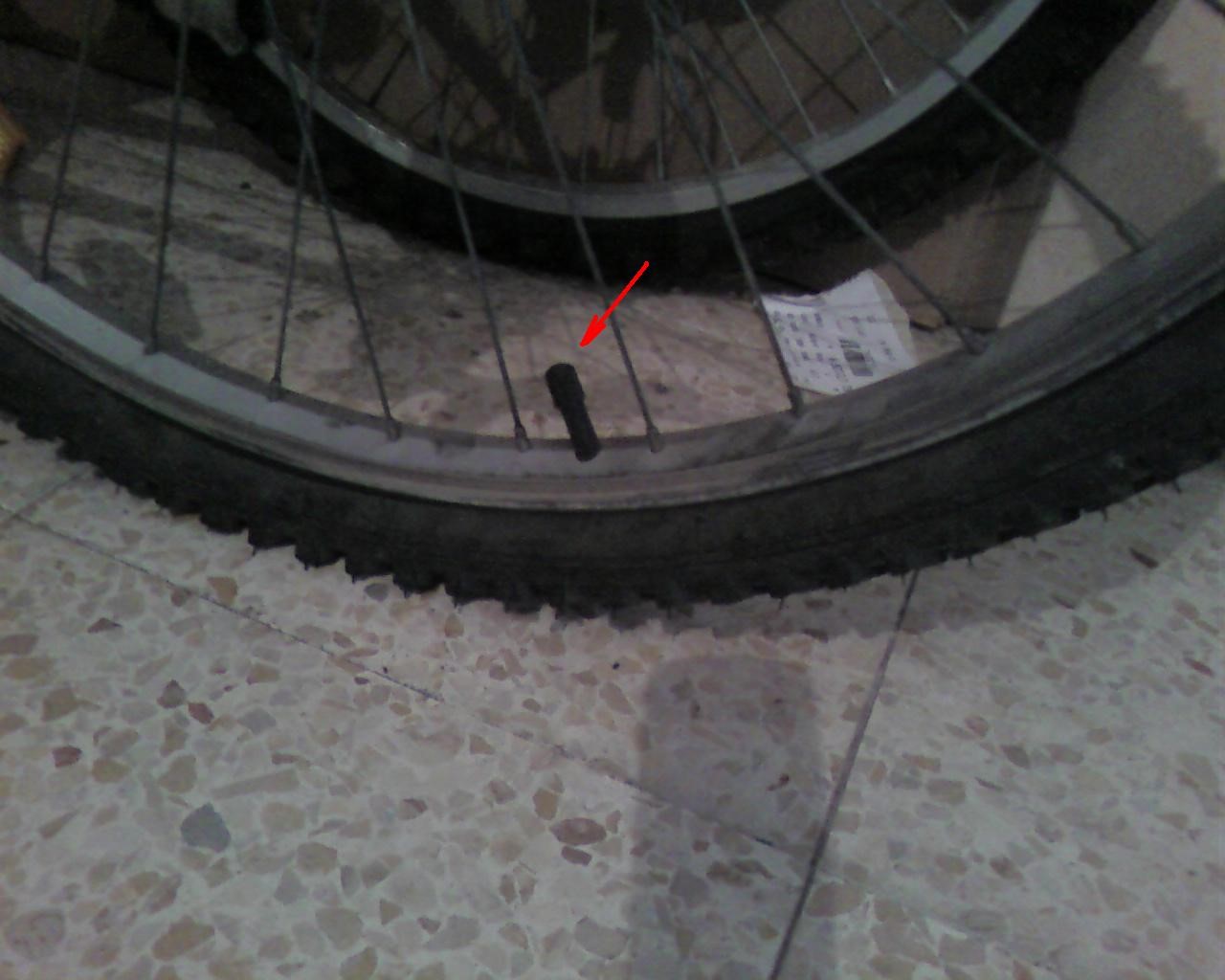
That apartment building had a public storage where tenants could store their bicycles and other stuff. So it was natural for me to store my own bike there as well. But it happened that someone stole the black valve cap on one of the tires of my bike.

This is how the valve cap I am talking about looks like
How to solve it?

Well, how would you solve this issue? I can tell you right away that at that time there were no cameras installed in the the storage room, and installing one would be prohibitive. It was possible not to do anything as well as a solution.

So let’s try to approach this problem using tools from TRIZ. As I mentioned before that’s first identify a contradiction that happens in this situation. I want to have my valve cap in place without people ‘borrowing’ it. Then more specifically, we may say that we want the cap to be distinguishable if it is stolen, and ideally not to be stolen in the first place. This is what called in TRIZ as administrative contradiction.

The issue lies in the fact that the valve cap is black on any of the bikes and it is indistinguishable when stolen. So the technical contradiction as it’s known in TRIZ, means that the cup isn’t distinguishable when it should be clearly distinguishable.

Ideal Final Result (IFR)

Now, it’s time to introduce one more term, which is an Ideal Final Result. It will help us to focus the contradiction and to resolve it. Ideal Final Result means that we are interested in such a state when the problem that exists resolves by itself, or it does not require any solution at all. When we think about the valve cap issue this way the solution becomes crystal clear.

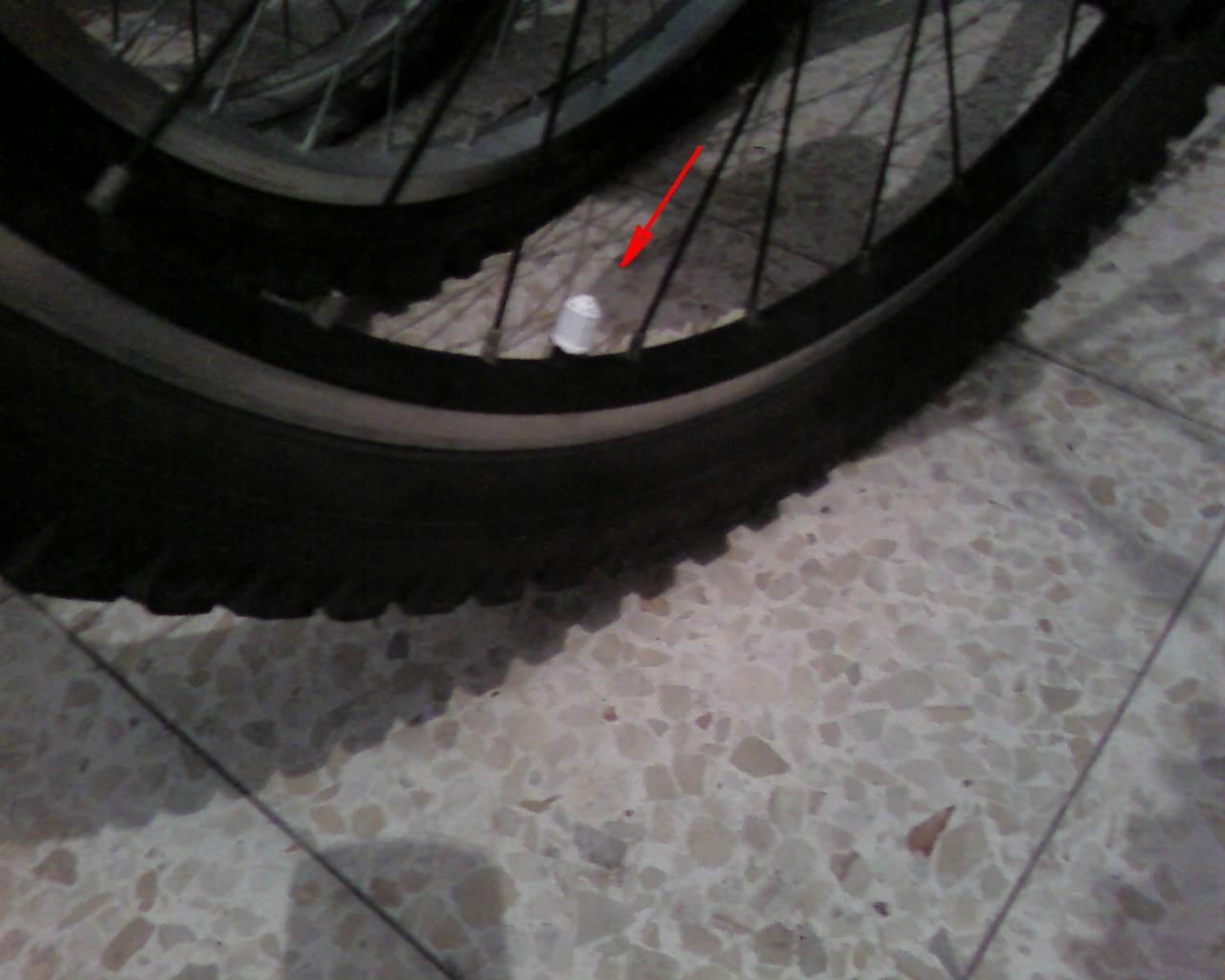
How about making the valve cap to notify us by itself that it was stolen? One way to achieve it is to have a valve cap that has a different structure, like shape or color. Well, indeed changing the color of the cap was what I did. I took a BIC wite-out and simply colored the cap in white color! Yep. That solved the issue, since even if the cap was stolen I’d see it right away on another bike.

This approach solved the issue and also made the valve easier to spot when I needed to inflate the tire.
Well, thank you for reading until the end and stay tuned for the next blog post in the series.

Take care.

Inventions are everywhere. You just need to look carefully.

From idea to invention by an algorithm

I think I’ve exhausted the nutrition and fasting topics, so I decided to move on to something else like creativity and inventions. You’ve heard it right, inventions. I’ve already posted a number of posts on this subject before. It happened that around 2004 I stumbled upon an article by Pavel Amnuel about how to come up with sci-fi ideas using an algorithm and since then I was hooked. Through Pavel Amnuel I learned about Genrikh Artshuller a soviet sci-fi writer and an inventor of the Theory of Inventive Problem Solving (aka TRIZ in Russian). Later I met with Pavel Amnuel who was a sci-fi writer and astrophysicist himself. Reading articles and books at altshuller.ru website I came alone Searing Mind short sci-fi story that Altshuler wrote. So I decided to translate it into Hebrew which I did together with Israela Beker. Through this work I came to know Vladimir Petrov who was an inventor and an engineer and also Altshuller’s close student as Pavel Amnuel was.

Everyone can be an inventor

Since then, I am back and forth with regard to TRIZ having read a number of books that Genrikh Altshuller wrote and trying to use his approach in a real life. So I thought to myself that I could write a series of posts where I’d describe how it was possible to use TRIZ methods in solving every day’s problems. How it is possible to approach various issues that each one of us face in everyday life. As one author wrote all that we see around us that was artificially made was once a one’s person idea. And it’s correct. Anything from houses, furniture, cars, computers didn’t exist and had to be invented. Actually, almost everything that we deal with on a daily basis which is a non-leaving matter was created by humans.

What I intend to write?

So there you have it a post that is dedicated to looking at a problem and how it was solved using TRIZ methodology. By the way what I refer to as a problem is actually defined as a contradiction in TRIZ. Contradiction lies at the heart of TRIZ, since its machinery is useful only when contradiction found and clearly reviewed to be later resolved. By the way, invention defined in TRIZ as a resolution of a contradiction. So if there was no contradiction there was no invention either by TRIZ definition. This makes it much more easier to decern among patents what is actual genuine invention in comparison to being a clone or a modification of an existing invention.

Next post will be such a post as described above. Till then take care.

68 hours fasting results

How did I end up doing it?

Previously I did a 42 hours fast. After that I returned to doing the usual 19 hours intermittent fasting with 5 hours eating window. But I thought to myself that I could do even better and try a longer fast to loss even more body fat as a result. So I tried and finished a longer fast which was scheduled to be 66 hours, but in the end ended up being 68 hours. The fast ended with a big surprise that I’ll discuss later.

Initial setup

Fasting length

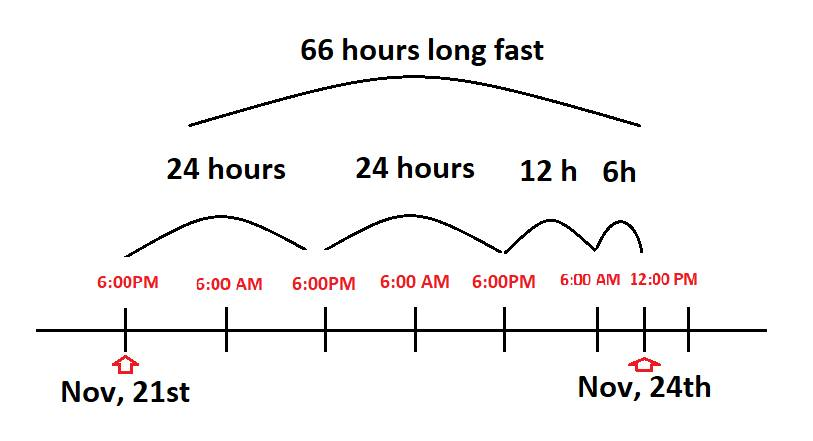
From 4:20 PM on Monday, Nov 21th to 12:20 PM on Thursday, Nov 24th.

Fasting progress

Detailed progress

Same information as a graph

Final result

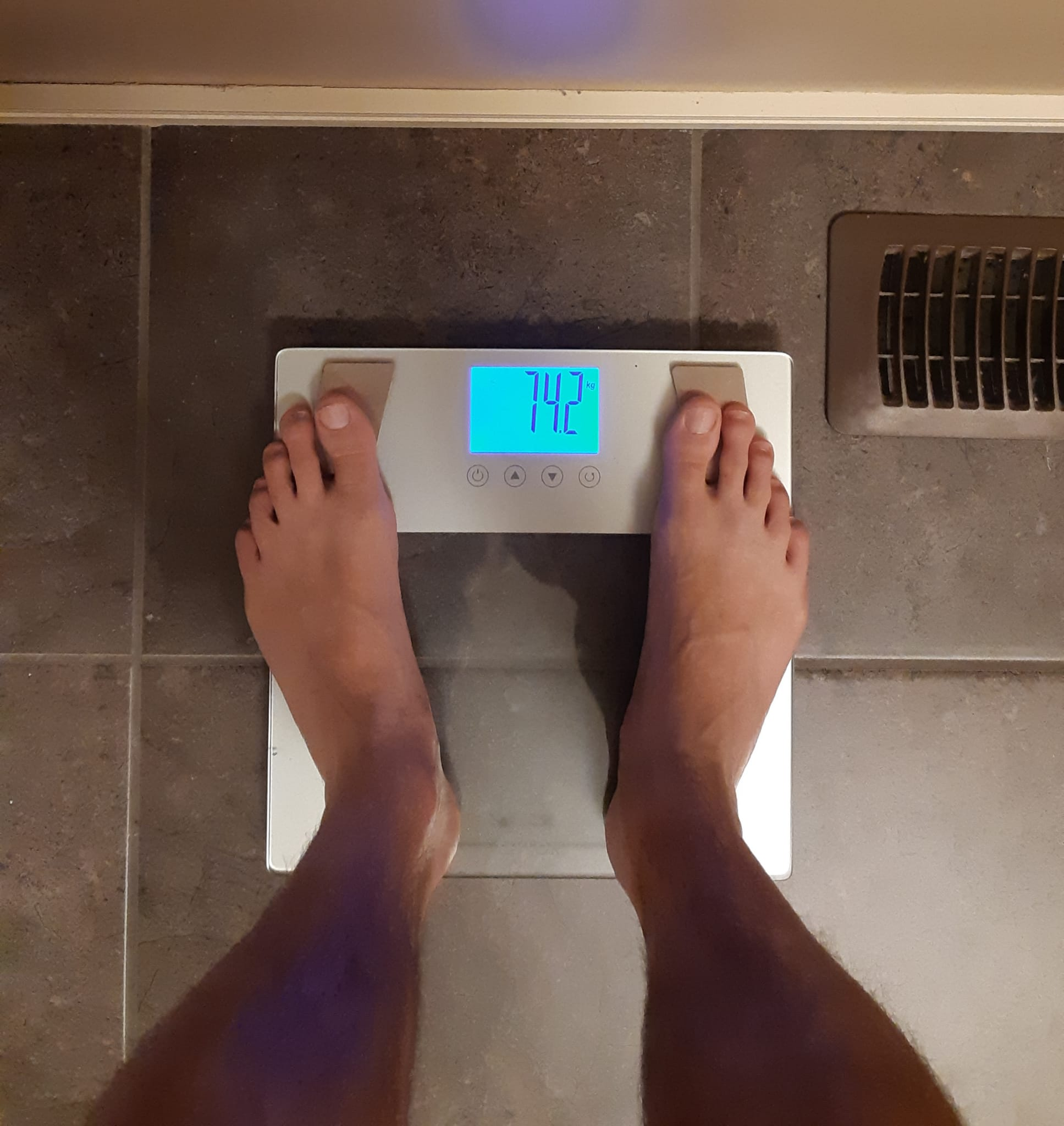
After 63 hours of fasting at 7:20 AM, Nov 24th

A big surprise

The fast has been finished successfully. This time it was more difficult than 42 hours fast. What is funny I did 26 hours more this time, but weight loss was the same as during 42 hours fast.

  • Initial weight was 78.1 kg (172.18 lb), body fat 24.8 %
  • Final weight is 74.4 kg (164.02 lb), body fat 23.4 %

42 hours fasting results

How did I end up doing it?

I am doing Intermittent Fasting for 23 weeks now. Starting from about 18th week my weight loss plateaued and I needed to do something to get it moving. So I recalled that I can try doing extended fasts which are fasts longer than 24 hours. Well, I decided to do 42 hours fast that starts on 6:00 PM and ends after 42 hours on 12:00 PM.

Initial setup

Fasting length

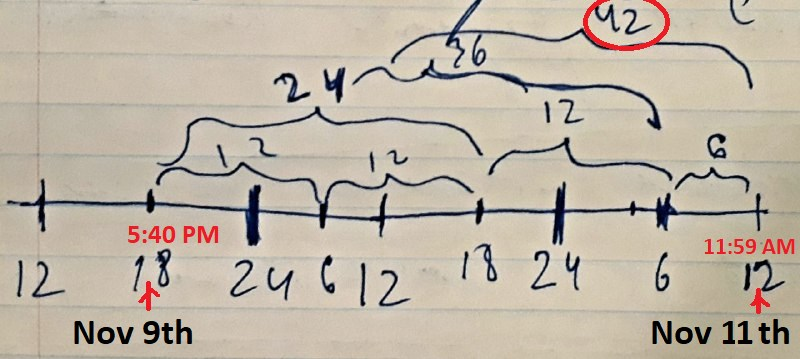
From 5:40 PM on Wednesday, Nov 9th to 11:59 AM on Friday, Nov 17th.

Fasting progress

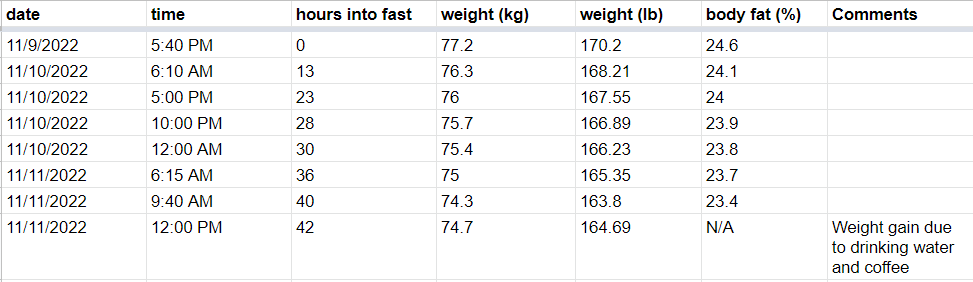
Detailed progress

Same information as a graph

Final result

After 42 hours of fasting 12:00 PM

weight after 40 hours of fasting

The fast has been finished successfully. Overall feeling is good. Nothing special to report except for crumbling belly feeling yesterday in the evening.

  • Initial weight was 77.2 kg (170.2 lb). Final weight is 74.7 kg (164.7 lb). That’s after drinking a cup of water and a cup of coffee which added about 0.4 kg (0.9 lb) of weight.

Significant weight loss at the very last hours of the fast

Again the same observation

Initial setup

Weight at 14th hour of the fast just before going for a walk/running was 75.8 kg (167.1 lb), body fat 23.9 %.

After walking

After walking/running for 66 minutes on 14th hours of the fast and doing 6.67 km (4.14 mi), weight became 75.3 kg (166 lb), body fat 23.8 %.

Overall weight loss 0.5 kg (1.1 lb), body fat 0.1 %.

Now, after 5 months of measuring weight to fat loss dependency,
Speaking of myself, I know that losing 0.1 % of body fat corresponds to 100 gram (0.22 lb) of fat loss.

Net body fat loss

So net body fat loss is 100 gram (0.22 lb) and the rest of 400 gram is water (sweat, breathing) and possibly energy that went on heating the body, since I walked at 5 degrees centigrade (41 F) with only T-shirt and light jacket on.

Why Calories In equals Calories Out is wrong again

According to tracker calculation below I burned 378 calories, which is 378 / 9 calories in 1 gr of fat = 42 gram of fat loss.

Again, it contradicts what my scale is showing, which means that Calories In = Calories Out theory is wrong. But we knew this already.

Books that literary make you who you are

Intro

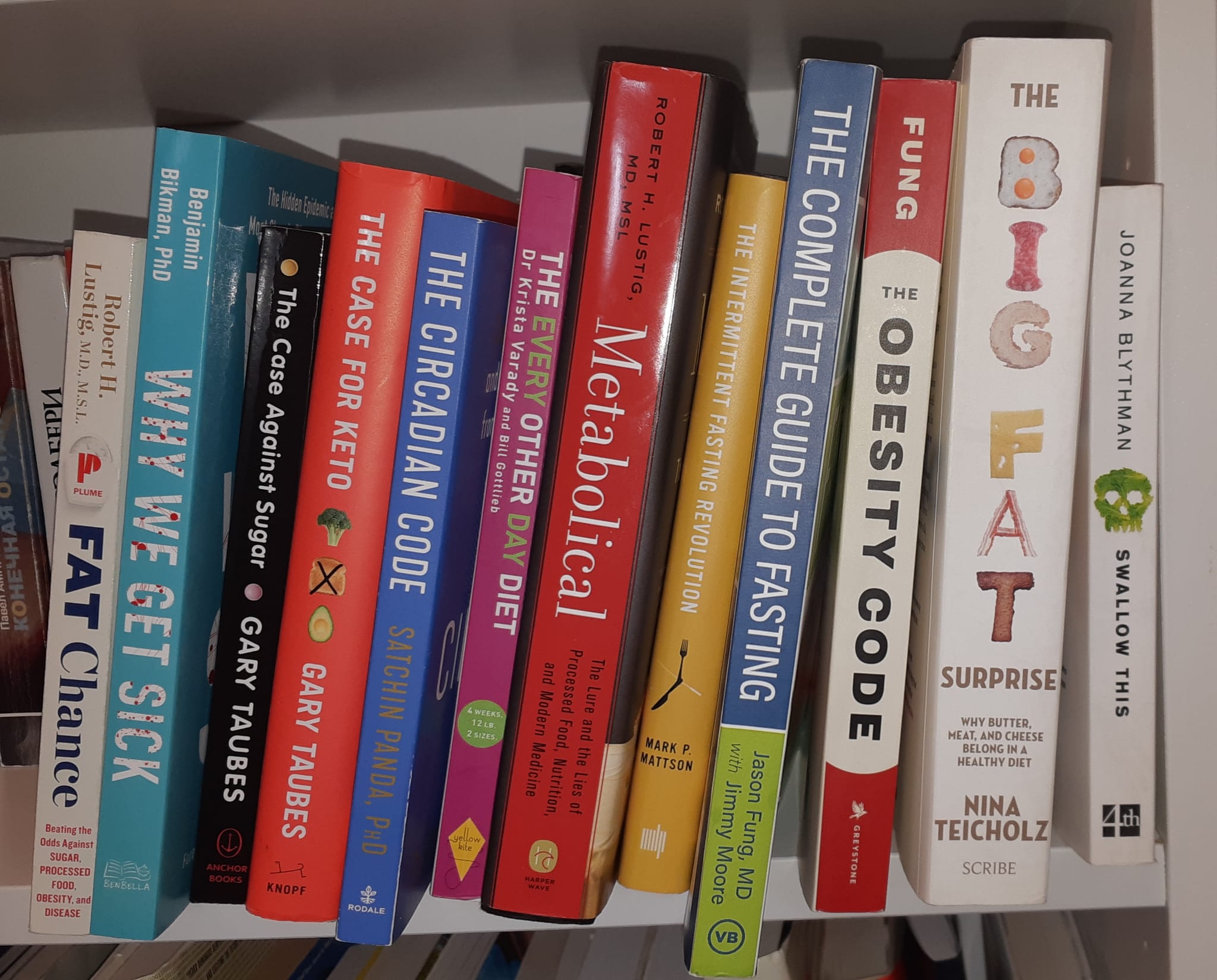
There are a number of posts that I wrote about books and how they helps us change our lives and ourselves. The books below literary helped me to change my body composition and shed dozens of pounds of fat that came from eating sugar, sweets, starchy foods and drinking soft drinks, in short, what we call nowadays Ultra Processed Food.

It seems to me they could be helpful to some of you who wants to make a change.

Books on fasting I read and recommend

I sorted the books based on how I liked them the most.

  1. FAST. FEAST. REPEAT by Gin Stephens
  2. The Obesity Code by Jason Fung
  3. The Complete Guide to Fasting by Jason Fung
  4. Why We Get Sick by Benjamin Bikman
  5. The Circadian Code by Satchin Panda
  6. Fat Chance by Robert Lustig
  7. The Case Against Sugar by Gary Taubes
  8. The Intermittent Fasting Revolution by Mark Mattson
  9. The Every Other Day Diet by Krista Varady
  10. Delay, Don’t Deny by Gin Stephens (it was her first book on the subject. In comparison to her second this one has more personal info about Gin’s experience with IF)

Books on nutrition that I read, but they were not that easy to make it through

  1. The Case For Keto by Gary Taubes
  2. The Big Fat Surprise by Nina Teicholz
  3. Metabolical by Robert Lustig
  4. Swallow This by Joanna Blythman (I’ve finished only 3/4 of this book. It turned to be quite boring)

Intermittent Fasting isn’t a diet

Photo by charlesdeluvio on Unsplash

There is a difference

There is a big difference between Intermittent Fasting (Time-restricted Eating) and a diet (Calorie Restriction).

In the Flipping the Metabolic Switch: Understanding and Applying Health Benefits of Fasting (Obesity, 2018 Feb., 26(2): 254-268) paper by Mark P. Matson et al. they are defined as follows,

  • Intermittent Fasting (IF) – This eating pattern involves fasting for varying periods of time, typically for 12 hours or longer.
  • Calorie Restriction (CR) – This eating pattern involves a continuous reduction in caloric intake without malnutrition.

Your typical diet

During regular diet when caloric intake is restricted a few things happen to your body.

  1. The body tunes down your metabolism. As a consequence you can have a feeling of cold, mood change and feeling of tiredness.
  2. Due to lower Leptin hormone, which signals to the brain that you have not enough stored energy, you start feeling continuous hunger.
  3. While at first you lose some weight (mostly muscle), in the end after struggling with the diet you gain your weight back, but more. After all 99.5 % of diets fail.

As for Intermittent Fasting

While you fast for at least 16 hours, which allows your body to deplete glycogen stored in muscles and liver, your body will switch from using glucose as a main source of energy to using ketones produced by liver from fatty acids (fat).

  1. When this transition happens your body is perfectly happy, there is no feeling of hunger.
  2. Metabolism is actually elevated and you feel good.
  3. There is almost no loss of muscle mass, but a connective tissue. Instead what is lost is the fat that was stored by your body. And if you do resistive training or walking while fasting there will be actually muscle mass gain!

Conclusion

So diet and fasting are complete opposites of one another.

One thing to mention is that it takes time (a number of weeks) for body to get used to fasting.
And even then you still could feel hunger in evenings due to naturally elevated level of the Ghrelin hormone. So it’s not simple, but doable and has such health benefits, not mentioning fat loss, which makes it beneficial in the long run.

Weight loss is very easy when you know how

Processed Food is a blocker for weight loss

When you eat sugary and starchy foods, aka Processed Food your glucose level in the blood is high, as a consequence Insulin hormone level is also high. When it’s high fat is stored.
If you eat more than 3 times a day and have snacks between the meals Insulin will stay high. So fat will continue to accumulate in the body.
Fructose in processed food is very harmful too, but it’s for another post, meanwhile check what Dr. Robert Lustig has to say about it.

Solution

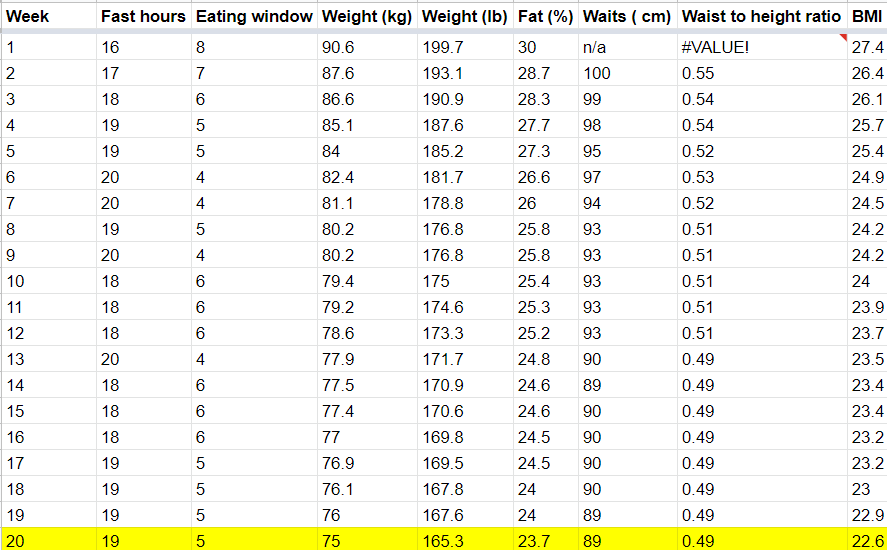
Drop Insulin level by constraining when you eat, which is called eating window. I have on average 5 hours eating window and 19 hours of fasting time.

Research shows that having 8 hours eating window could be enough for body to switch to burning stored fat.

My emphasize is on the word could. This is because it’s not enough to follow 8 hours eating window. Because if you do, but continue to eat Processed Food, fasting for 16 hours could be not enough to use all glycogen stored in muscles and liver. If this happens your body won’t switch to burning fat at all.

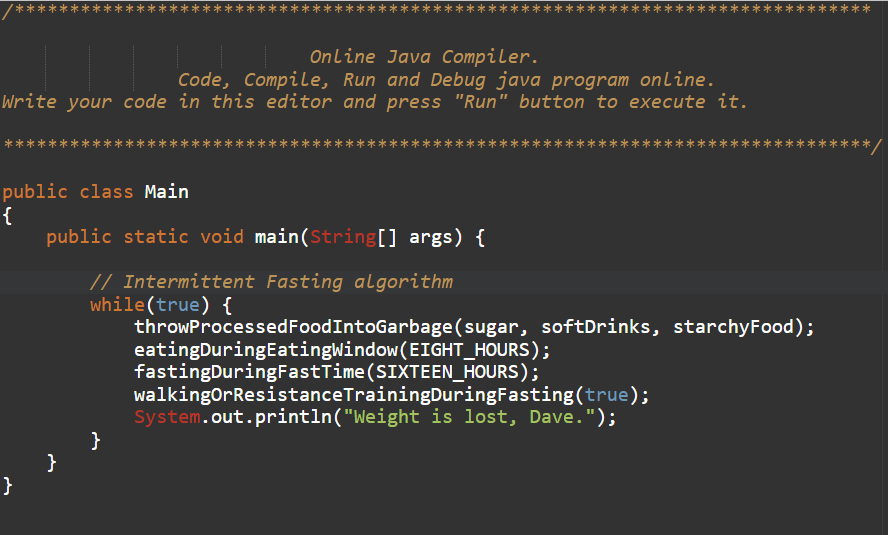
So weight loss algorithm is simple

  1. Have at most 8 hours eating window and 16 hours of fast time.
  2. Eating sugary and starchy food during eating window prevents you from losing weight during 16 hours fast.
  3. Walking or doing resistance training at the very last hours of the fast, when body switched to using stored fat as energy speeds up the fat loss even more.