Century of Aviation at Your Fingertips

Great news!

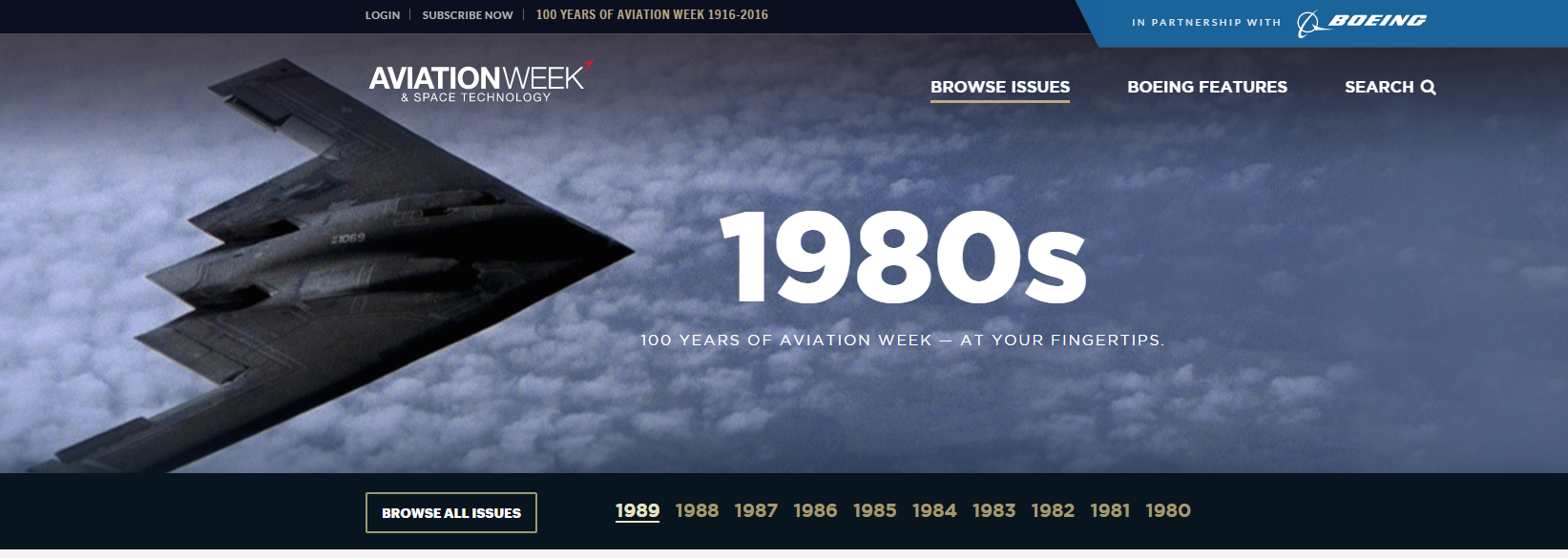
For those of you who are interested in aviation and space there are great news because Aviation Week & Space Technology magazine in partnership with Boeing released a digital archive of the Aviation Week & Space Technology magazine.

This digital archive is very nicely composed and easy to navigate. In addition now it is easier than ever before to follow the history of aviation, space exploration, computers evolution and do historical research based on this archive.

Stealth evolution

If you are interested in stealth technology evolution such as F-117A, B-2, YF-23, YF-22 and more throughout the years ‘Search’ functionality will help you find pieces of information here and there across the issues of the magazine.

Lean back

And just enjoy the capabilities.

Gravitational Waves Discovered

And so it begins …

This post is a  very special one due to the fact that on 2/11/2016 it was announced that long ago predicted from General Relativity Theory gravitational waves were detected by

Laser Interferometer Gravitational-Wave Observatory  (LIGO) in USA.

This is the most exciting discovery of the 21st century so far and its consequences are hard to predict. What is for sure that now we have a mean to probe what happens in the places such as where black holes collide.

I congratulate all of humankind with this achievement that is a great example of science teams collaboration around the world that is a way to go.

Resources you won’t want miss

  1. An interview with the Kip Thorne the genius behind the machines that made it a reality.
  2. Video from Washington’s National Science Foundation press-conference were this announcement was made.

Taken by the Swift

swift

Swift is here to stay

This post was inspired by a one day Swift crash course. I have to tell you that Swift is a very nice language with impressive syntactic structures that turn iOS/ OS X development into very joyful experience in comparison to Objective C.

What is also very encouraging about Swift that its core is opened source by Apple and the source code is available at GitHub. In addition, development in Swift is now possible not only under OS X, but also on Linux (Ubuntu). It is also possible to develop in Swift on Widows with OS X running under Virtual Machine, but about this later.

Current version of Swift is 2.2 and 3.0 is about to be ready later this year (2016).

Introduction from Swift.org site

About Swift

Swift is a general-purpose programming language built using a modern approach to safety, performance, and software design patterns.

The goal of the Swift project is to create the best available language for uses ranging from systems programming, to mobile and desktop apps, scaling up to cloud services. Most importantly, Swift is designed to make writing and maintaining correct programs easier for the developer.

Playground

1. IBM Swift Sandbox

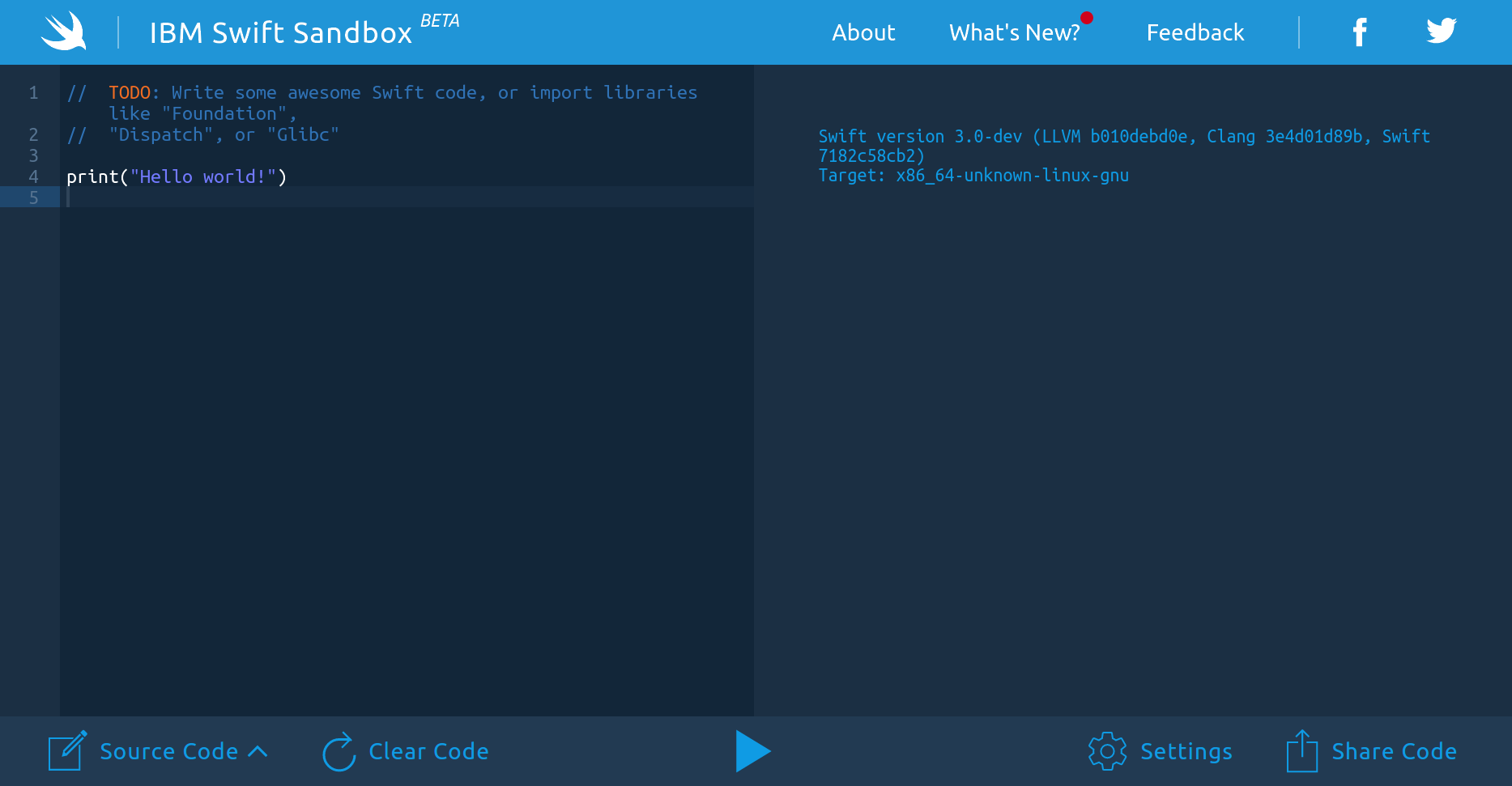
There are a number of ways to start playing with Swift. The most generic one is to use IBM Swift Sandbox web site for this matter. It makes it possible to try Swift out without buying Mac or installing VM with OS X/Ubuntu or installing Ubuntu itself.

OK. When you are at the site what you see is REPL running on Linux. And it looks just like this. And it’s kind of interpreter for Swift.

ibm_santbox


2. Swift on Linux (Ubuntu)

Currently Swift is supported on Ubuntu 14.04 and 15.10. In order to play with Swift on Ubuntu please follow very detailed how to guide from official Swift site here.

3. Swift on Windows in OS X Virtual machine 

As of today Swift is not supported on Windows so Windows users must use virtual machine running Ubuntu in order to be able to develop application in Swift. On the other hand one may develop natively in Swift with VM that runs OS X on it. To be able to do this please use this YouTube detailed tutorial.

Main steps are

  1. Install free VMware Workstation Player
  2. Download OS X image from the link in the tutorial description in YouTube
  3. Install VMware customization batch file.
  4. Configure VM and run OS X under it
  5. Create Apple account in order to be able to download XCode via App Store.

4. Swift on OS X with XCode (pretty expensive for those of us who have no Mac)

If you already posses a Mac then it is easy to install Swift in accordance with the steps below from official Swift site.

That’s it and stay tuned. 

Java Code Geeks

Mono on Linux and feeling good

Mono, mono

If you haven’t heard about Mono on Linux then it is time to fill this gap.
Mono is an open source platform that implements CLI specification and enables building and runnig C# applications on Linux, OS X, Windows which is fun.
This is the official description from the site

Mono, the open source development platform based on the .NET framework, allows developers to build cross-platform applications with improved developer productivity. Mono’s .NET implementation is based on the ECMA standards for C# and the Common Language Infrastructure.

Starting fast

In order to start playing with Mono fast there is a need to install three things.

Linux

  • You need to have Linux (Ubuntu) installed on you PC (vm). It is possible to work with Mono on Windows too.

Mono

  • You need to install mono on you system with these commands in the terminal
sudo apt-key adv --keyserver keyserver.ubuntu.com --recv-keys 3FA7E0328081BFF6A14DA29AA6A19B38D3D831EF

echo "deb http://download.mono-project.com/repo/debian wheezy main" | sudo tee /etc/apt/sources.list.d/mono-xamarin.list

sudo apt-get update

sudo apt-get install Mono-Complete

MonoDevelop

  • Now to be able to code and build C# projects there is a need to install cross-platform IDE for C#, F# and more, such as MonoDevelop.
sudo apt-get install monodevelop
  • After monodevelop package installation simply type in terminal ‘monodevelop‘ for IDE to startup.
  • To learn to use this IDE you may refer to this Xamarin Studio documentation.

 Mono, mono?

To create a simple project when IDE is up

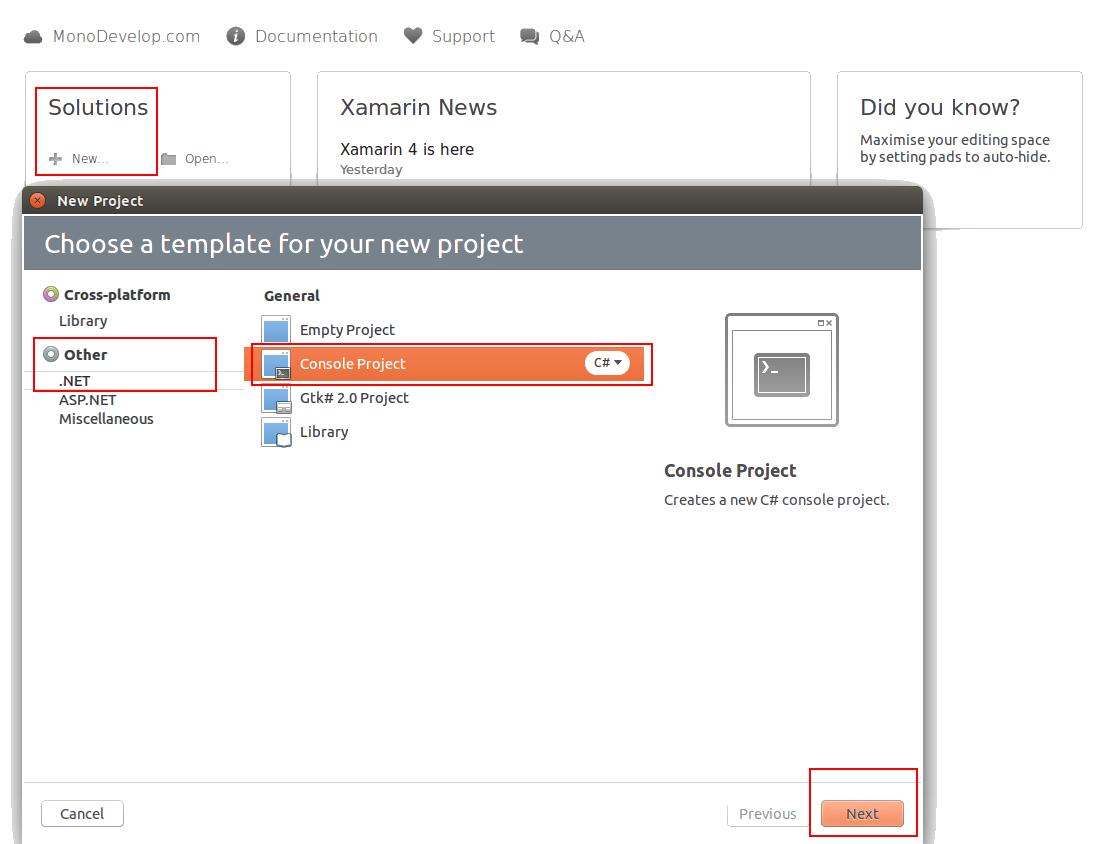
  • Click on create New project under Solutions section
  • When new from will open select .NET under Other section
  • Then select Console Project and click Next

step-1


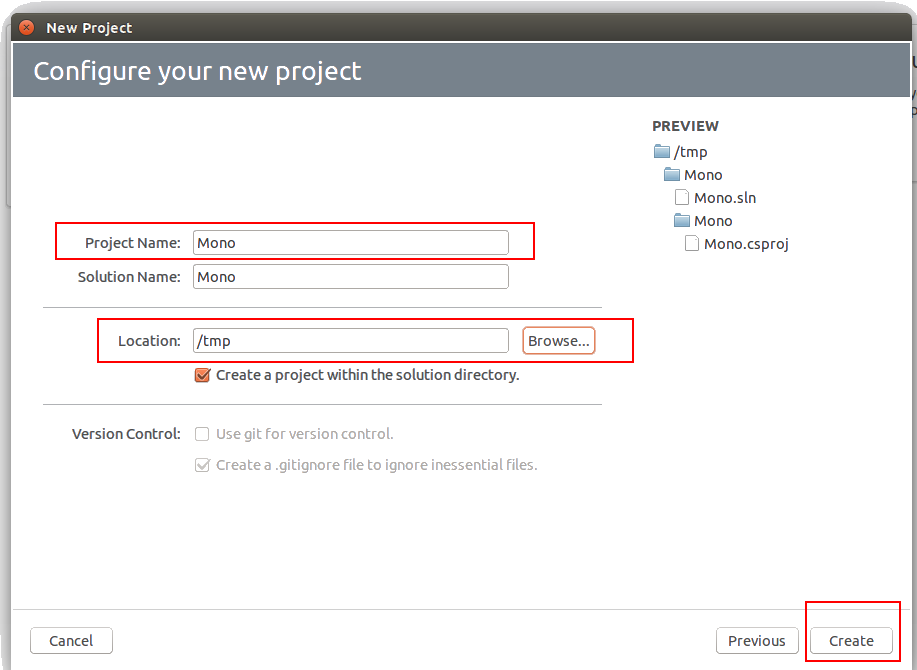
  • In the Configure your new project form name your project
  • Set project location
  • Click Create

step-2


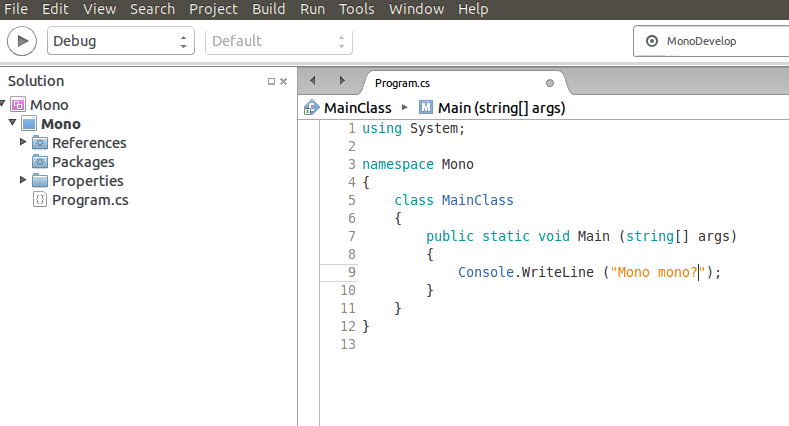
  • That’s it you are all set up

step-3


Wrapping-up

  • Mono is good for you if you feel lonely without C# on Linux
  • Mono is open source and as such contribution is more than valued
  • Mono is great but it seems Stereo must have been even better

Java Code Geeks

Meet ANTLR v4

antlr4

Change brings opportunities

Current post is affected by the fact that I started to work at Checkmarx company that specializes on static code analysis.

As it often happens starting new things brings unexpected opportunities and discoveries. One such discovery for me was ANTLR (ANother Tool for Language Recognition) that was written by professor Terence Parr.

The main purpose of the tool is to generate parsers based on provided grammar or as Terence Parr puts it at the ANTLR site

What is ANTLR?

ANTLR (ANother Tool for Language Recognition) is a powerful parser generator for reading, processing, executing, or translating structured text or binary files. It’s widely used to build languages, tools, and frameworks. From a grammar, ANTLR generates a parser that can build and walk parse trees.

It is fun

From yesterday (12/8/2015) I’ve started to learn working with ANTLR v4 with the help of very detailed and down to earth The Definitive ANTLR 4 Reference book by Terence Parr.

If you’ll consider to read the book then you’d be better off by practicing with OS X or Linux since book’s examples are oriented to those operating systems. As David Ray puts it ‘who does still use Windows machines anyway?’

ANTLR v4 is fun to learn and practice especially if you previously had some experience with Java since the tool is written in Java itself.

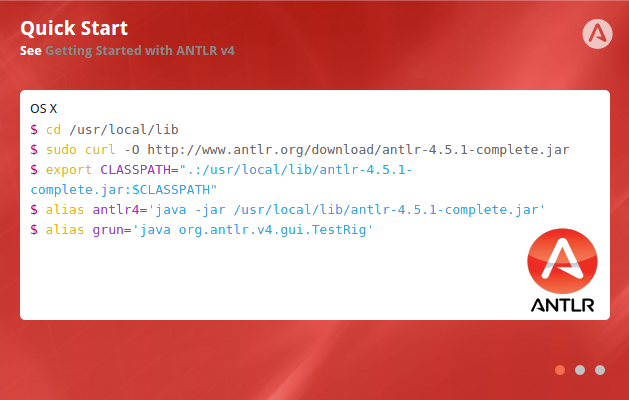
Quick Start

OS X/ Linux (Ubuntu)

$ cd /usr/local/lib
$ sudo curl -O http://www.antlr.org/download/antlr-4.5.1-complete.jar
$ export CLASSPATH=".:/usr/local/lib/antlr-4.5.1-complete.jar:$CLASSPATH"
$ alias antlr4='java -jar /usr/local/lib/antlr-4.5.1-complete.jar'
$ alias grun='java org.antlr.v4.gui.TestRig'

Useful links

There are a couple of links that make you life more interesting and happier since Terence Parr, in my opinion, is not only a very insightful programmer but he’s also very entertaining lecturer.

Well, that’s it. Here come two talks that Terence gave in recent years that are related to parsers and ANTLR.

  1. Video – Why Program by Hand in Five Days what You Can Spend Five Years of Your Life Automating?  – 2011
  2. Video – The Quest for the One True Parser – 2015
  3. Video – ANTLR v4 with Terence Parr – 2013
  4. Book – The Definitive ANTLR 4 Reference – 2013
  5. Book – Language Implementation Patterns – 2009
  6. Thinks of contribution – ANTLR open source at GitHub.

Takeaways

  • Change keeps a surprise for your
  • ANTLR v4 is powerful and fun like never before
  • This post is a first part of a number of posts that I plan on the subject


Java Code Geeks

VS 2015 Installation Instructions

101_BoxShot_2015_07_17T14_17_21

Why not to try Visual Studio Community 2015?

Try to follow these steps for low probability of success installation

  1. Download VS iso file from MS DreamSpark site
  2. Mount the image using instructions from How-To Geek, for instance those ones.
  3. Confirm Default installation.
  4. When you’ll find out that installation will be stuck use Your Uninstaller to get rid of VS 2015.
  5. When you’ll find out that removal process will be stuck (how funny) kill vs_community.exe *32 process in Windows Task Manager.
  6. Finally, remove VS 2015.

Now you have two options left

  1. Reinstall VS Community 2015 with Repair option and pray it will work this time.
  2. Switch to Java on IntelliJEclipse on Ubuntu (or Windows).


Java Code Geeks

seL4 – Formally Verified General-Purpose OS Microkernel

seL4seL4 the first formally verified microkernel OS

Recently I’ve come across an interesting article in Aviation week journal that was related to computing actually.

This article described seL4 microkernel operating system that had unique security features built-in that make this OS hard for hackers to crack. What is interesting is that seL4 microkernel was formally verified using automatic prover.

After digging a bit more I’ve found a whole new world of formal verification in general and of seL4 verification specifically.

If you are interested in formal verification of code and in microkernel operating systems then you’ll find below links useful.

In addition, the detailed article about formal verification of seL4 may be of interest as to SW so to QA engineers.

By the way seL4 OS is used in mobile phones running Android and in other security demanding platforms, such as a quadcopter unmanned aircraft and Boeing’s Unmanned Little Bird (ULB) helicopter that were mentioned in Aviation week article.

Links

Key takeaways

  • Formal verification methods were made practical and affordable.
  • If you need secure general purpose operating system consider seL4.

Java Code Geeks

Stealth Exposed

Intro_Picture

Abstract

This post’s goal is to gather scattered pieces of information about stealth technology and share it in a logical and clear order. Links to posts, articles, popular books, scientific papers and technical books on the subject will be provided. In addition, valuable links to video materials where it is appropriate will be provided too along with my description of them.

Introduction

Stealth technology or as it also known in a more technical term Low Observable is a fascinating technology that has been put for military use. For a curious person there always exists a temptation to figure out how it functions, why it functions this way and what future brings with it for this technology.

So far stealth has been used in air, sea and beneath the sea. There are a number of attempts to use stealth on the ground to mask vehicles. But it is reasonable to extrapolate the usage of stealth in space too.

Stealth technology evolved throughout the years and came to operational usage for the first time at first Gulf War in 1991.

Early attempts to deceive the adversary by means of stealth dating back to 1943 when Yehudi Lights project was initiated.

yehudi_lights

It is worth mentioning that stealth technology was incorporated by nature even earlier than by men. For instance, land creatures, such as chameleon or ocean creatures, such as Peacock Flounder below use color camouflage and restrained body movement to deceive predators and become kind of invisible.

1024px-Peacock_Flounder_Bothus_mancus_in_Kona

A Few Words on Stealth

The purpose of Low Observable technology is to hide vehicle’s visual, acoustic, infrared, electromagnetic and radar signatures be it a submarine, an aircraft or a spacecraft.  To achieve this goal those vehicles incorporate in their design special shape, RADAR or SONAR absorbent materials and other design considerations that are based on physics, math and other exact sciences.

Logical and systematic approach

Due to a large amount of various materials on the subject it is nice to have it sorted in a way that a novice may learn about stealth technology in a interesting and encouraging way starting from simple to complex. To this end I’ll start from general articles and posts on Low Observable subject moving to more detailed materials.

Posts

bill_sweetman

One can look at posts written by renowned journalist and defense editor of Aviation Week & Space Technology journal Bill Sweetman that writes on stealth.

Tyler Rogoway’s blog on aviation has pretty informative posts on various aviation topics and among them stealth.

General Articles

understanding_stealth_article

Understanding Stealth  by John Shaeffer.

This is an article written to help non-technical personnel gain insightful knowledge on how stealth works.

B-2_book

B-2 Spirit of Innovation, 2013, by Rebecca Grant.

Book’s overview

A new book from Northrop Grumman about the people and innovation that created the U.S. Air Force’s B-2 stealth bomber, one of the nation’s most powerful, most survivable – and most valued aircraft

Analogues of Stealth, 2002, by Robert P. Haffa, Jr. and James H. Patton, Jr., the Northrop Grumman Analysis Center.

A quote from the article

The U.S. Department of Defense plans to invest hundreds of billions of dollars in stealthy aircraft over the next several decades. Will low-observable (LO) capabilities incorporated in military aircraft such as the B-2 bomber, the F-22 air superiority fighter and the F-35 joint strike fighter prove as successful and enduring as submarine stealth?

stealth.png

SURVIVABILITY IN THE DIGITAL AGE: The Imperative for Stealth, 2017 by  Maj Gen Mark Barrett, USAF (Ret.) with Col Mace Carpenter, USAF (Ret.). This article is a must read for every person interested in application of low observable to air crafts.

Stealth, or aircraft signature reduction, is a potent and viable military capability in modern combat, and
will remain so well into the future. It is not, however, an all or nothing capability, as some critiques have
suggested. Investments in stealth technology significantly improve the ability of US aircraft to penetrate
enemy air defenses and create significant costs for adversaries who attempt to defend against this technology

Aviation History Books on the Subject

F-117_book

Lockheed F-117 Nighthawk Stealth Fighter (Air Vanguard), 2014, by Paul F Crickmore (Author), Adam Tooby (Author, Illustrator), Henry Morshead (Author, Illustrator). 

This book is pretty concise and specifically focuses on F-117A description, but still it is worth reading if you’re ready to pay about $15.00 for it.

area_51_book

Area 51 – Black Jets: A History of the Aircraft Developed at Groom Lake, America’s Secret Aviation Base, 2014 by Bill Yenne

This is an interesting and refreshing book on the subject of black projects at Area 51 that includes among them information on SR-71, Tacit Blue, F-117A and B-2 aircrafts. Author’s writing style is encouraging and easy to follow. It is well worth its $15.00 price.

Books by Key Skunk Works’ Engineers

kelly_johnson_book

Kelly: More Than My Share of It All, 1989, by Clarence L. “Kelly” Johnson (Author), Maggie Smith (Contributor).

This book is highly recommended for reading due to Kelly John’s insights and life journey.

ben_rich_book

Skunk Works: A Personal Memoir of My Years at Lockheed, 1996, by Ben R. Rich (Author), Leo Janos (Author)

Just read and you’ll found out why this book is a pearl.

radar_man_book

Radar Man: A Personal History of Stealth, 2010, by Edward Lovick Jr (Author). 

This books is written by RADAR engineer Ed Lovick Jr. that contributed to U-2, SR-71, D-21, F-117A stealth properties. It is very entertaining and likely will be very much loved by radio electronics engineers since a background in this profession required to fully appreciate the book content.

Scientific papers

JournalOfComputations

Low Observable Principles, Stealth Aircraft and Anti-Stealth Technologies, by Konstantinos Zikidis (Maj, HAF), Alexios Skondras (2nd Lt, HAF), Charisios Tokas (2nd Lt, HAF)

This is a good paper on current state of the art of stealth technology. This article was published in Journal of Computations & Modelling, 2014, Volume 4, Issue 1. Reading and understanding it requires basic knowledge of radio electronics.

ufimzev_book

Method of Edge Waves in the Physical Theory of Diffraction, 1962

Petr Ufimtsev’s groundbreaking work that paved the way for stealth feasibility.

Technical Books

have_blue_book

Have Blue and the F-117A: Evolution of the “Stealth Fighter” (AIAA Education), 1997 by David C. Aronstein, Albert C. Piccirillo

This is a book on stealth technology as it was developed for F-117A aircraft. It goes into detailed description of Low Observable principles.

A quote from official book’s introduction

This text documents the history, observations and lessons learned from the development and acquisition of the first very-low-observable combat aircraft. The book is a case study of the high-payoff, low-profile strike fighter development effort (code-named “Have Blue” and “Senior Trend”). Most of the material presented in the book was once highly classified information. The Have Blue stealth technology demonstrator aircraft had its genesis in 1974 with studies of Soviet radar-guided air defence systems. In 1978, the Air Force initiated full-scale development of the F-117A under the Senior Trend programme, which aimed to create a weapon system capable of highly-survivable precision attacks against an enemy’s high-value targets. In 1991, the aircraft played a key role in the air campaign against Iraq during Operation Desert Storm. The book describes the clear vision, strong leadership and teamwork, rapid-responsive decision making and keen focus on achieving an operational capability which marked the project. Also discussed are potential applications of the strategies used in the project to today’s acquisition environment.

Next book is an expanded version of previous one that includes information on F-22 stealth development.

f-22_book

Advanced Tactical Fighter To F-22 Raptor: Origins Of The 21st Century Air Dominance Fighter (AIAA Education)1998 by D. Aronstein, M. Hirschberg, A. Piccirillo.

A quote from official book’s introduction.

The authors have been intimately involved in the acquisition and development of the advanced tactical fighter (ATF) programme from its inception through today. This book traces the history of the ATF programme and the evolution of the ATF requirements from the beginning of the programme through the start of the engineering and manufacturing development.

Pay attention that two of these books are very expensive for purchase each costing about $50.

RADAR_rcs_book

Radar Cross Section (Scitech Radar and Defense), Second Edition, 2004, by Eugene F. Knott (Author), Michael T. Tuley (Author), John F. Shaeffer (Author).

This is a good book on Radar and Stealth interaction. It requires knowledge and experience in physics and radio electronics and will be fully appreciated by RF engineers.

Overview

This completely updated second edition helps the non-specialist understand how radar echo requirements may influence design objectives. With a full review of the fundamentals, background, and history of radars and electromagnetic theory, this book contains something for everybody — from novice to expert.Contents: Radar Fundamentals. Physics and Overview of Electromagnetic Scattering. Exact Prediction Techniques. Phenomenology. High-Frequency RCS Prediction Techniques. Phenomenological Examples of Radar Cross Section. Radar Cross Section Reduction. Radar Absorbing Materials. Radar Absorber Measurement Techniques. Antenna RCS and RCSR. RCS Measurement Requirements. Outdoor RCS Test Ranges. Indoor RCS Ranges. Hip-Pocket RCS Estimation, Data Presentation, and Reduction.

Video Materials on The Subject

People at Work

Lockheed Martin

Northrop Grumman

“Fathers of Stealth” 

  • John Cashen,
  • Irv Waaland,
  • Jim Kinnu,
  • John Griffin

Boeing

  • Alan Wiechman

Former USSR