Understand the system. How does fasting work?

Why is it 16 hours long fast mostly useless?

If you fast without knowing how it works then you probably are doing the infamous 16 hours long fast (aka 16:8).

Moreover, if you fast 16:8, but haven’t changed what you eat then it’s almost certainly that you won’t lose much weight.

The are a couple of issues with this mechanistic approach to fasting.

Without knowing how it works you do not have a true motivation to succeed, and you don’t know what to tweak to influence your progress.

But the main issue has to do with the food you eat.

First, let’s look at some physiological facts.

1. When you eat sugar, starchy food, drink sugary drinks, generally eating processed food the carbohydrates in it are stored in the body as glycogen.

On average body stores about 600 grams of it, mostly in muscles (~80 %) and the rest in the liver.

2. On average adult requires about 2500 calories (kcal) a day.

Now, let’s do some calculation:

1. How much calories our body needs an hour: 2500 cal / 24 hours ~ 105 cal an hour.

2. Since glycogen is a carb and 1 gram of carb contains 4 calories of energy, then how much energy is stored in the glycogen in the body?

600 grams * 4 cal = 2400 cal!

3. To burn this energy you need 2400 cal / 100 cal an hour = 24 hours

Do you see what’s going on here? It means that to be able to burn all the stored glycogen in the body you need about 24 hours!

It means that doing 16 hours long fast won’t cause your body to switch to burning fat at all within that time frame.

Now, let’s understand why it’s important to change what you eat

As, soon as you stop eating sugar, drink sugary drinks and stop eating bakery, pasta etc. Insulin hormone level will go down in your body which will signal to your body to switch to use fat as an energy source.

But before this can happen you body will first use glycogen stored in muscle and the liver.

As we said, at most it can store 600 grams, but if you changed what you eat this amount would be much smaller, let’s say 300 grams.

It means 300 gram * 4 calories = 1200 calories. And if you burn 100 calories an hour, it means that you need only about 12 hours of fasting for your body to switch to fat burning mode.

Now there you have it

Doing blindly 16 hours long fast possibly won’t help you lose much fat if you continue to eat sugar and starch containing food.

When you understand how fasting works you know what you are doing and can influence the process and the progress you make.

And lastly, on average 18 hours long fast is the least amount that can cause your body to switch to fat burning mode. It’s better to go for 19, 20 hours a day.

And do extended fasts from time to time.

Books that could change your health for better

These are good books to begin with when you start your Intermittent Fasting journey

  1. Fast. Feast. Repeat by Gin Stephens is the book for beginners on an Intermittent Fasting journey. It’s the book that started it all for me.
  2. Why We Get Sick by Benjamin Bikman is a must read if you want to really understand metabolic syndrome origins and what to do about it.
  3. The Complete Guide To Fasting by Jason Fung is the book that tells you everything there is to know about fasting. I review it from time to time it to this day.

Now that you’ve read first three books, below come additional three you couldn’t miss

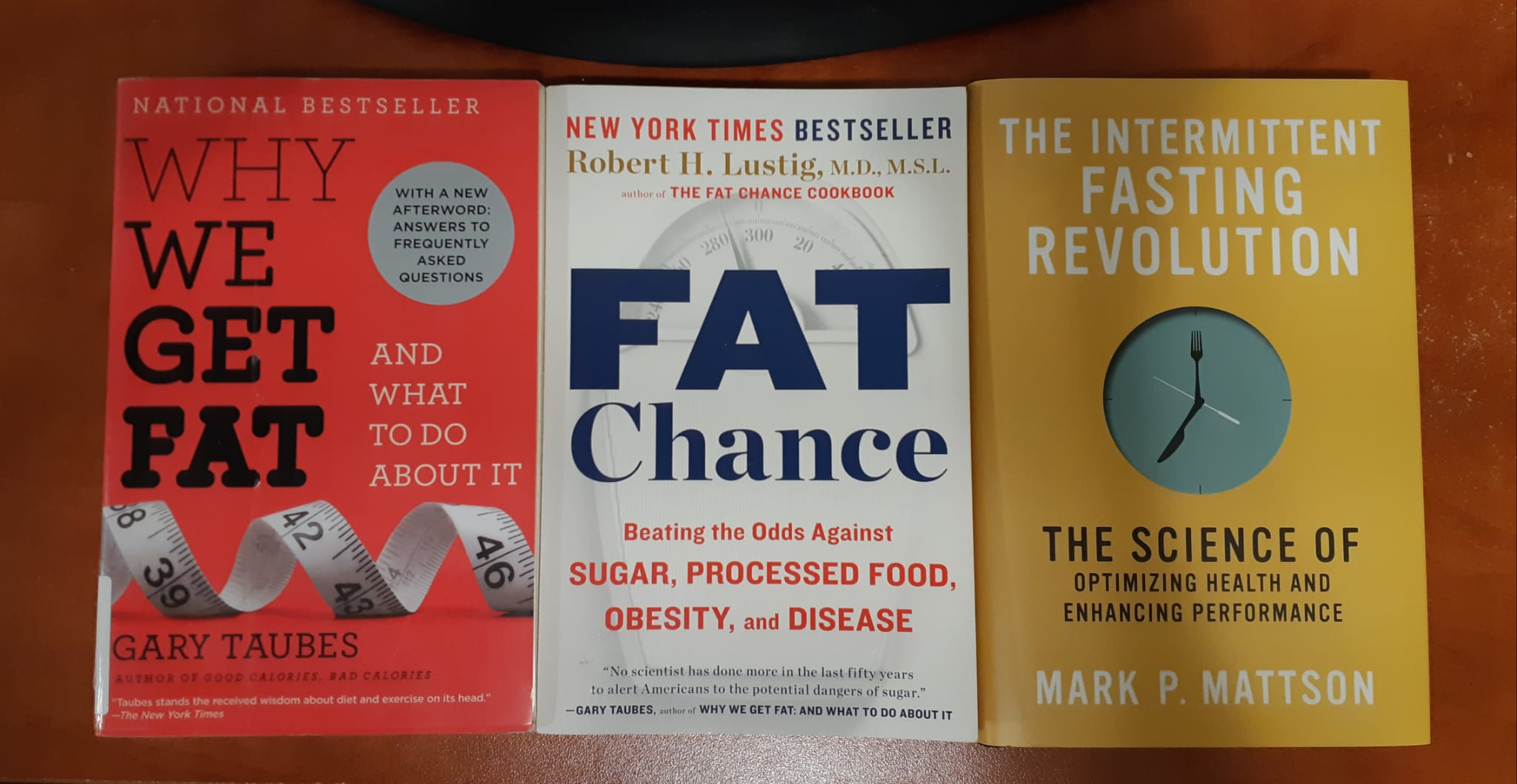
  1. Why We Get Fat by Gary Taubes tells you why the obesity and diabetes 2 are caused by sugar and starchy food.
  2. Fat Chance by Robert Lustig will teach you why we get fat from biological point of view. And fructose is poison.
  3. The Intermittent Fasting Revolution by Mark Mattson talks about evolutionary origins of fasting and delves into physiology of fasting. Mark fasts for mor than 30 years himself doing 18:6.

It’s time to delve a little bit into history of why sugar (fructose) is bad for you

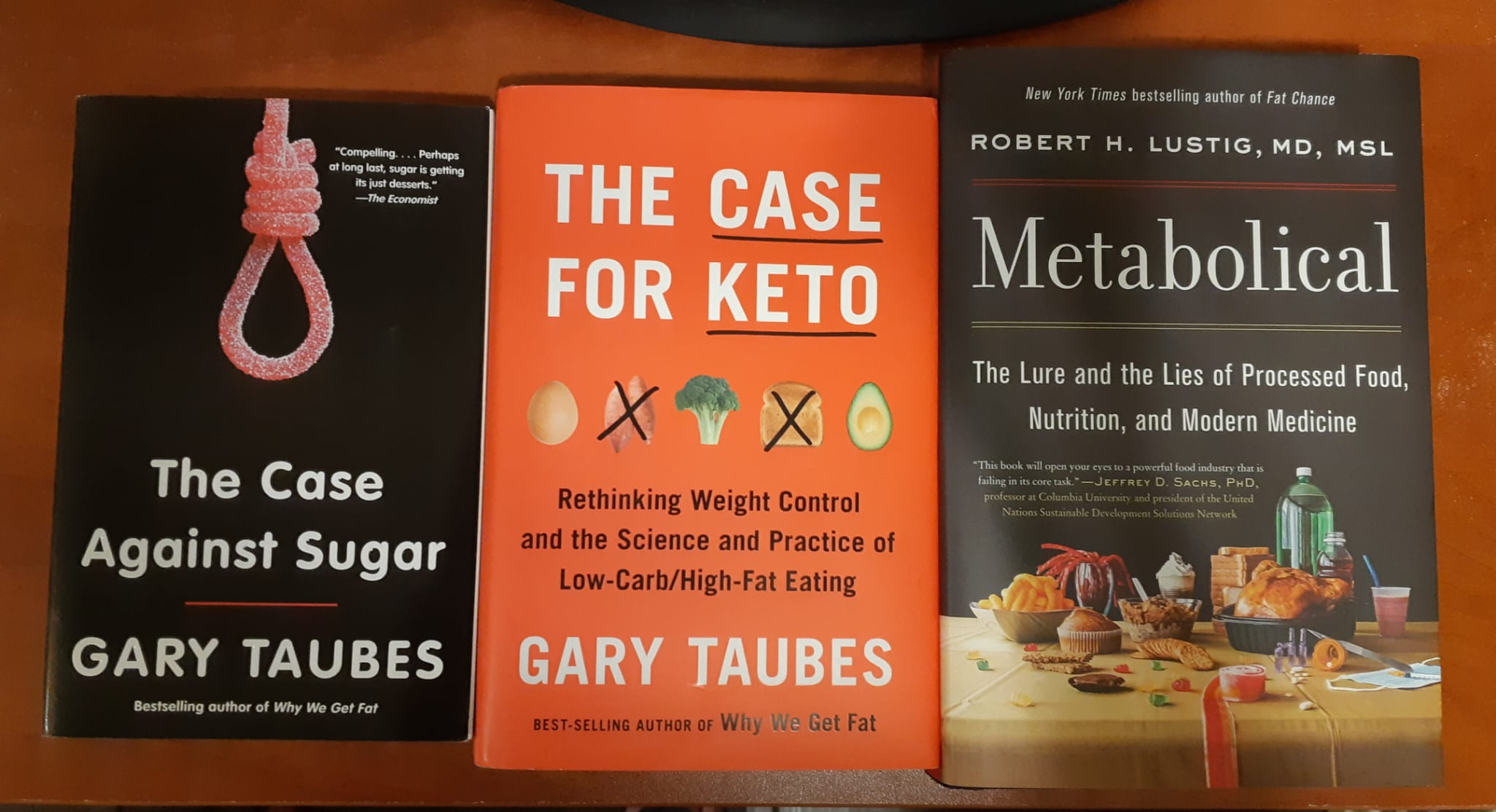
  1. The Case Against Sugar by Gary Taubes talks about history of sugar usage and why it’s the main cause of diabetes 2 and other diseases.
  2. The Case For Keto by Gary Taubes is an opposite of the book above.
  3. Metabolical by Robert Lustig looks at the obesity and metabolic syndrome in a systematic way and again highlights that sugar and particularly fructose is poison.

The books below will be helpful in applying practical advice to lose weight by fasting

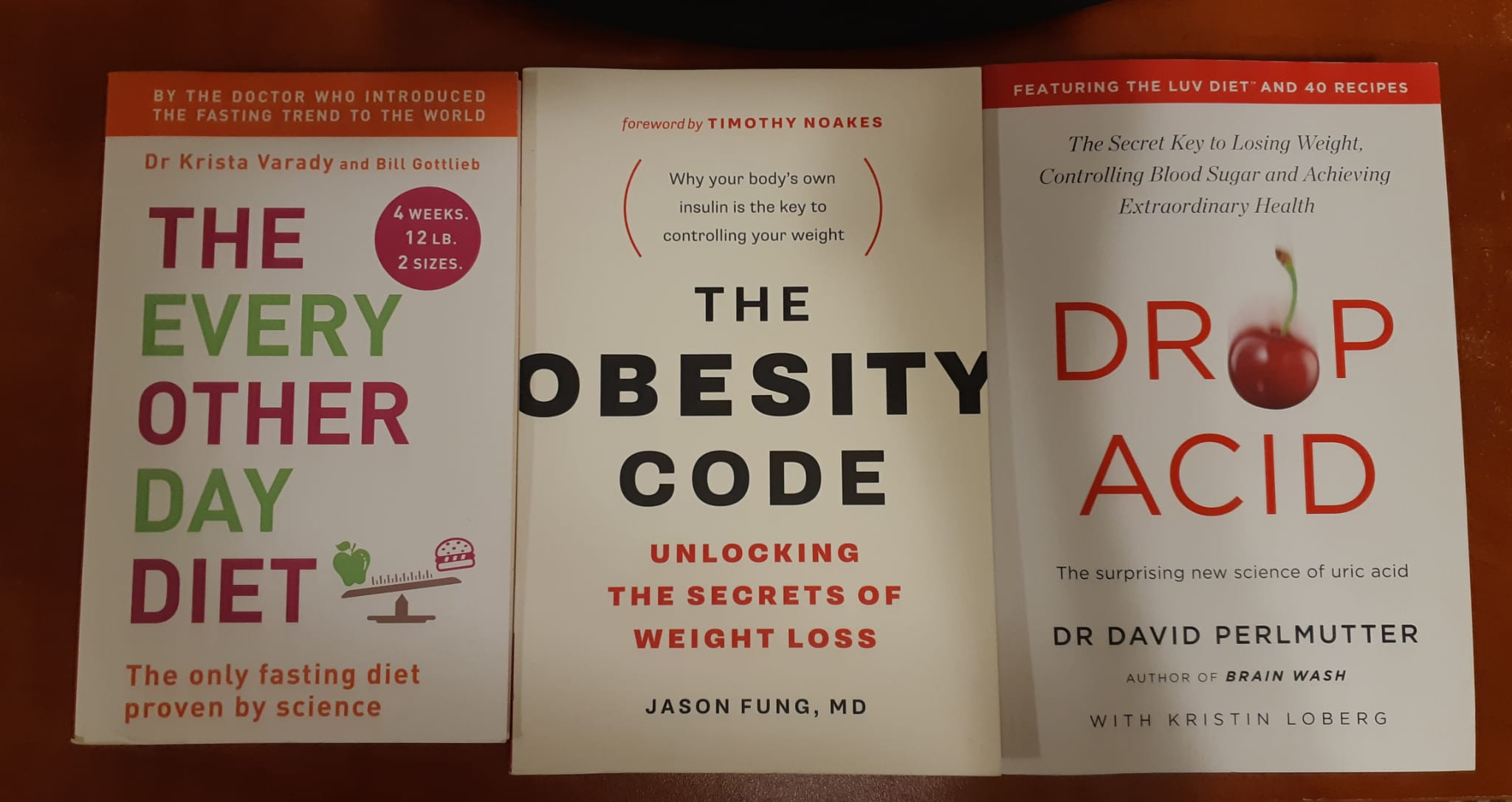
  1. The Every Other Day Diet by Krista Varady is dated, but still has good advice about alternate day fasting. Pay attention, that she is a representative of the flawed and wrong hypothesis of calories in equal calories out.
  2. The Obesity Code by Jason Fung will explain you why we get obese and what to do about it.
  3. Drop Acid by David Perlmutter explains why fructose is the main culprit behind elevated levels of uric acid which causes gout and what to do about it.

How to achieve a goal? A simple working algorithm

How to achieve a goal? A simple working algorithm


1. Set a goal with a deadline
2. Write a plan on how to get there
3. Track your progress daily
4. Consider sharing you goal publicly
5. Bet with someone

Now, to act on my own advice


1. I set a goal of getting a visible abs by August 30th 2023
2. My plan is to
2.1 Continue doing 18:6 intermittent fasting daily and walk in a fasted state
2.2 Do resistive training with dumbbells at least 3 times a week
2.3 Eat low-carb food and avoid processed food as much as possible

Finally, thank you for your support since you are my peer pressure.

Take the first step and continue doing one more step each day

Why is that we don’t achieve the goals that we set to ourselves like losing weight, getting fit etc. Maybe, it’s because we never take the first step towards a goal in the first place. Then those of us who take that first step usually stop right after doing it. What is missing is the determination to continue to make small steps, day after day after day. As they say the road of 10,000 miles starts with the first step, but as I mentioned it’s more important to continue making step after step.

So, start small. Make a goal, say you want to lose weight. First, understand that most diets alone don’t work. Second, if you have no physical constraints start doing intermittent fasting going from long eating window to a short one. Then as you get used to fasting start incorporating walking into your fasting routine. Walking in a fasted state helps to lose more weight and also makes you feel good.

Write down your goal on a paper or digitally. Each day document the small step your took that day, summarize your progress. You can consider sharing your goal and your progress as you make it on social media which may help you to stick to your commitment due to peer pressure.

You can consider joining a support group or starting one yourself. Having other people engaged in the same activity, seeing their progress and how they overcome difficulties along the way could motivate you and provide you with a desire to persevere and move forward towards your goal.

In short, try to do something each day that moves you towards your goal just a little bit. Remember, that doing nothing is not going to help you in any way. But incremental steps in the end sum up to a long way you’ve made. The way that is taking you to where you want to be. Yes, it’s not easy. Yes, it takes will power. Yes, it’s uncomfortable at times and frustrating, but there is no other way.

Below comes a quote from Contact movie that summarizes it good

This is the way it’s been done for billions of years. Small moves, Ellie. Small moves.

‘Contac’, 1997

Physical activity alone won’t help. Change what you eat first.

Photo by Content Pixie on Unsplash

The usual advice to eat less and move more is completely wrong and is against scientific evidence. I won’t go into detail here and you can read about it in the books by Jason Fung The Obesity Code or Gary Taubes Why We Get Fat.

What I do want to discuss is the fact that workout on its own won’t help you losing weight, since it contributes only a very small fraction of the energy that is burnt by the body when doing physical activity, especially, if you aren’t an athlete exercising twice a day every day.

If you are an average person who is not doing any sport usually and working mostly sitting in a chair then starting doing some exercise won’t make you slim. It won’t gonna happen. What you need to think of first is changing what you eat and when you eat it. Because this change can really be a drastic change in you life that can bring you weight down, help you loss excessive fat and feel better.

For example, if you exercise even three times a week, but still continue eating processed food full of any type of sugar, added or not, drinking soft drinks, diet or not, eating sweets, pastries etc., then no amount of exercise will ever help. You are doomed to stay overweight or obese. This is because eating these products raises Insulin hormone level which causes you body to store what you eat as fat. Then fructose which is a part of sugar or high fructose corn syrup, causes you liver to become fat, and raises Uric Acid which makes Insulin resistance even worse. So you get a double whammy here.

If instead you stopped eating sugar and starchy food in any form, then transition to eating meat, eggs, cheese and vegetables and some fruit. Do it during eating window of no more than 6 hours, then incorporating some physical exercise during you fasting hours can be a real boost to your weight loss.

So the bottom line is that you can’t outrun a bad diet. And this is true.

Intermittent Fasting is healthy. Sugar is not

It has been more than 9 months since I started to follow Intermittent Fasting regimen. I should say it was beneficial to me from lots of points of view. I lost about 31.5 pounds of weight (14.3 kg) going from 200 lb to 168.5 lb within this timeframe. I look slimmer and younger and overall I have a feeling of lightness and agility when I move.

I changed what I eat and moved away as much as I could from consuming processed food, though I do eat it a couple of times a week. I completely refrain from eating raw sugar or drinking soft drinks. I eat almost no sweets or pastries.

As for Intermittent Fasting I went from 16:8 which stands for 16 hours of fasting and 8 hours eating window to 18:6 that I do for months now. And I did 19:5 for a couple of months in a row. I also did prolonged fasts of 24, 39, 42 and 68 hours. I mostly did 42 hours fasts which I documented in this blog previously. I should say that prolonged fasts are nothing like 16:8 and they are more trickier to handle, but they result in faster and larger weight loss in comparison to classic 16:8 fast.

I also started to walk regularly throughout the week doing twice as much steps a day in comparison to pre-fast time. Over the weekends I actually do 3-4 times more steps than before I started fasting and do on average 10,000 steps or more. On weekends, I always walk in a fasted state in light clothes even in a very cold weather. In addition, initially I started doing weight training in a fasted state right after walking, but now I do it on evenings about three times a week using dumbbells and resistance bands.

What helped me to be motivated and keep on going were the books and YouTube videos that medical doctors, journalists and regular people produced on the subject of weight loss using Intermittent Fasting. These people were challenging wrong and widespread nutrional dogma of eating low fat and high carb food that caused worldwide epidemic of metabolic syndrome.

To name just a few, Gin Stephens, Jason Fung MD, Mark Mattson PhD, Robert Lustig MD, Benjamin Bikman PhD, David Perlmutter MD, Gary Taubes and others. Their books shed the light on why Intermittent Fasting worked and what were the dangers of sugar and especially fructose that was a part of it. All in all, I watched a couple of dozens of videos and read more than 15 books on the subject and a number of peer-reviewed scientific papers.

I also a member in a group of friends where we share advice on Intermittent Fasting and weight loss. My friends who followed me were able to loss 48 lb and 28 lb pounds each one respectively. I guess they are happy with the change they went through. And they are.

Well, despite all of this progress, sugar is still an addictive substance that I crave from time to time, especially after extensive workouts and other physical activity that accumulates during the day. Today, was such a day. On Saturday, I walked and ran in a fasted state for 3 km, than walked in a snow in the afternoon for about 3 km, and then had a workout with dumbbells in the evening. All in all it was quite exhausting. On Sunday, I woke up and went on walking and running in a fasted state this time for 6.2 km. Then in the afternoon I walked additional 3 km. As a result, in the evening at about 8 PM I had a craving for sugar and ate two slices of white bread with chocolate spread. All in all, about 16-20 gr of sugar (half of which is fructose).

So even though I know that sugar is unhealthy and outright dangerous, just like alcohol, tobacco and other drugs are having sugar a part of my diet for most of my life makes it quite difficult to eliminate it completely. Most of the time I am good without it, but sometimes cravings are there.

I hope, in time I’d be able to get rid of sugar and substitute it with berries or fruits rich in fiber. It isn’t an easy fight, fighting an uphill battle with sugar addiction that hundred millions if not billions of people face daily.

42 hours fast experience. To do or not to do?

Photo by Emre on Unsplash

It is 6th time that I am doing a prolonged fast (more then 24 hours). And it’s 4th time I am doing 42 hours fast. Below comes some observations.

  • It’s not getting any easier in comparison to previous fasts. First 26 hours are quite normal, but then the feeling of discomfort prevails. It’s not a hunger, but a feeling of an empty, glued and ‘vacuumed’ stomach.

  • The main difficulty is sleeping at night since I tend to wake up a number of times to drink and the dreams are quite annoying. Sometimes about food.

  • As for weight loss this time, it’s insignificant. But one possible explanation is that in the last 4 days I am doing about 120-150 pushups a day in addition to usual walking about 7000 steps. And yesterday while doing 42 hours fast I did 200 pushups throughout the day. So it seems like there is no weight loss. When actually, fat has lessened, but muscles have grown. Visually, I see less fat, than ever.

  • Will I continue to do extended fasts? Well, it seems like I won’t but I am for 24 hours fasts, since they are a piece of cake (oh no, carbs are even here 🙂 )

Start small

To be able to make a progress in anything there is a need to be able to set achievable goals. This is true also for weight loss. Setting grand goals that are hardly achievable can overwhelm you and even stop you from doing anything altogether.

That is why I suggest to set very small goals that you can reach with some effort. For example, instead of setting as a goal to be super muscular body builder, how about first starting to walk on a daily basis? Walking is free, easy to do and you do not need any special equipment for this.

Next, if you want to start with Intermittent Fasting don’t jump right into 48 hours fast, but start small with 12 hours eating window. Then decrease it gradually to 10, 8, 6, 4 hours.

If you want to include resistance training with rubber bands, dumbbells then start small by doing push ups in the morning or evening or both. Or maybe, start with one session a week at home, then two sessions a week etc. Gradual increase in a number of sessions is much easier than committing to a gym membership that costs you a lot of money.

So starting it small can take you quite far. As a teacher in a martial school used to tell us do it
Gradually, sequentially, continuously.

68 hours fasting results

How did I end up doing it?

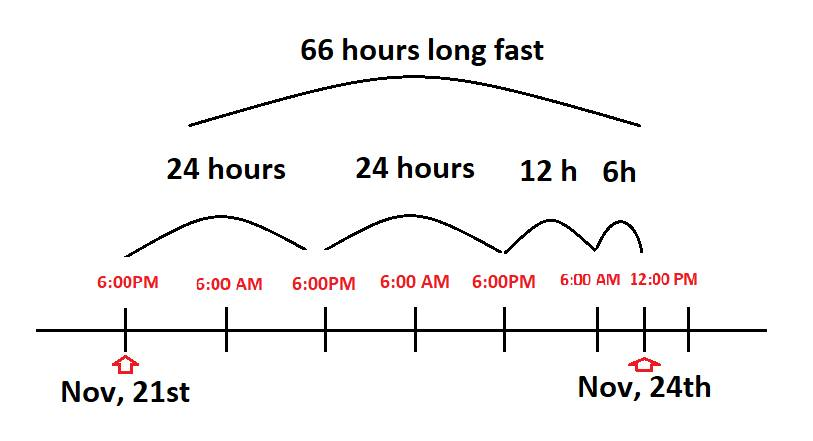
Previously I did a 42 hours fast. After that I returned to doing the usual 19 hours intermittent fasting with 5 hours eating window. But I thought to myself that I could do even better and try a longer fast to loss even more body fat as a result. So I tried and finished a longer fast which was scheduled to be 66 hours, but in the end ended up being 68 hours. The fast ended with a big surprise that I’ll discuss later.

Initial setup

Fasting length

From 4:20 PM on Monday, Nov 21th to 12:20 PM on Thursday, Nov 24th.

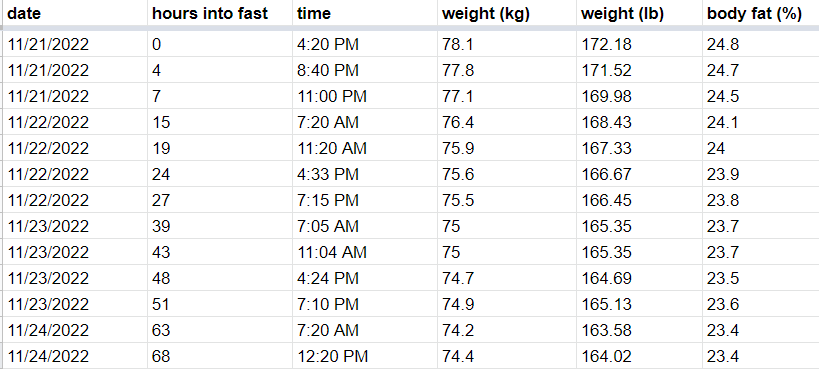
Fasting progress

Detailed progress

Same information as a graph

Final result

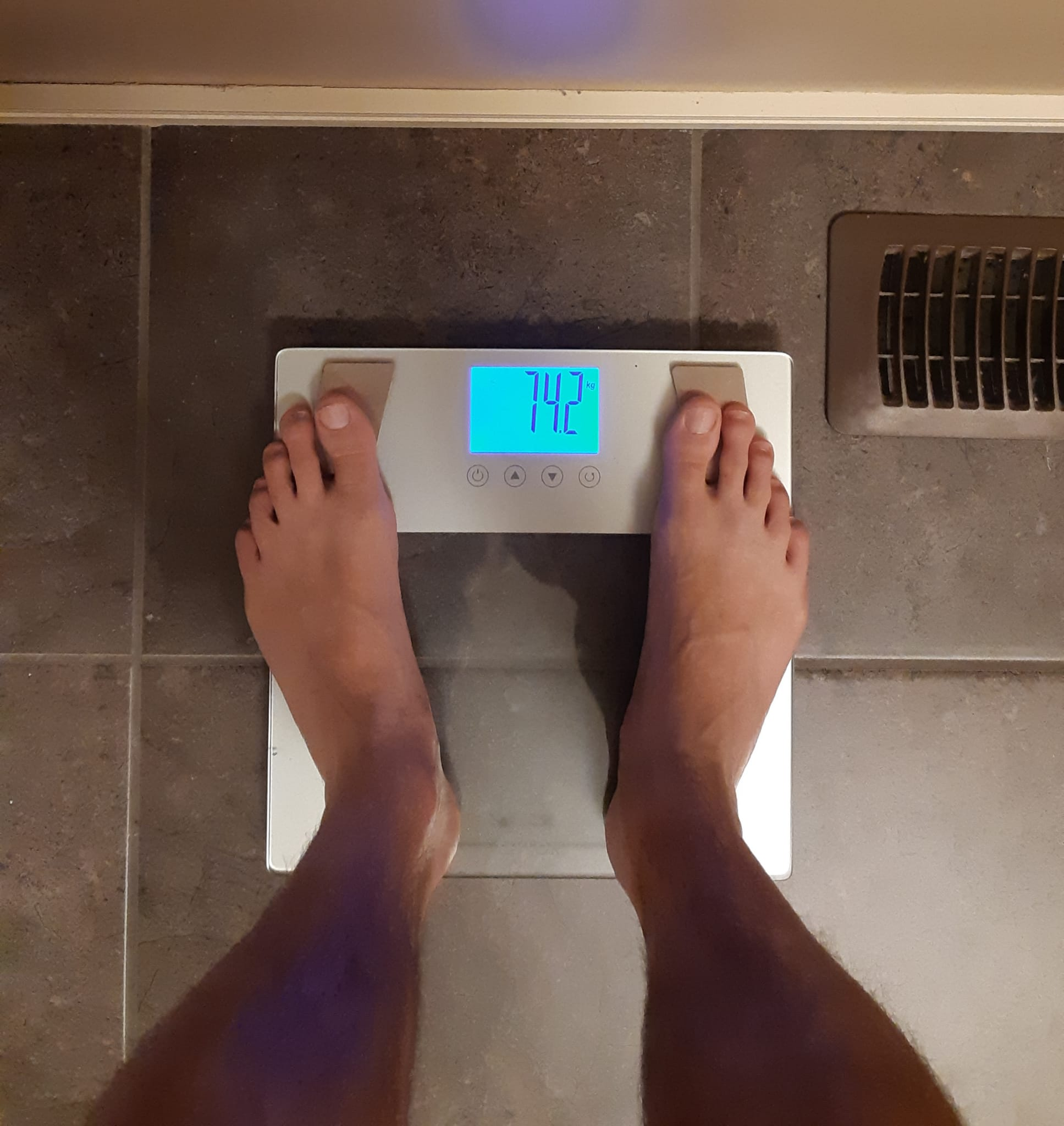
After 63 hours of fasting at 7:20 AM, Nov 24th

A big surprise

The fast has been finished successfully. This time it was more difficult than 42 hours fast. What is funny I did 26 hours more this time, but weight loss was the same as during 42 hours fast.

  • Initial weight was 78.1 kg (172.18 lb), body fat 24.8 %
  • Final weight is 74.4 kg (164.02 lb), body fat 23.4 %

42 hours fasting results

How did I end up doing it?

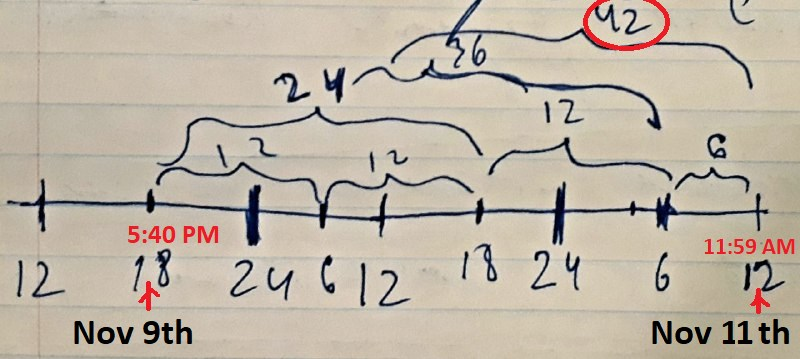
I am doing Intermittent Fasting for 23 weeks now. Starting from about 18th week my weight loss plateaued and I needed to do something to get it moving. So I recalled that I can try doing extended fasts which are fasts longer than 24 hours. Well, I decided to do 42 hours fast that starts on 6:00 PM and ends after 42 hours on 12:00 PM.

Initial setup

Fasting length

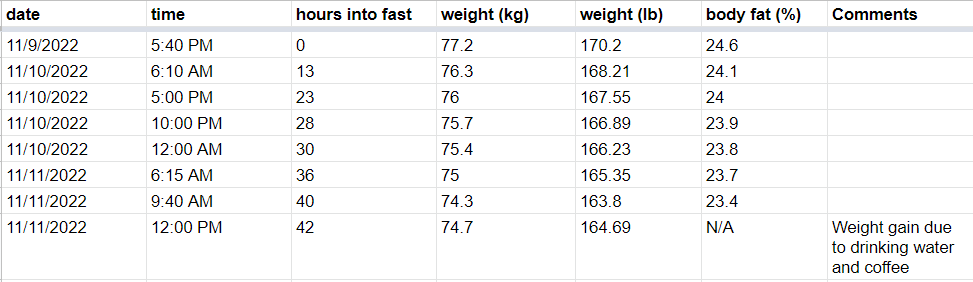
From 5:40 PM on Wednesday, Nov 9th to 11:59 AM on Friday, Nov 17th.

Fasting progress

Detailed progress

Same information as a graph

Final result

After 42 hours of fasting 12:00 PM

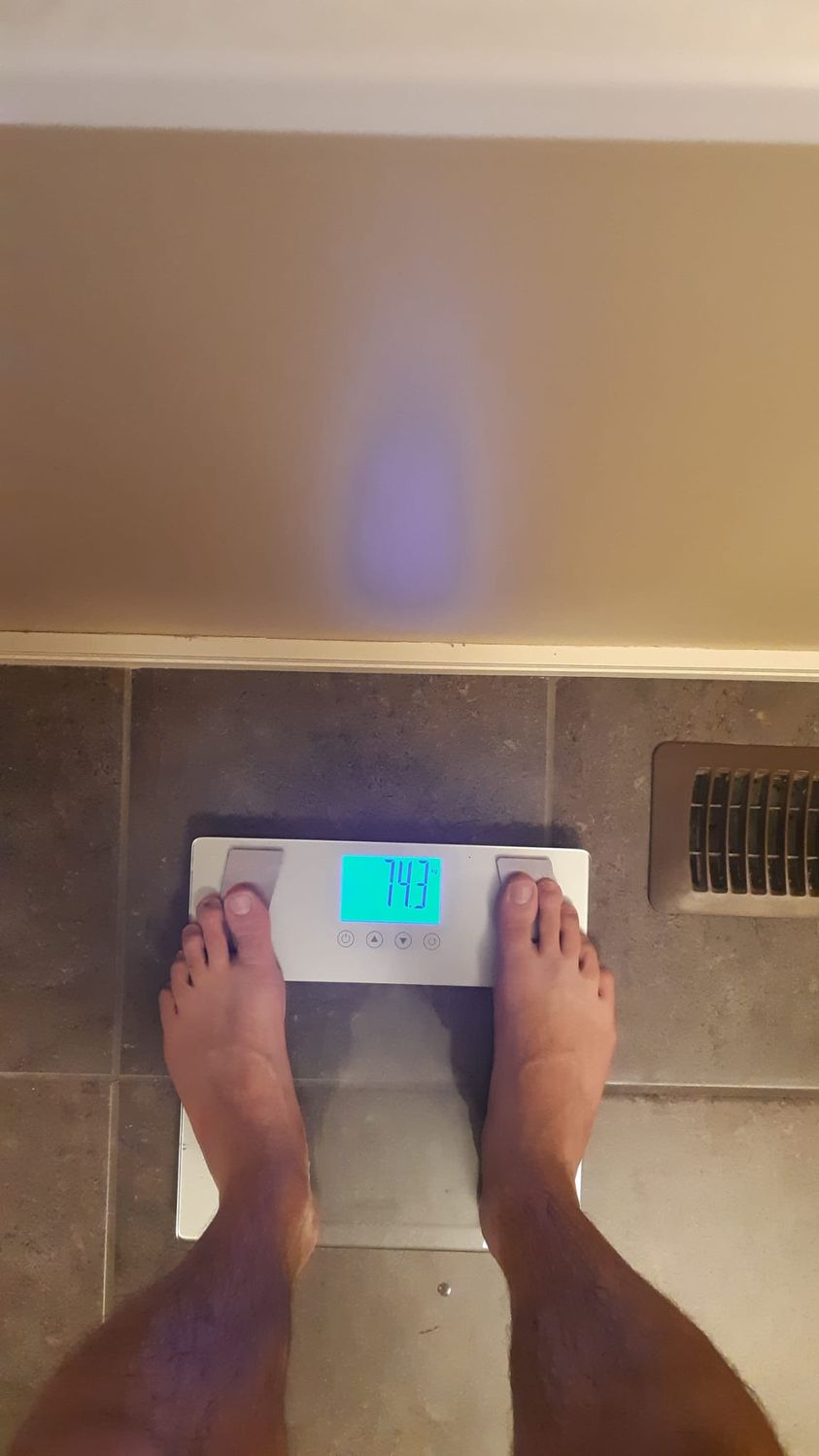
weight after 40 hours of fasting

The fast has been finished successfully. Overall feeling is good. Nothing special to report except for crumbling belly feeling yesterday in the evening.

  • Initial weight was 77.2 kg (170.2 lb). Final weight is 74.7 kg (164.7 lb). That’s after drinking a cup of water and a cup of coffee which added about 0.4 kg (0.9 lb) of weight.