The title of this post is provocative on purpose. Especially, for people who doesn’t speak neither Chinese nor Japanese. For learning each language separately already isn’t simple, but learning both at once may seem like a daunting task. And indeed, it’s not easy. But the main question is whether it is even possible. Judging by my own experience it is possible, and even interesting.
To provide some context I wrote in previous posts that I learnt Japanese for a year and a half back in 2004 while at university. But since then I didn’t touch it until this year when I visited Japan. So, before going there I brushed up on what I remembered from Japanese and reviewed the basics again. What helped me was that I didn’t need to learn from scratch both of the Japanese alphabets which are called katakana an hiragana. Also, I could recall some of the Chinese characters, which are called kanji – 漢字 in Japanese, I learnt a long time ago,
When I returned back home I brought with me Japanese textbooks to learn Japanese from the very beginning and started to watch Japanese YouTubers that spoke natural Japanese to get a good exposure to speaking Japanese. I should say that after listening for a couple of weeks to Japanese I started to actually understand pieces of the conversations. Also, in parallel I started to learn kanji more seriously and even tried to read a real Japanese book I brought with me as well.
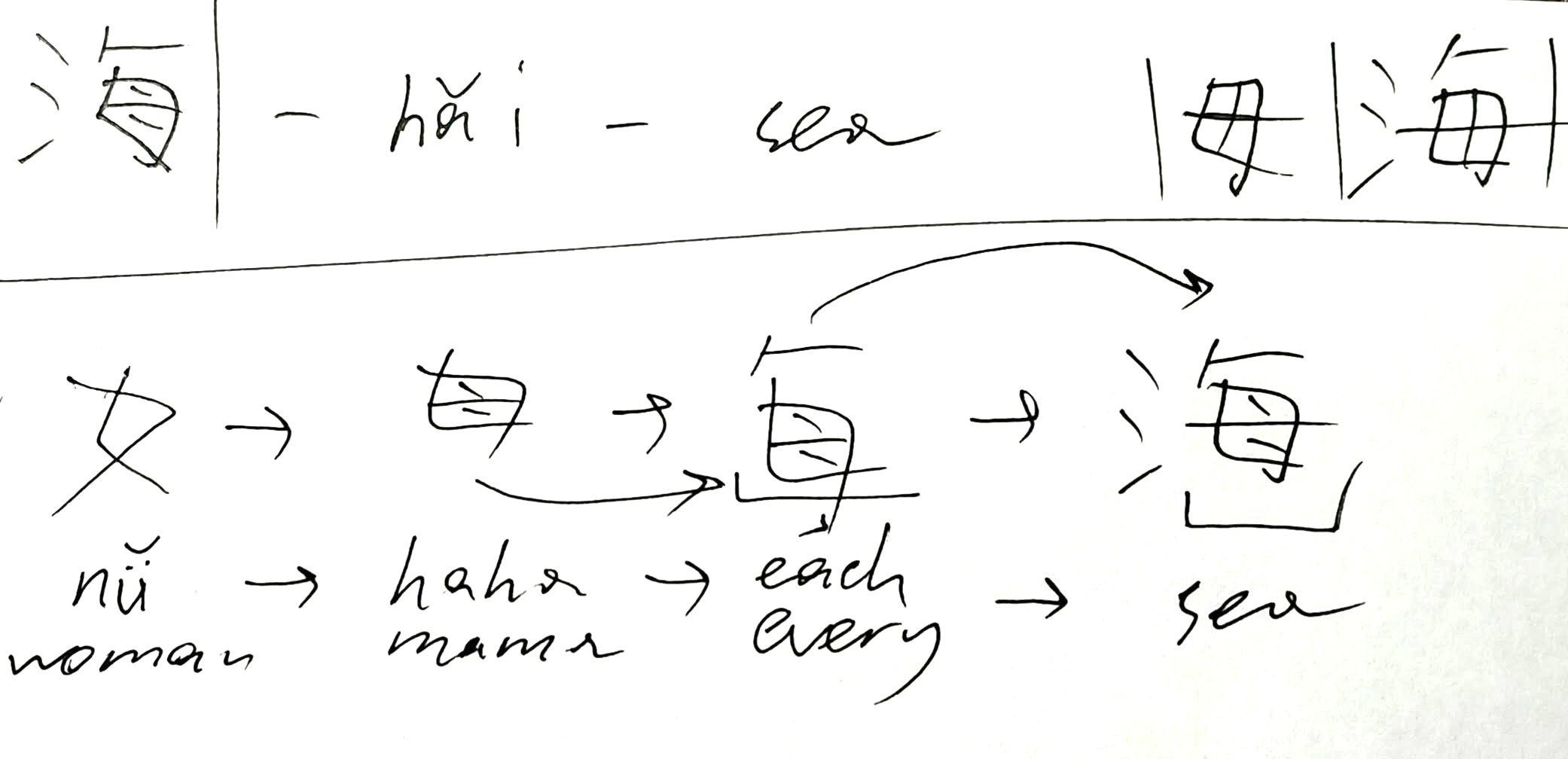
To be able to read Japanese books a person is required to know at least 2136 kanji which is the proficiency level that children graduating school should master. In reality you may need to know a little bit more, but it should be enough for most people most of the time. So, when you learn kanji you may be curious how they came up to be. It’s actually interesting and not that simple to answer this question. Luckily, there is a body of linguistic knowledge that is based on the analysis of oracle bone inscriptions, bronze vessels and ancient Chinese scripts that allows us to have a good idea of what is the origin, or most probable, origin of Chinese and hence Japanese characters.
For example, The Complete Guide To Japanese Kanji contains not only all these 2136 kanji, but also provides a reader with historical etymologies. So, when I read about how kanji came to be I became curious to know whether Chinese characters or hanzi – 汉字 have the same meaning and pronunciation in Chinese. So from the pronunciation point of view, they are completely different, since Japanese and Chinese are very different languages. Also, it turns out that characters themselves may look different due to the fact that in China as well as in Japan they revised and simplified some of them back in the middle of 20 century to help with elevating literacy among the population. What’s interesting the extent and type of simplification was very different between two languages with some small overlap here and there. That’s why in China we have Simplified Chinese that has a big number of simplified characters, while Chinese in Hong Kong and Taiwan actually has very similar characters to Japanese kanji. But that’s a different story.
So, about a year ago I started to learn a Standard Chinese which is also known as Mandarin, but stopped after learning about the four tones it’s using. Now, back from Japan and with a renewed motivation to understand what is the origin of Chinese characters and how they are different and similar in both languages I am back to studying Chinese. And I should say it is going well. I employ the same strategy to learning Chinese as I do to Japanese. Watching YouTubers that talk in natural or slower pacing Chinese with subtitles having Pinyin, English and Chinese characters or hanzi.
What is very important in studying Chinese is to master tones and pronunciation well from the very beginning. Learning hanzi is very very important too. For me, since I already know hundreds of kanji from Japanese it’s a much more easier task since I already understand to some extent the logic behind how characters are composed and as I’ve mentioned some of them have the same or similar meaning. What’s funny that learning Chinese helps to understand the function and evolution of kanji in Japanese. For example, the hanzi for yesterday, today and tomorrow are almost the same in Japanese and Chinese. First character is the same in both languages, but the second characters which means 日’sun’ (‘day’) in Japanese and 天 ‘sky’ in Chinese is different, though it has the same concept. There are other similar compound characters and there are words that are exactly the same in both languages, but they pronounced differently.
You may ask isn’t learning these two languages produces a very big confusion in the end. I can tell you that it isn’t the case for me. I don’t learn both on the same day or at the same time. Since I have some grasp of Japanese, I tend to listen to it most of the time. As for Chinese I do invest more effort in Chinese grammar and listening and reading.
So, at least for now it’s an engaging and captivating experience for me to learn both at once. Will it work in a long run is still unclear, but it shows that it is at least possible.
I’d like to mention a couple of useful resources I recommend for people beginning to study Standard Chinese below.
Books
I find the Chinese Verbs & Essential Grammar by Julian K. Wheatley as a very good textbook on the subject. If you are linguistically inclined person you may find it very helpful.
Gen AI
I suggest to use any Gen AI website or application you want to use as a very helpful tool in learning any language. I use it for English, Japanese, Chinese and even Ukrainian.
YouTube
I personally find this YT Chinese teacher very helpful and her videos are interesting to watch.
I’d also recommend this documentary by Irish-American stand-up comedian Desmond Bishop – Des Bishop Breaking China. In which he described how he lived and studied Chinese in China. And overall, this is funny and an educational documentary to watch.

