Levels of understanding or how good explanations matter

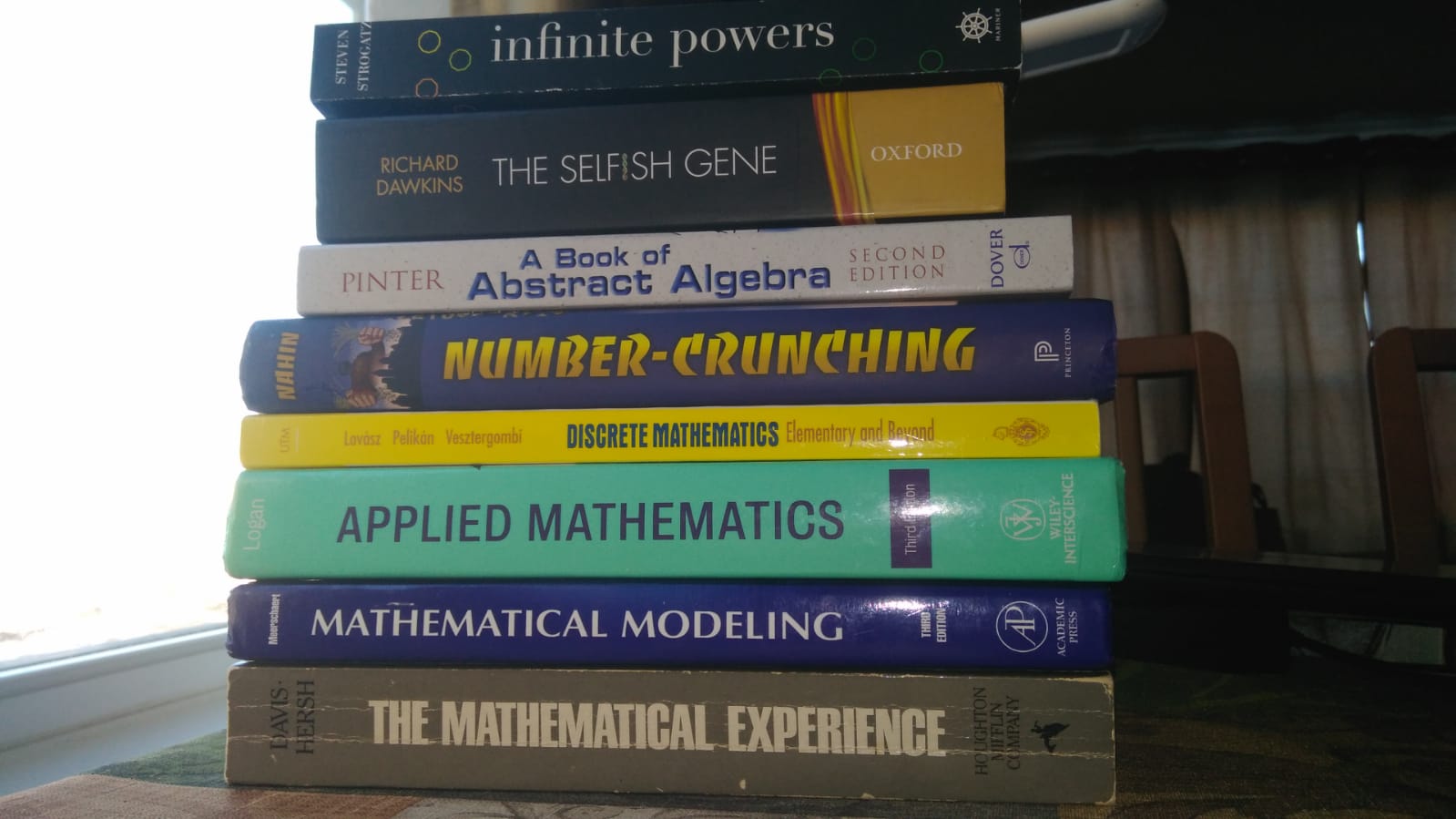
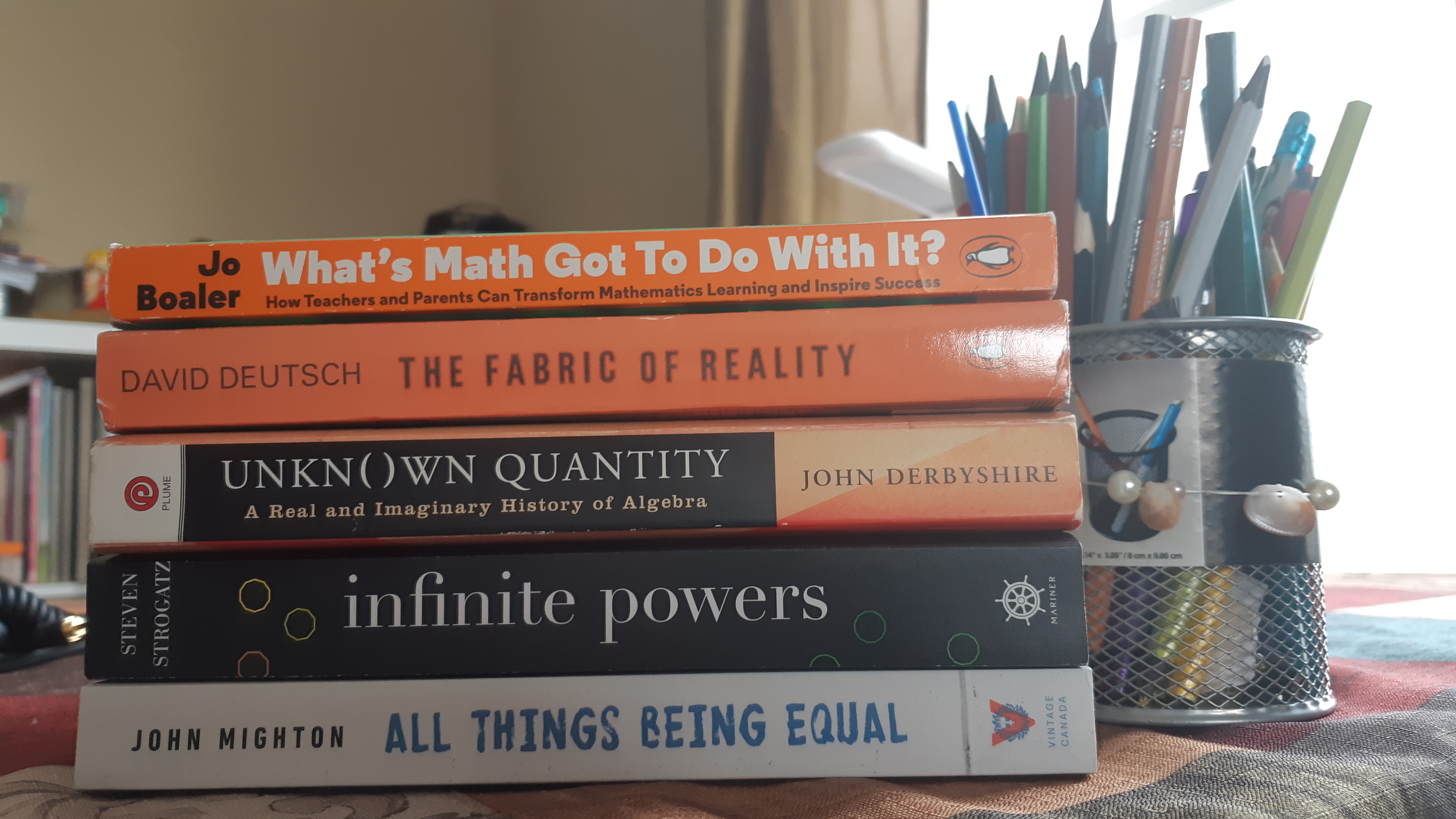
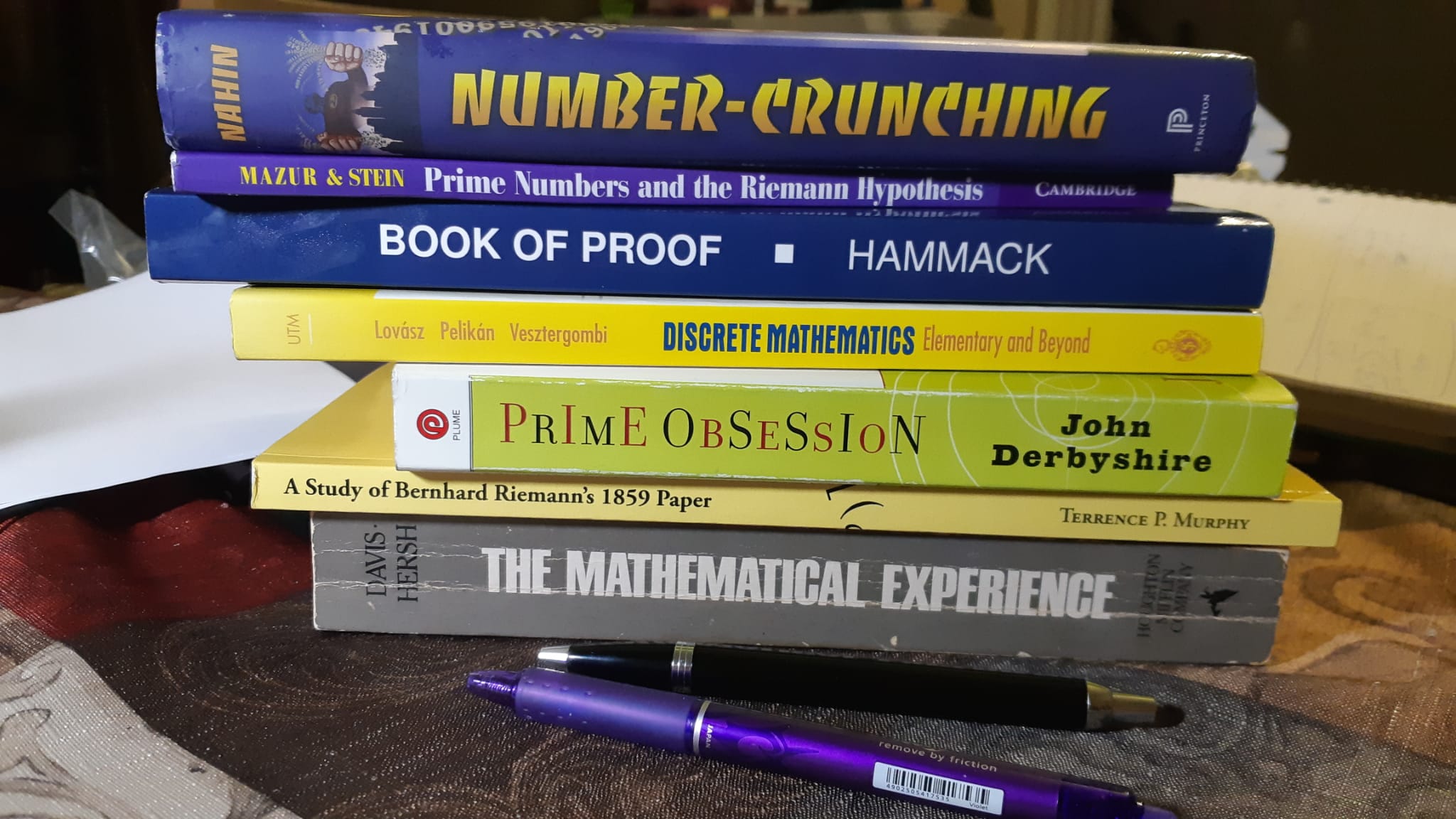
In this post I want to talk about why providing good and detailed explanations can be a key in deep understanding of things in different fields of life. Particularly, I want to talk about detailed proofs in mathematics that have good step by step explanations of how the proof was constructed. Recently, I’ve started to read the books on math that are piling on my table just as the image above depicts.

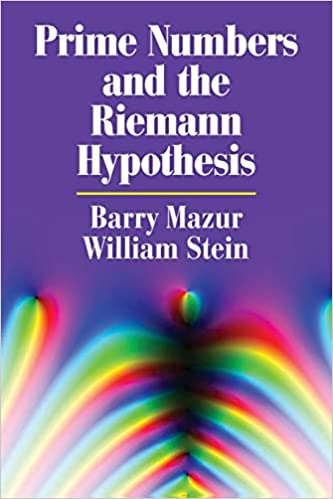
I want to point your attention to the second book at the top of the pile, which is Prime Numbers and the Riemann Hypothesis book from 2016 written by Barry Mazur and William Stein. This book talks about Riemann Hypothesis by starting from ‘simple’ math and gradually moving to details about Riemann Hypothesis that require more advanced math background.

So what levels of understanding and well explained proofs have to do with the content of the book. Well, you see in the first part of the book, which authors claim requires some minimal math background a read sees this

Here are two exercises that you might try to do, if this is your first encounter with primes that differ from a power of 2 by 1:

1. Show that if a number of the form M = 2^n – 1 is prime, then the exponent n is also prime. [Hint: This is equivalent to proving that if n is composite, then 2^n -1 is also composite.] For example: 2^2 – 1 = 3, 2^3 -1 = 7 are primes, but 2^4 – 1 = 15 is not. So Mersenne primes are numbers that are

– of the form 2^ prime number – 1, and

– are themselves prime numbers

Some context for the quote

Here comes a little bit of a context about this quote. The quote comes from, part 1, chapter 3: ‘”Named” Prime Numbers’, on page 11. The chapter describes what are Mersenne Primes, which are prime numbers that are one less than a power of two:

M = 2^n – 1

Also, it’s good to know that a prime number is a whole number (positive integer) that can be divided only by itself or 1. For example,

2, 3, 5, 7, 11 … are prime numbers since they can only be divided by themselves and 1.

Now, that we know what prime numbers are, I want to draw your attention to the point in the quote where it says, that the exercises are good for ‘your first encounter with primes that differ from a power of 2 by 1‘. Well, in my opinion these exercises are good only for readers who have at least a BSc in Math or possibly an engineering degree. In a couple of sentences we’ll see why I think so. Since I consider myself as a person who is interested in math and have a BSc degree in Electronics, I think the first part of the book which is indented for a layman person is just for me. Were you able to arrive at the proof for that simple exercises above?

Frankly, I wasn’t able to prove it. So, I went and looked for a proof on the internet. As always, Wikipedia is at the top of the Google search when it comes to math topics. Lo and behold there is a page in the wiki about Mersenne primes, what they are and a number of proofs related to them. One of the proofs was exactly the solution to the exercise in the quote above. Here it comes:
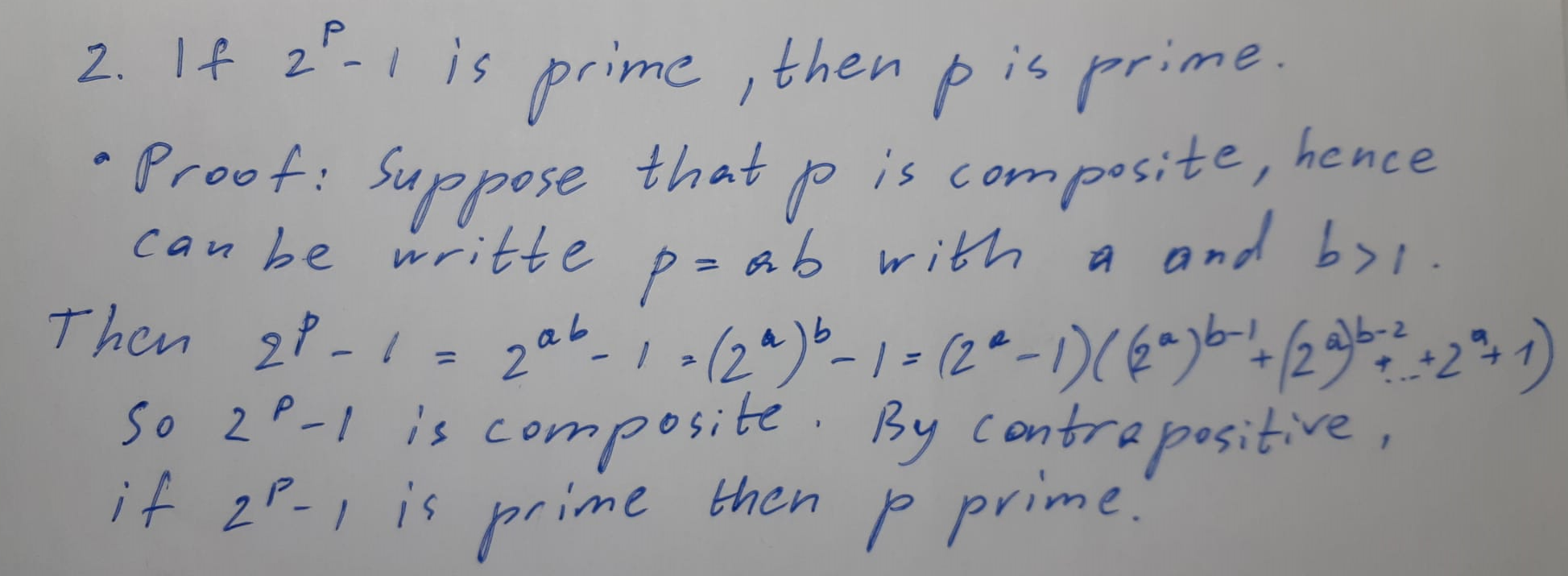
Note: Since, I had no time to learn how to use LaTeX properly in the WordPress, and believe me WordPress doesn’t make blogger’s life easy I write the proofs and picture them.

Does this proof looks like a piece of cake to you? Is it intuitive and easy to grasp? In my opinion, it’s not and also this proof shows why Wikipedia gets a good portion of criticism about its content.

What I find not so obvious about that proof is how the right hand side of the equation came about. Especially, the part that has powers of a * (b – 1) , a* (b – 2), … , a, 1. And then the statement that says ‘By contrapositive, if 2^p -1 is prime then p prime‘. In this particular statement, if you had no courses on mathematical proof, logic or Abstract Algebra, then the words composite and contrapositive can be a little bit mysterious.

I thought to myself, well, the proof looks kind of unclear to me, so I searched better using the internet and also checked the books I own. I was able to find a couple of proofs that were easier to understand and also was able to find a proof in the Book of Proof by Richard Hammack that you can see in the title image for the post. It’s the blue one and it comes third from the top of the pile.

Let’s start with the proof from the Book of Proof, which sounds like a good place to begin with. The proof is a solution to the exercise 25 from Chapter 5 in the book.
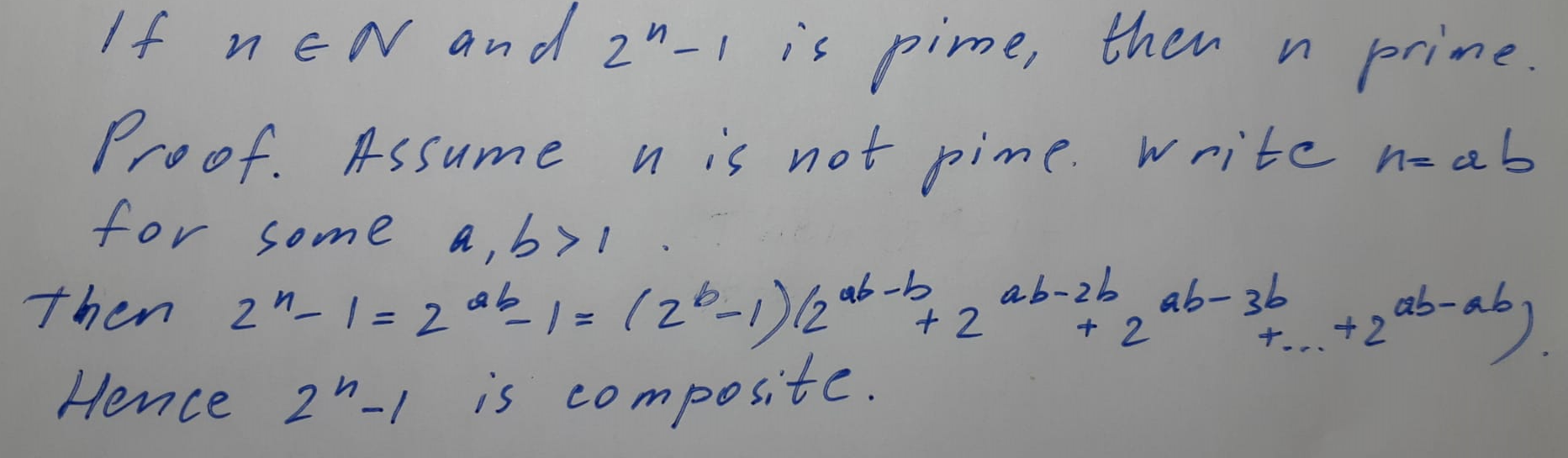
If we look carefully at this proof it look almost exactly as the proof in the Wikipedia. It even look less clear. But one important thing to notice is that this proof shows where the ‘1’ comes from on the right hand side of the equation, in comparison to the proof in the wiki. I think so, since 2^(ab-ab) which equals 1, provides more information than a simple number 1. This is because it provides some clues on how the proof was constructed. But for a reader who does not remember math, both of the proofs are not that helpful. Also, we need to take into consideration, that the Book of Proof intended audience is undergraduate students of exact sciences. So the book presupposes some math background.

Some math background

We already mentioned that a prime number is a positive integer that can be only divided by itself or number 1. All other integers, are composite, since any of them can be composed by multiplying prime numbers. This is where composite comes from. As for contrapositive the Merriam-Webster site provides this definition

 a proposition or theorem formed by contradicting both the subject and predicate or both the hypothesis and conclusion of a given proposition or theorem and interchanging them

if not-B then not-A ” is the contrapositive of “if A then B ”

For example,

If it was raining then it is wet.

Then contrapositive statement would be

If it is not wet then it wasn’t raining.

Returning back to the original exercise from the Prime Numbers and the Riemann Hypothesis book, now, it becomes a little bit clear, what the hint [Hint: This is equivalent to proving that if n is composite, then 2^n -1 is also composite.] there was for. So the proofs, went to prove that

If n is composite then 2^n – 1 number is composite

and by contrapositive

If 2^n – 1 number is not composite (i.e. prime) then n is not composite (i.e. prime)

Polynomial factorization

Now, that we know what contrapositive proof is that’s turn to the right hand side part of the equation which is

2^n – 1 = (2^a – 1) * ( 2^a*(b-1) + 2^a*(b-2) + … + 2^a + 1).

It turns out that to derive it there is need to remember what polynomial factorization is, or remember how to divide one polynomial by another, or to know what Polynomial remainder theorem is. Also it’s good to know for a start what is a polynomial.

Since this post is becoming to long I need to make it shorter, which defeats the point of providing detailed explanations 😦

But I’ll provide some hints on how the right hand side was derived.

There is a known math formula to compute the following expression a^n – b^n
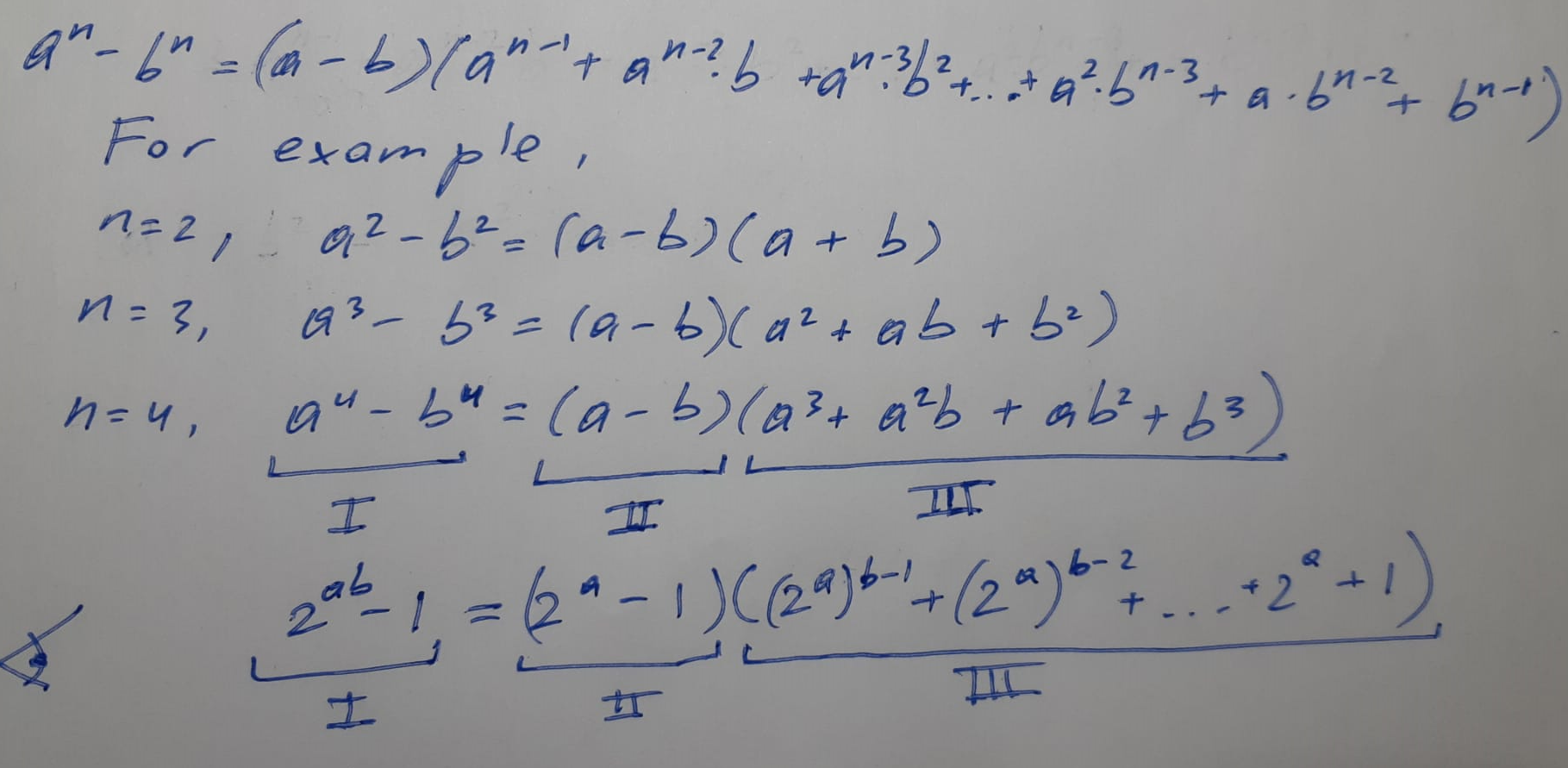
It turns out that the equation in the proofs that were mentioned in this post has the same structure as the formula to derive a^n – b^n. But the most interesting part is this. If you look at the last equation the Roman numeral I stands for the initial composite number 2^n – 1, and it is composed by multiplying Part II by Part III.

Part I = Part II * Part III

What is interesting about this composite number and that me use A, B and C instead of using I, II and III

A = B * C

is that B and C are factors of A, or alternatively B is a divisor and C is a quotient.

So to summarize the initial number 2^n -1 is composite since it is a product of two other numbers.
Prime time for Riemann Hypothesis

Books that make you think

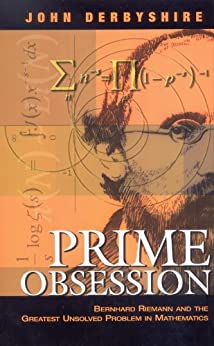
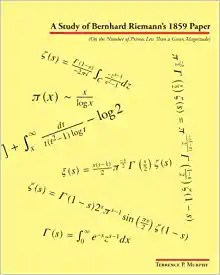
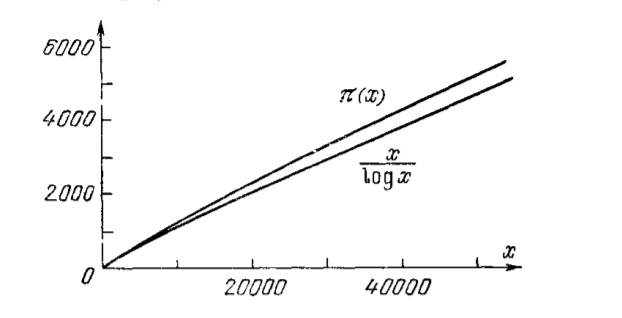
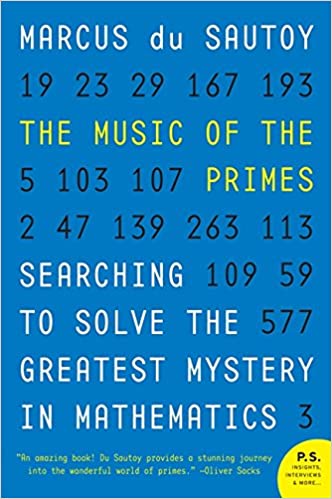
I already had a post where I mentioned Reimann Hypothesis after reading The Music of The Primes by Marcus du Sautoy. As far as I recall, I liked the book a lot. It was written for a wide audience and was an easy read. Later, I accidentally found another book on the subject that was intended for more mathematically inclined readers, namely, Prime Obsession by John Derbyshire. Having been fascinated by the subject of prime numbers, the prime number theorem it was a short way to other similar books, such as Prime Number and the Riemann Hypothesis by Barry Mazur and William Stein. Then smoothly transitioning to A Study of Bernhard Riemann’s 1895 Paper by Terrence P. Murphy. Just to conclude with H.M. Edwards Riemann Zeta Function. By the way, the order in which I mentioned the books more or less conveys the mastery of mathematics required to be able to understand what’s going on in them. Which means that two last books require substantial background in calculus and complex analysis. But it’s doable if you have time and prime obsession.

Easy to not-so-easy books

I’d like to provide more details about the books above which I personally read end-to-end and also about ones that I bought, but haven’t finished yet, or only skimmed through.

Actually, I’d rather start with a short description of what the Reimann Hypothesis is by citing the Millennium Problems web site that describes a number of 21st century math problems that can bring you 1,000,000 USD for solving any of them.

So the Riemann Hypothesis is

Source: Millennium Problems

Some numbers have the special property that they cannot be expressed as the product of two smaller numbers, e.g., 2, 3, 5, 7, etc. Such numbers are called prime numbers, and they play an important role, both in pure mathematics and its applications. The distribution of such prime numbers among all natural numbers does not follow any regular pattern.  However, the German mathematician G.F.B. Riemann (1826 – 1866) observed that the frequency of prime numbers is very closely related to the behavior of an elaborate function
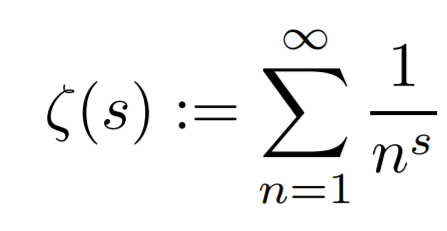
    ζ(s) = 1 + 1/2s + 1/3s + 1/4s + …
called the Riemann Zeta function. The Riemann hypothesis asserts that all interesting solutions of the equation
    ζ(s) = 0
lie on a certain vertical straight line.
This has been checked for the first 10,000,000,000,000 solutions. A proof that it is true for every interesting solution would shed light on many of the mysteries surrounding the distribution of prime numbers.

Having said that now let’s look at the books.

The Music of The Primes

The book was written by Marcus du Sautoy in 2003. As I mentioned, the book does not require a degree in mathematics to be able to understands what it’s talking about. The material in it is interesting and engaging. In addition to covering, The Prime Number Theorem and Reimann Hypothesis it also covers other topics related to prime numbers usage, like cryptography. It can be a good starting point into a long journey with prime numbers.

Prime Numbers and the Riemann Hypothesis

The book was written by Barry Mazur and William Stein in 2016. It has four parts, where first part intended for a wide audience, and each consecutive part presuppose gradually increasing knowledge of math to be able to grasp the content. What’s interesting about this book that it sheds light on some interesting connections between Riemann Hypothesis and Fourie Transform, which electrical engineers can relate to. Also the book is quite short.

Prime Obsession

The book is written by John Derbyshire in 2003 (same year when Marcus du Sautoy wrote his book). This book has two parts: The Prime Number Theorem and The Riemann Hypothesis, but it goes into nitty gritty details of both of them and don’t allow a reader relax too much. Following the content of the book could require some math background and at times some calculations to be sure that one gets proper understanding of what’s going on. Personally, out of all the books I mention in this post I find this one the most engaging.

A Study of Bernhard Riemann’s 1859 Paper

The book is written by Terrence P. Murthy in 2020. It is one of the two most technical books on the subject that requires substantial background in mathematics. The book provides Riemann’s 1859 paper in full in English and then systematically goes and provide proofs for all relevant parts of Riemann’s paper in subsequent chapters (except for the Riemann Hypothesis itself :). I think Terrence Murphy summarizes who this book is intended for in his own words the best:

Who Is This Book For?
If you are reading this, chances are you have developed a keen interest in the Reimann Hypothesis. Maybe you read John Derbyshire’s excellent book Prime Obsession. Or perhaps you read that the Riemann Hypothesis is one of the seven Millennium Prize Problems, with a $1 million prize for its proof.
To advance your knowledge substantially beyond Derbyshire’s book, you must have (or develop) a good understanding of the field of complex analysis (we will describe that as knowledge at the “hobbyist” level). So, this book is probably not for you unless you are at least at the hobbyist level.

Riemann Zeta Function

The book was written by H.M. Edwards in 1974. I’d rather describe it by continuing the citation from the previous book by Terrence P. Murthy:

After developing an interest in the Riemann Hypothesis, the first stopping point for many is Edwards’ excellent book Riemann’s Zeta Function. The Edwards book provides a wealth of information and insight on the zeta function, the Prime Number Theorem and the Riemann Hypothesis. And that brings us to the next group of people who do not need this book. If you eat, sleep and breath complex analysis, we will say you are at the “guru” level. In that case, the Edwards book will be easy reading and will provide you with the information you need to substantially advance your knowledge of Riemann’s Paper and the Riemann Hypothesis.

As you may tell, “guru” level in math is required to fully digest this book. So it want be easy to say the least.

A good introductory paper on the subject

If you are interested in a short, but engaging introduction into what are Prime Number Theorem and the Riemann Hypothesis I recommend to read Don Zagier’s The First 50 Millions Prime Numbers paper, published in New Mathematical Intelligencer (1977) 1-19.

If you know Russian you can read the same paper that was published in Russian only in 1984 in the Uspekhi Matematicheskikh Nauk journal.

Parting words

All in all, these five books can take a good chunk of a full year to work through or possibly even more, especially the last two. So what are you waiting for? Life is too short to waste it on watching TV series or YouTube nonsense. The treasures of math and deeper understanding of the world are awaiting for ones who know where to look for.

Reading by doing. ‘Thinking Better’ the book by Marcus du Sautoy

Have you heard about a new book Thinking Better: The Art of the Shortcut in Math and Life by Marcus du Sautoy? If not, you may consider given it a try, since this book is very engaging. The book is about various topics in mathematics and how they provide shortcuts that can be used in different fields of daily life to find solutions to seemingly daunting problems. These shortcuts speed up the computations and free time for you to do other things. Each chapter of the book starts with a puzzle that the reader is asked to solve. Then the main content of the chapter is related to the puzzle, while the solution is provided in the end.

I’ve already read The Music of the Primes that was also written by Marcus and thoroughly enjoyed it. What makes this book to stand out in comparison to The Music of The Primes is that it’s focused on practical advise that could be actioned by readers. But what I find most compelling about this book is that reading it is not enough to get the most out of the content, there is also a need to play with the content of each chapter, carefully examining it. Otherwise the subtle details and insight could be lost and not understood properly.

Marcus tries to present his ideas in a way that is accessible to a reader who is not supposed to be a math expert. That is why it seems his approach is to use as little of math terminology and formulas as possible. Even the word ‘formula’ doesn’t show up until page 20 into the book. This approach to writing popular science books is not new and it tries to achieve a trade off between a number of readers who may be frightened by the mathematical notation, and the number of readers who could be disappointed by the lack of it. Which brings me to the main point of this post. Even though Marcus doesn’t shy away from writing down some equations to exactly convey his ideas, there are places in the book where additional mathematical details could clarify his point even better. I also suggest to name the math objects as they are used in mathematics. There is no harm in doing that just like Steven Strogatz did in The Joy of x or John Derbyshire in the Unknown Quantity books. Proper math notation doesn’t frighten, but could actually help readers understand concepts better.

For example, in the first chapter of the book, on page 20 the following sequence is introduced

1, 3, 6, 10, 15, 21 …

Which as Marcus explains is a sequence of triangular numbers and the general formula to get the nth triangular number is

1/2 * n * (n + 1)

What I think is missing here is the fact that Marcus stops short of explaining that there is a general formula to find the sum of members of a finite arithmetic sequence. This is important, since each nth number in the triangular numbers sequence is a sum of the nth numbers of the arithmetic sequence that Marcus mentions on page 2, talking about Gauss’s school lesson

1, 2, 3, 4, 5, 6 …

Notice that this sequence is arithmetic, since the difference between each consecutive member and the previous one is constant. In this particular case it equals to 1.

For example, that general formula is

Sumn = 1/2 * n * (a1 + an), where a1 is the first member, which in the case of natural number sequence is 1; an stands for the last number until which we want to sum and n stands for the number of members starting from the first to the last we want to sum. Then substituting these values into the general formula we arrive at the formula Marcus mentioned in the book

nthtriangular number = 1/2 * n * (1 + n)

What this gives a reader is that now it’s possible to use this general formula to calculate sums of other arithmetic sequences, for example the sequence of odd numbers.

1, 3, 5, 7, 9, 11, 13, 15 …

Let’s calculate the sum of first 8 members of this sequence, a1 = 1, an = 15, n = 8, then

Sumn = 1/2 * n * (a1 + an) = 1/2 * 8 * (1 + 15) = 64

One additional, example where this general formula could have been mentioned by Marcus was on page 28, where he explains how to calculate the number of handshakes in a population of a city having N people. It goes like this. Imagine these N people standing in a line. Then the first person can make N – 1 handshakes ( minus one, since he cannot shake his own hands). Then the second one can make N – 2 handshakes, continuing in similar fashion until the last person who can make no handshakes, since everyone already handshaked him. Then Marcus mentions that the sum of handshakes is the sum from 1 to N – 1, which is the sum that Gauss was asked to perform in his math class:

1/2 * (N – 1) * N

It seems to me a reader can be very confused at this point, since it’s not that clear that this is the sum Gauss was tasked to perform. This is because Gauss was asked to calculate the sum of the first nth natural numbers,

1, 2, 3, 4, 5, 6 …

As was mentioned earlier the general formula for this sum is Sumn = 1/2 * n * (a1 + an) and in this particular case it’s

Sumn = 1/2 * n * (1 + n), Then, one may ask, where does the 1/2 * (N – 1) * N comes from?

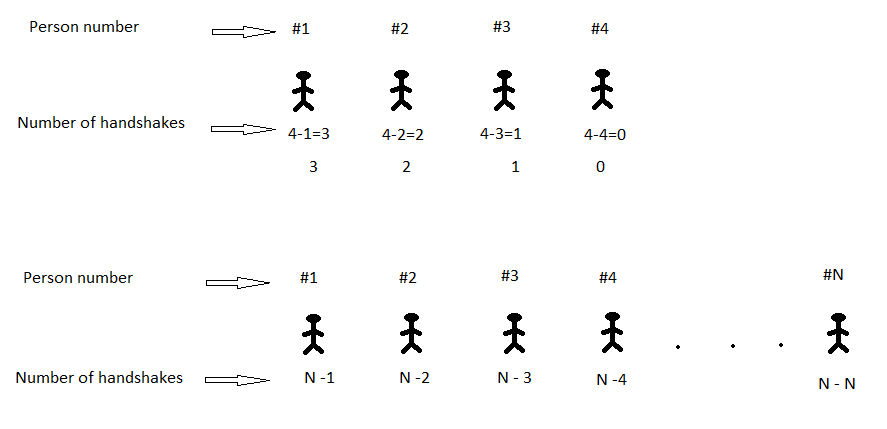
To get out of the confusion state, two things could be helpful. First, it’s a diagram of people standing in line waiting to be handshaked, and a little bit more details on how the 1/2 * (N – 1) * N formula was derived.

Looking at the diagram with four people in line we can see that the total number of handshakes is 3 + 2 + 1 + 0 = 6. Now, if we take N people in line as in the book’s example, then the first person in line is a1 = N – 1 , and the last person in line an = N – N, and the total number of people in line is N. Then substituting these numbers into the general formula for the sum of arithmetic sequence we got:

Sumn = 1/2 * n * (a1 + an) = 1/2 * (N – 1 + N – N) * N = 1/2 * (N – 1) * N

This is how the formula in the book was derived.

This post is not the last one, since I have not finished reading the book yet. There are more to come.

Infinite Powers to explain

This post continues a series of post were I provide my thoughts on books that I deem worth reading.

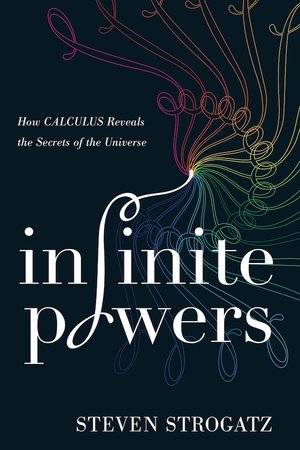
This time it is the Infinite Powers book by Steven Strogatz that takes the reader into a realm of taming infinity to grasp nature’s secrets. The title of the book ambiguously plays on a method of using power series to approximate curves and powers which such a method, when exercised skillfully, brought to humankind. The book artfully describes how deferential and integral calculus was developed from Archimedes efforts to measure quadrature of curves through Descartes and Fermat, culminating in calculus invented by Isaac Newton in England and Gottfried Wilhelm Leibniz in Germany working independently. Lots of examples are provided showing how calculus is essential in many of inventions that are an important part of the modern civilization, be it GPS navigation, microwave ovens or the development of effective treatments to viruses induced diseases.

The power of insight

What I liked about the book is how the author is capable of explaining mathematical concepts, that usually require a solid mathematical background, mostly using analogies and down to earth explanations. Though, what I also liked that a mathematically inclined readers were not ignored, since what could, possibly, explained using proper mathematical notation was described as such. It is difficult to appreciate the beauty of calculus without using the mathematical symbols standing for derivative (differentials) and integral, that are so familiar to many people. I should say any person who studied at school should be familiar with them, and if not, the book provides a gentle and very intuitive explanation of what derivative stands for and why it is required, the same goes for integral.

As an example of a good explanation, I want to emphasize a Pizza Proof that is used to find an area of a circle. Since I recalled the formula for it being A = pi * R2, it was very interesting to see how the Pizza Proof showed clearly that A = R*C/2, where R is a radius of a circle and C its length. I think since school time I was curious where the power of two came in the area formula that I remembered. So, using the Pizza Proof result and substituting the C in it with the known formula for the length of the circle which is C = pi * 2R (which derivation was also explained in the book ) we get A = pi * R2. It was a nice insight, first one of many that the book provided.

I also liked how the method used by Fermat to find the maximum value of a curve, using a smart approach of double intersection, provides a correct result similar to what using derivatives would give. Another example, that was also insightful showed how the concept of derivative and curve interpolation could be used to find patterns in the seasonal changes of day length compared to the rate of change of day length, which both could be approximated by a sinusoidal function with a quarter cycle shift (pi/4 phase shift).

One can’t explain math without using it

Importantly, the concept of derivative was developed and shown very clearly using proper mathematical notation which should be clear even to readers coming from non-mathematical background, since the explanations gradually and systematically build up from simple to more advanced, as a reader progresses through the book (which means that the book should be read continuously). Then the concept of integral is shown quite remarkably well and the two concepts combined to showcase the Fundamental Theorem of Calculus about the duality of derivatives and integrals.

As I always mention, this book passes the test of providing references to other resources on the subject, like original papers of Newton or The Archimedes Palimpsest, which I was unaware of before reading the book.

Summary

It could be that reading Infinite Powers would provide your with appreciation of how calculus is essential in our day to day life and understanding of the world around us. And, maybe, show why mathematics could be beautiful in its own way and also applicable and useful, which could be an unexpected revelation to some.

Other resources

The books’ stack is changing

And so it continues…

This is a quick update on the status of the stack of the books I am reading. I am glad that it’s changing and worrying that its size remains the same overtime. The issue is, as I already mentioned in other posts, good books reference other good books and here we go. This time the culprit was Mind and the Cosmic Order book by Charles Pinter that mentioned the Selfish Gene and the ‘meme’ term created by Richard Dawkins. I have to say that I’ve heard about this book a long time ago, but never thought it was worth reading. But since a number of authors respected by me mentioned it I could no longer skip reading in. I should also mention that David Deutsch mentioned the meme term, coined by Dawkins, in his The Beginning of Infinity book. So did Jeff Hawkins in his recent A Thousand Brains book.

By the way, did you know that the preface to Jeff Hawkins’ book was written by Richard Dawkins?

The books that were on the stack physically or virtually since the last time

  • Mind and the Cosmic Order by Charles Pinter (A Book of Abstract Algebra brought me here)
  • The Right Kind Of Crazy by Adam Steltzner (well, have you heard about Curiosity and Perseverance?)
  • The Interstellar Age : Inside the Forty-Year Voyager Mission by Jim Bell (courtesy of watching a documentary on YouTube)
  • A Thousand Brains: A New Theory of Intelligence by Jeff Hawkins (following him since 2004)
  • Extraterrestrial: The First Sign of Intelligent Life Beyond Earth by Avi Loeb (a Google suggestion)
  • Unknown Quantity by John Derbyshire (I read the Prime Obsession so it was a natural continuation)
  • All Things Being Equal by John Mighton (was referenced by Anders Ericsson in his book on expertise )

Currently in progress

Infinite Powers by Steven Strogatz (well his text book on dynamic systems is a culprit). With regard to Steven Strogatz I want to mention his article he wrote for the Notices of the American Mathematical Society in 2014. In this article he descried tips on successful popular-science writing.

Writing about Math for the Perplexed and the Traumatized

Next to be popped from the stack

Selfish Gene by Richard Dawkins (mentioned by David Deutsch, Jeff Hawkins, Charles Pinter and others)

Rest of the stack

  • A Book of Abstract Algebra by Charles Pinter (Unknown Quantity sparked an interested in abstract algebra in me)
  • Number-Crunching by Paul Nahin (Paul Nahin’s book about Oliver Heaviside brought me here)
  • Discreet Mathematics by Lovasz, Pelikan and Vesztergombi (bought as a used book in 2014 while roaming in US, New Hampshire)
  • Applied mathematics by J. David Logan (who can resists math?)
  • Mathematical Modeling by Mark M. Meerschaert (the same as above)
  • The Mathematical Experience by Davis Hersh ( bought as a used book in 2014 while roaming in US, New Hampshire )

Why random reading could be useful

Random thoughts on a reading process

I have to confess I am an obsessive reader. I like books, I like to read them a lot, I like to read them daily. It seems like the most efficient way of reading books or doing other tasks is doing it in a sequential way, where each book completed before the next one is read. The issue is that I cannot help, but defy this approach. I can read a number of books in parallel, jumping from one to another and returning back again. I also can be distracted by a reference to a different book, and so it goes.

Now, we may ask is there any point is such haphazard reading, where the focus is constantly lost, things and thoughts are getting mixed? Personally, I do not find this confusing or disorganizing, but actually, I see some merit in this approach. First, you do not get bored and have some fresh point of view when you return to a book (if you remember where you’ve left last time). Second, since good books are just like candies, it’s difficult to decide where to start, what have next and when to finish.

Stack overflow of the books

Having described my non-linear approach to reading I should mention that nevertheless, on average, I usually able to read 1.5 books a month. This is nice, but there are a couple of books that are still in the stack and they tend to overflow it. There is this book What’s Math Got Do With It by Jo Boaler, then there is The Fabric Of Reality by David Deutsch, underneath is the Unknown Quantity by John Derbyshire. Further below is All Things Being Equal by John Mighton, traveling by US post is a Number-Crunching: Taming Unruly Computational Problems from Mathematical Physics to Science Fiction by Paul Nahin, and last but not least is infinite powers by Steven Strogatz.

Speaking of Steven Strogatz book. Last year I was looking for a good book on applied mathematics and stumbled upon Nonlinear Dynamics and Chaos: With Applications to Physics, Biology, Chemistry, and Engineering which is very good. Then I checked other books Steven wrote and found that in addition to textbooks he also wrote a number of popular science books. One of them was infinite powers. It is enough to read just a few pages of this book to understand that it’s a pure gem in the world of popular science books and if you’d like to really get a good understanding of what differentiation and integration is without going directly to a calculus course then this book may be of interest to you. When I finish reading it, I’ll write a more extensive review of the book.

Random walking

For now, keep reading and try reading sequentially, otherwise start a random walk. Who knows what you stumble upon and where it take you.

Good books come in tuples

This post continues a number of post were I kind of reviewed books that I read and thought it would be helpful to share them with other readers. All Things Being Equal: Why Math Is the Key to a Better World by John Mighton is such a book that deserves to be shared and read by people who care about math education, their children’s math education and math in general. The title of this post is not a mere gimmick, but it means that good books always mention or reference other authors or books that worth reading. This is what exactly happened when I read the book by Anders Ericsson that I mentioned in the previous post. In the Peak Ericsson mentioned John Mighton a Canadian mathematician that incorporated elements of deliberate practice with clear goals and problems that had increasing level of difficulty to teach math to children. This approach is now known as JUMP Math and it is taught to thousands of kids helping them master mathematics while enjoying the subject, unlike in the usual way math is taught in schools.

What is so interesting about this book?

I am past 1/3 of the book, and so far I wasn’t disappointed. The book itself is not only about teaching math to kids. John Mighton discussed also psychological approaches, such as a research into Expertise that plays important role in education in general and in math in particular. He also provides us with an interesting observation that usual math education results in the same distribution of grades among pupils of public schools and among pupils in private schools. It worth mentioning, intellectual poverty a term he coined to emphasize that even though there is a research in to expertise that resulted in clear guidance on how to effectively approach teaching, we as a society still do not incorporate this approach, and what we get is a suboptimal outcome, where kids dislike math, since they think they are not good at it, they have no innate ability or inclination towards it.

Apart from this, John Mighton incorporates a number of examples from math lessons at schools, where he shed light on some of the arithmetic operations that are usually taught as a mere algorithms, without explaining how they work and why. For example, he provides a neat explanation why one could substitute a division of a number by a fraction, by a multiplication of the inverse of that fraction.

Overall

The book is worth reading, since it provides a fresh approach to teaching math to kids and adults alike, in an engaging and exciting way, where kids are gently guided by discovering math step by step, building on the knowledge they gain at a previous step, facing gradually increasing challenges along the way.

Unknown Quantity is a math book to work through

This post is similar to my other posts on books I read or am in the process of reading. This time it is second book by John Derbyshire I read on mathematics. The previous book Prime Obsession was an inspiring, interesting and a pleasure to read, since it was all about the Riemann hypothesis. It took me though a little effort to not only read it, but also work through author’s explanations.

So this second book is called Unknown Quantity and it is as captivating as the Prime Obsession was. What is different about the Unknown Quantity that it has more of a historical context on how algebra developed from ancient Mesopotamia to our days.

What I like the most about how John explains mathematical topics in his books is the way he is capable of explaining mathematics the way I never experienced in a school or later in a college. Most of the time math was taught as a given, without trying to convey the essence of the subject, why this formula such and such, how it was conceived and developed. In my opinion, these are very important questions, if not the most important in mathematics. Questioning and curiosity are crucial in mathematical research.

For example, in the Unknown Quantity John shows with enough details how general solutions to second, third and forth degree equations were developed. Why determinant is useful in solving systems of linear equations and why it is important in matrices. These are only some examples, since I haven’t yet finished reading the book.

In short, if you are curious about algebra, and want to know how it evolved historically, and also get some new insight about math you were taught, but never really understood, then the Unknown Quantity is the book for you.

Prime Obsession with Math

Meet the math book you’re were craving for so long

If you are interested in math and like to have your hands dirty in nitty gritty calculations then the Prime Obsession book by John Derbyshire is just for you. Unlike other popular books on mathematics it provides a gentle and powerful introduction to all math you need to know to understand the Riemann Hypothesis (RH). Reading, I should say, working through the book you’ll learn about interesting properties of Prime Numbers, meet the Prime Number Theorem (PNT) and really understand what the Riemann Hypothesis is all about. In this book you’ll meet Gauss, Euler, Riemann, Hilbert and other renowned mathematicians that influenced the development of mathematics.

What I find most useful about this book

There are books that require a discipline to read through, there are books that are plain boring, and there are books that excite you and your imagination, books that you can’t help, but continue reading more and more. The Prime Obsession is of the latter kind.

What I most like about the book is the historical context John Derbyshire provides throughout the book in addition to his sense of humor and his ability to explain required math in a way that each mathematically inclined person can get fast. I should mention, that having an engineering degree could speed up you understanding significantly, but strictly speaking, it is not required.

In addition, the references to other books on mathematics that John provides are very useful and may provide you with additional materials to digest, like the Hardy’s A Course of Pure Mathematics.

Where to get the book?

Surely, the easiest way to get the book is to buy a copy of it in a Kindle format or a print one. I bought a used one quite cheaply, for less than a Kindle book, which generally cheaper than a hard copy. An old fashion way would be to go to a nearest library and fish for the book their.

Mathematical Modeling

A new math book each blog-post 

There are quite a few books on mathematical modeling available out there, but I want to literally and figuratively focus  on a single one, which is Mathematical Modeling by Mark M. Meerschaert.

First, a number of details about the author of the book. Mark Meerschaert is  a University Distinguished Professor in the Department of Statistics and Probability at Michigan State University. He authored a number of books among them the Mathematical Modeling.

What is special about the book?

I have a third edition of the book and I want to provide some thoughts about it. Personally, I like books that provide detailed explanations and ample of examples accompanying the theoretical parts of the book. In my opinion, author’s own view on the subject phrased in his own words, instead of strict adherence to formal definitions is a valuable aid in comprehending mathematical theory.

As for the content of the book, it is divided in three parts which reflects the fact that most of the mathematical models fall into three types 

  • Optimization Models
  • Dynamic Models 
  • Probability Models

Each chapter in the book has detailed examples and quite a few exercises for the reader to tackle. What is also nice that the book is quite practical and have examples from various fields of science and engineering.

References

mark