In the age of GenAI tools dominance it is easy to use these tools blindly, without thinking how the tools come up with their answers.
The main issue with treating these tools as a black box is the fact that people learn by making mistakes, while they apply what they try to learn. The problem with GenAI tools is that they give you a complete answer without you exerting any effort in trying to solve the problem on your own. Hence, you miss a critical step in a learning process, which is without a challenge there is no gain.
I can say this based on my own experience with using GenAI tools at work and at home for dozens if not hundreds times a day. The main issue with using GenAI tools at work, such as M365 Copilot Chat and the like, for software development tasks, is what I’ve mentioned above. These tools may give you a complete implementation that works, but you don’t learn anything new as a result, since you don’t try to implement that same thing on your own.
A good example, can be a situation where you’d like to have a Python script that can transform data from one format into another. Recently, I needed to transform an OWASP Dependency Check plugin JSON report into a more user friendly format, specifically into a CSV file (aka Excel) to be able to see security vulnerabilities at a glance and to be able to sort them by the NVD last updated date.
To write such a script in Python would take me some time for sure. For I need to understand how to parse JSON file, extract various fields and then write the data in to CSV file. I had a bright idea to use GenAI to do it quickly to save time and effort. Indeed, after a few back and forth iterations with M365 Copilot Chat I had a working Python script that delivered what I needed, without me even looking into the implementation. It was what I’ve mentioned a black box treatment of the GenAI response. It worked and I didn’t care how. But, the main point was, that I didn’t learn anything in the process and felt actually as I was cheating.
I needed to update the script in the end, so I did indeed look at the implementation. And it took me some time to figure out how it worked. It was written well and in a modular fashion. But, I think I’d never do it in a similar way as a GenAI model did. I was able to understand and adapt the code enough for it to work, but it didn’t work quite well. So, I said to myself, well it’s time to save my effort and asked GenAI to refactor it, which it did correctly first time.
So, in the end, I did save time on that script, and I did learn how it worked, since I was curious, but I didn’t get the same amount of experience, should I implement it on my own from start to finish.
In this case, I am not talking about GitHub Copilot, for I don’t use it currently. But, even using free GenAI tools can be harmful in the long run, if you treat them as black boxes, instead of tools that help you think better. They cannot substitute thinking, for then you become dumber in the process.
Also, with recent improvements in Anthropic Claude agents, people such as Andrej Karpathy state that we are in the new era of software programming. It sounds that it’s a valid statement to make, since he’s not the only one noticing this change in performance of GenAI agents, but the crucial point is that people who didn’t have software programming experience before starting to use such tools will certainly have a gap in programming skills, for they didn’t face challenges that taught them how to really think. Karpathy is a good example, since he was a programmer before GenAI tools where on the horizon.
In the end, GenAI tools can be very helpful and effective in helping you learn whatever topic you want, but they can be as effective in preventing you from gaining valuable experience while you master the subject.
If you have some basic background in programming, or even if you don’t, but want to get some then you can turn to chatbots and in particular to Windows Copilot (I’ll refer to it as Copilot for shortness). You can use Gemini, ChatGPT, Claude etc. if you prefer, and they’ll be as useful. This is what I did just recently when I stumbled upon a post by Dave Plummer at X, where he talked about the need for programmers to understand how compilers produced their output, hence the need to know assembly language. By the way, Dave Plummer developed Windows Task Manager when he was a programmer with Microsoft . He has a YouTube channel where he posts interesting videos related to programming.
Why chatbots can be helpful in this case? First, if you didn’t program in assembly before it can be difficult to approach it. Second, chatbots are very helpful in explaining existing code in any programming language they had in their training data. And, I guess, it means it should know details about most modern programing languages.
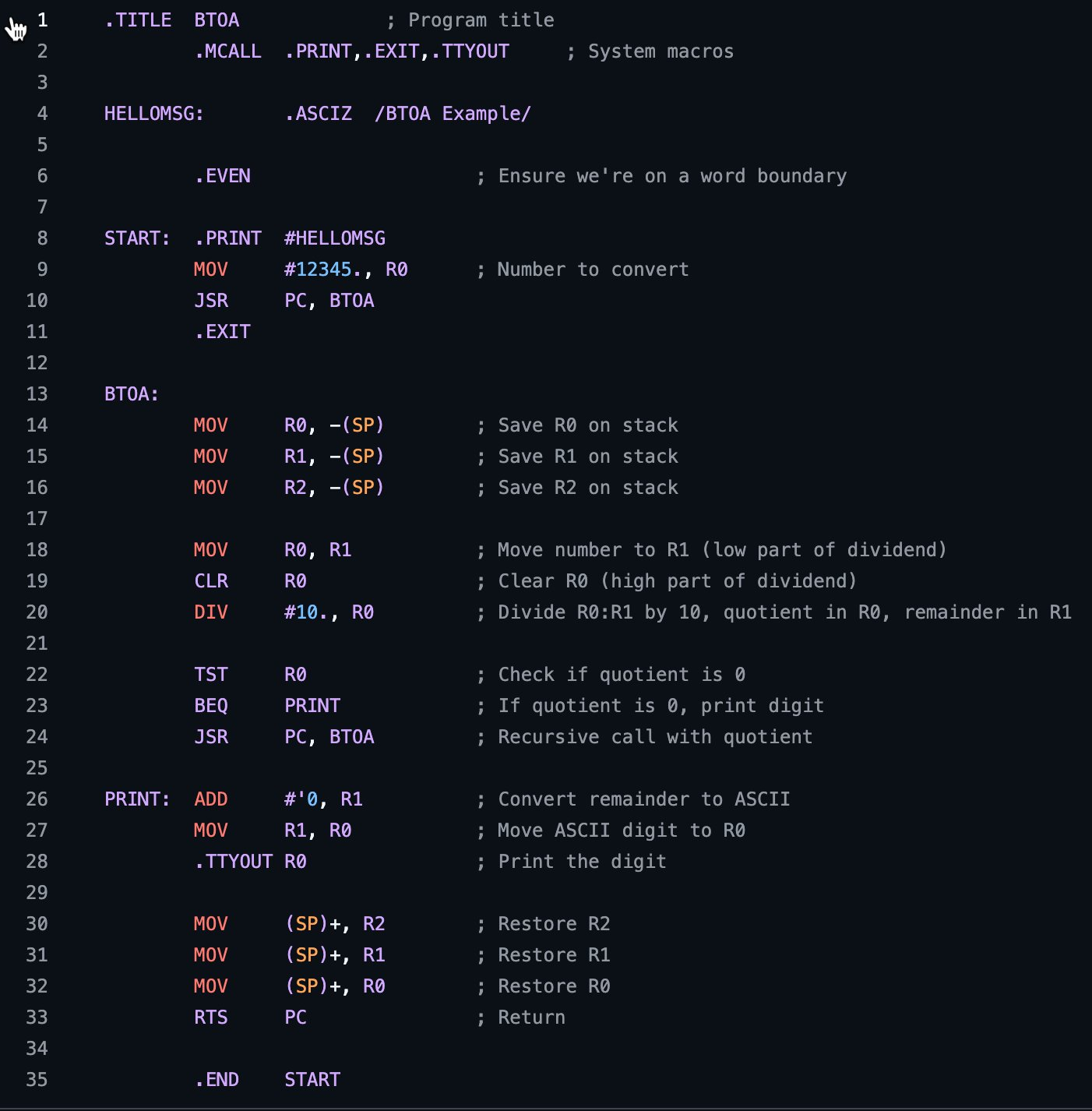
Well, next I’ll provide a screenshot of that post, then I’ll show you that chatbot can transcribe the code from an image alone and explain what we are looking at there. The short summary is that post was about binary to ASCII (BTOA) conversion program written in PDP-11 computer assembly. By the way, all these details where extracted by Copilot from the code in the image. Then, I’ve used Copilot to explain to me in detail how the code works to get full understanding of it.
Pay attention, that I use line separator to mark when the response from chatbot has finished.
Original post
I suppose there's a whole class of programmers for whom a compiler is akin to magic, but knowing what's getting emitted and how it works is fundamental to your success over the long haul.
I suppose there’s a whole class of programmers for whom a compiler is akin to magic, but knowing what’s getting emitted and how it works is fundamental to your success over the long haul. Write some assembly. Read the Dragon book on an airplane. AI will still be here when you get back. In five years, anyone capable of structured thought will be able to become a prompt engineer, but only 1% of software developers will actually be able to debug the stuff that comes out the other end. Be the 1%
What did I do next?
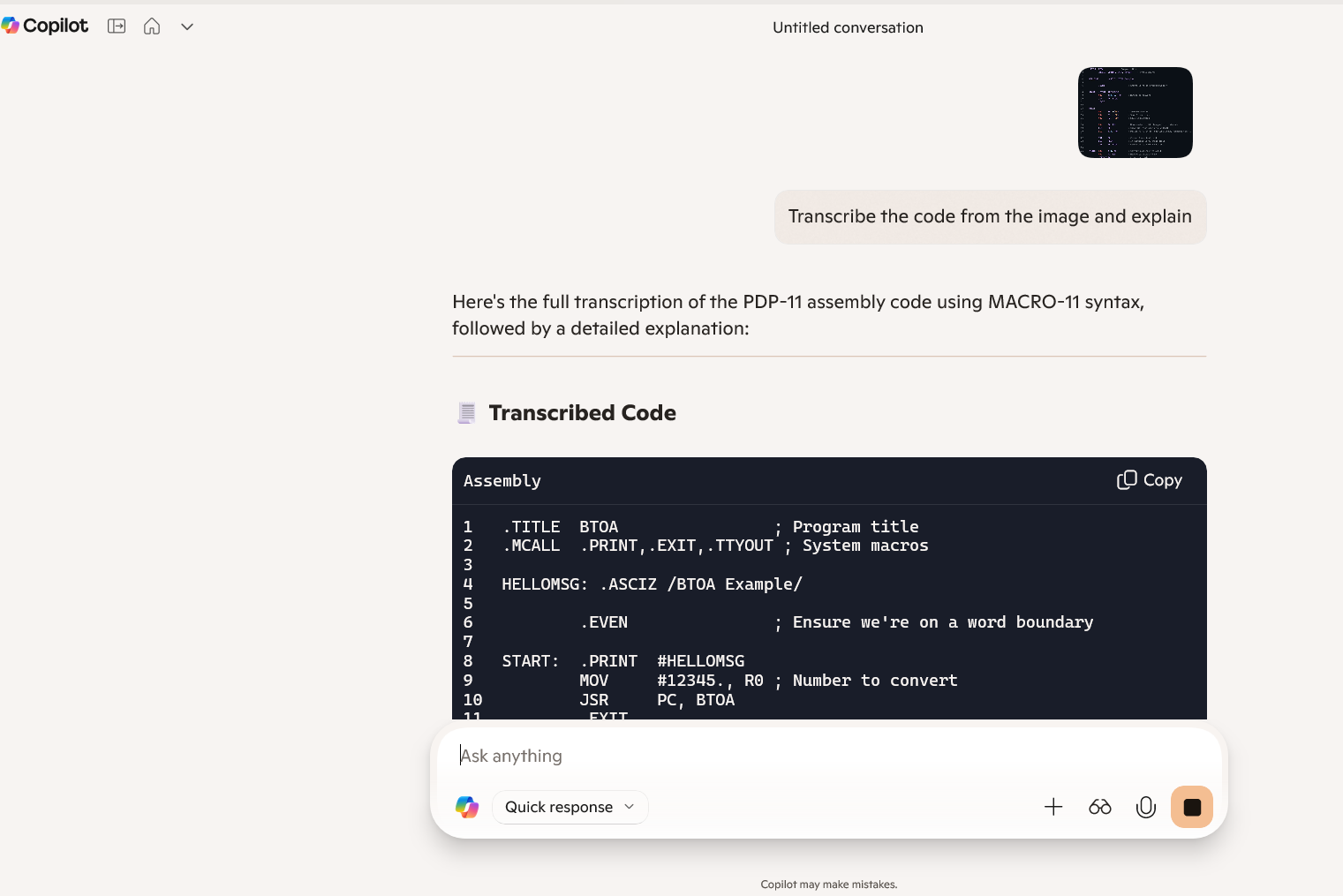
As I’ve mentioned I’ve copy and pasted the image in Copilot and asked it to transcribe the code from the image and explain what it’s doing.
Prompt: Transcribe the code from the image and explain (an image was attached as can be seen in the screenshot below). Response:
Below comes a full response.
Here’s the full transcription of the PDP-11 assembly code using MACRO-11 syntax, followed by a detailed explanation: Transcribed Code
.TITLE  BTOA                ; Program title
.MCALL  .PRINT,.EXIT,.TTYOUT ; System macros

HELLOMSG: .ASCIZ /BTOA Example/

        .EVEN               ; Ensure we're on a word boundary

START:  .PRINT  #HELLOMSG
        MOV     #12345., R0 ; Number to convert
        JSR     PC, BTOA
        .EXIT

BTOA:
        MOV     R0, -(SP)   ; Save R0 on stack
        MOV     R1, -(SP)   ; Save R1 on stack
        MOV     R2, -(SP)   ; Save R2 on stack

        MOV     R0, R1      ; Move number to R1 (low part of dividend)
        CLR     R0          ; Clear R0 (high part of dividend)
        DIV     #10., R0    ; Divide R0:R1 by 10, quotient in R0, remainder in R1

        TST     R0          ; Check if quotient is 0
        BEQ     PRINT       ; If quotient is 0, print digit
        JSR     PC, BTOA    ; Recursive call with quotient

PRINT:  ADD     #'0, R1     ; Convert remainder to ASCII
        MOV     R1, R0      ; Move ASCII digit to R0
        .TTYOUT R0          ; Print the digit

        MOV     (SP)+, R2   ; Restore R2
        MOV     (SP)+, R1   ; Restore R1
        MOV     (SP)+, R0   ; Restore R0
        RTS     PC          ; Return

.END    START
🧠 Explanation
This program converts a binary number (in this case, 12345) to its ASCII decimal representation and prints it to the terminal.
🔹 Header and Setup
.TITLE BTOA: Sets the title of the program.
.MCALL .PRINT,.EXIT,.TTYOUT: Declares macros for printing, exiting, and terminal output.
HELLOMSG: .ASCIZ /BTOA Example/: Defines a null-terminated string.
.EVEN: Ensures the next instruction is aligned on a word boundary.
🔹 Main Routine (START)
.PRINT #HELLOMSG: Prints the greeting message.
MOV #12345., R0: Loads the number 12345 into register R0.
JSR PC, BTOA: Calls the BTOA subroutine to convert and print the number.
.EXIT: Ends the program.
🔹 Subroutine (BTOA)
Saves registers R0, R1, and R2 to the stack.
Sets up for division: moves the number to R1, clears R0 to form a 32-bit dividend.
DIV #10., R0: Divides R0:R1 by 10. Quotient goes to R0, remainder to R1.
TST R0: Tests if quotient is zero.
If yes, go to PRINT.
If not, recursively call BTOA with the quotient.
PRINT: Converts the remainder (digit) to ASCII by adding '0', then outputs it using .TTYOUT.
Restores registers from the stack and returns.
This recursive approach ensures digits are printed in the correct order (most significant to least significant). Would you like to see how this would look in C or another language for comparison?
Let’s try to understand how it works in more detail.
Question: First of all, what is BTOA?
Response:
Great question! 🧠
BTOA stands for Binary To ASCII. It’s a common abbreviation used in programming to describe the process of converting a binary (or numeric) value into its ASCII character representation, typically for display or output purposes.
🔍 What does “Binary to ASCII” mean?
Binary: In this context, it refers to a numeric value stored in binary format (e.g., the number 12345 in machine-readable form).
ASCII: The American Standard Code for Information Interchange — a character encoding standard that maps numbers to printable characters like '0' to '9', 'A' to 'Z', etc.
Okay, now that we know what that mysterious BTOA was how about we understand what happens inside this block of code that resides inside the BTOA function?
        MOV     R0, R1      ; Move number to R1 (low part of dividend)
        CLR     R0          ; Clear R0 (high part of dividend)
        DIV     #10., R0    ; Divide R0:R1 by 10, quotient in R0, remainder in R1

        TST     R0          ; Check if quotient is 0
        BEQ     PRINT       ; If quotient is 0, print digit
        JSR     PC, BTOA    ; Recursive call with quotient
Also, before jumping to Copilot for help we can see assembly language program that is doing some computation using registers in CPU such as R0 and R1. We can see the data is moved, cleared, a division is done and then there is a conditional logic on lines 5, 6 and 7. In the screenshot it corresponds to lines 22, 23 and 24.
So what is the explanation ? Response:
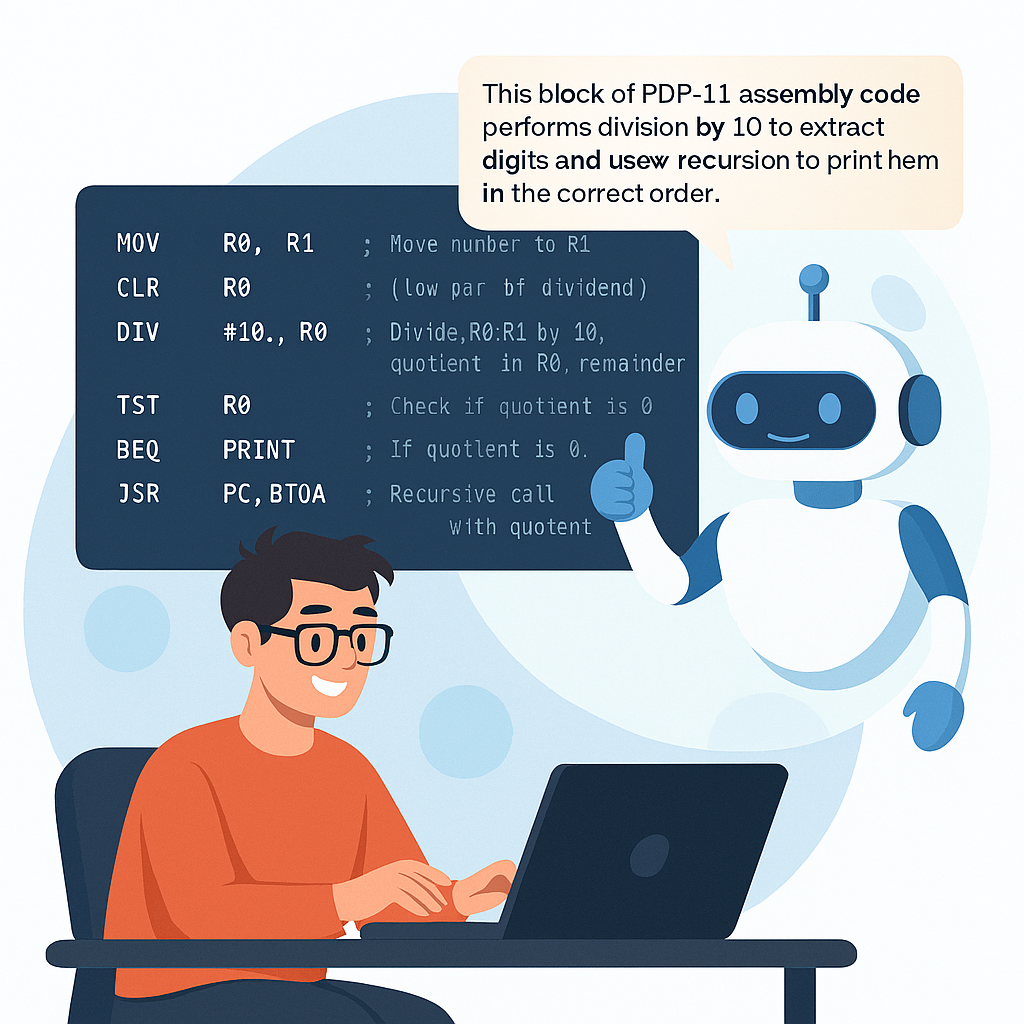
This block of PDP-11 assembly code is the core of the binary-to-ASCII conversion logic. It performs division by 10 to extract digits from a number and uses recursion to print them in the correct order. Here’s a breakdown of each line:
🔍 Line-by-Line Explanation
18 MOV R0, R1 ; Move number to R1 (low part of dividend)
Copies the number from R0 to R1.
This sets up the 32-bit dividend for division: R0:R1 (high:low).
19 CLR R0 ; Clear R0 (high part of dividend)
Clears R0 to zero.
Now the full dividend is 0:R1, effectively treating the original number as a 32-bit value with high word = 0.
20 DIV #10., R0 ; Divide R0:R1 by 10, quotient in R0, remainder in R1
Performs a 32-bit division of R0:R1 by 10.
After this:
R0 contains the quotient (i.e., number / 10)
R1 contains the remainder (i.e., number % 10), which is the rightmost digit
22 TST R0 ; Check if quotient is 0
Tests if the quotient is zero.
This determines whether there are more digits to process.
23 BEQ PRINT ; If quotient is 0, print digit
If R0 is zero, it means this is the last digit.
Branches to PRINT to output the digit.
24 JSR PC, BTOA ; Recursive call with quotient
If R0 is not zero, it means there are more digits.
Recursively calls BTOA with the quotient in R0, continuing the process.
🧠 Summary
This block:
Extracts the least significant digit of the number.
Uses division and recursion to process digits from most significant to least significant.
Ensures digits are printed in the correct order by printing only after recursion unwinds.
Conclusion
Well, I guess it clarifies a bit what the code is doing. And you probably got a point of how you can use a chatbot to help you understand a piece of code in a programming language you probably never saw and drill down to nitty gritty details of the implementation and really understand how it works.
In this post I’d like to provide a short example of how chatbots, in particular Windows Copilot, can help you address issues related to web browsing, programming, reverse engineering, intelligent internet searching (aka semantic searching) etc.
The issue
In this case I wanted to check what sci-fi writer Pavel Amnuel had on his website. Even though that website looks dated and it is, the information it contains is still relevant to this day. There you can find his essays on hard science fiction, a “A Course of Lectures on TRIZ and the Development of Creative Imagination (PTB)” and more.
That course on Development of Creative Imagination consists of thirteen parts, and it turns out that the 11th one has incorrect encoding and looks like this at the time of writing
So, what I did I’ve posted a part of it in Windows Copilot and asked about the encoding issue. It came up with a correct explanation right away.
prompt: fix encoding of this text …
response: The text you’ve provided appears to be Cyrillic text misinterpreted as Latin characters due to incorrect character encoding. Most likely, it was originally written in Russian using Windows-1251 encoding, but then read or displayed using Windows-1252 (Latin-1) or UTF-8 without proper conversion.
🔍 Correct Encoding: Windows-1251 (Cyrillic)
When decoded properly, the text reads as: РТВ — ЭТО ОЧЕНЬ ПРОСТО! Г. Альтшуллер Курс лекций по развитию творческого воображения и теории решения изобретательских задач для начинающих. (Proverb 11)
В тексте есть некоторые задачи по ТРИЗ из РТВ, из книг и статей Г.С. Альтшуллера, Б.Л. Злотина, А.В.В. Асмана и других авторов.
🛠 How to fix encoding issues
If you encounter similar garbled text:
Identify the original encoding — in this case, Windows-1251.
Use a text editor or converter that allows you to change encoding (e.g., Notepad++, Sublime Text, iconv).
Convert from Windows-1251 to UTF-8 to make it readable across modern systems.
Would you like me to help you convert a file or more text like this?
I’ve tried a couple of approaches, again, using Copilot’s assistance. In the end what I’ve ended up doing is saving the page as html file and updating the headelement with the following meta tag below which provided correct Cyrillic encoding instead of the Latin one.
<meta charset=”windows-1251″>
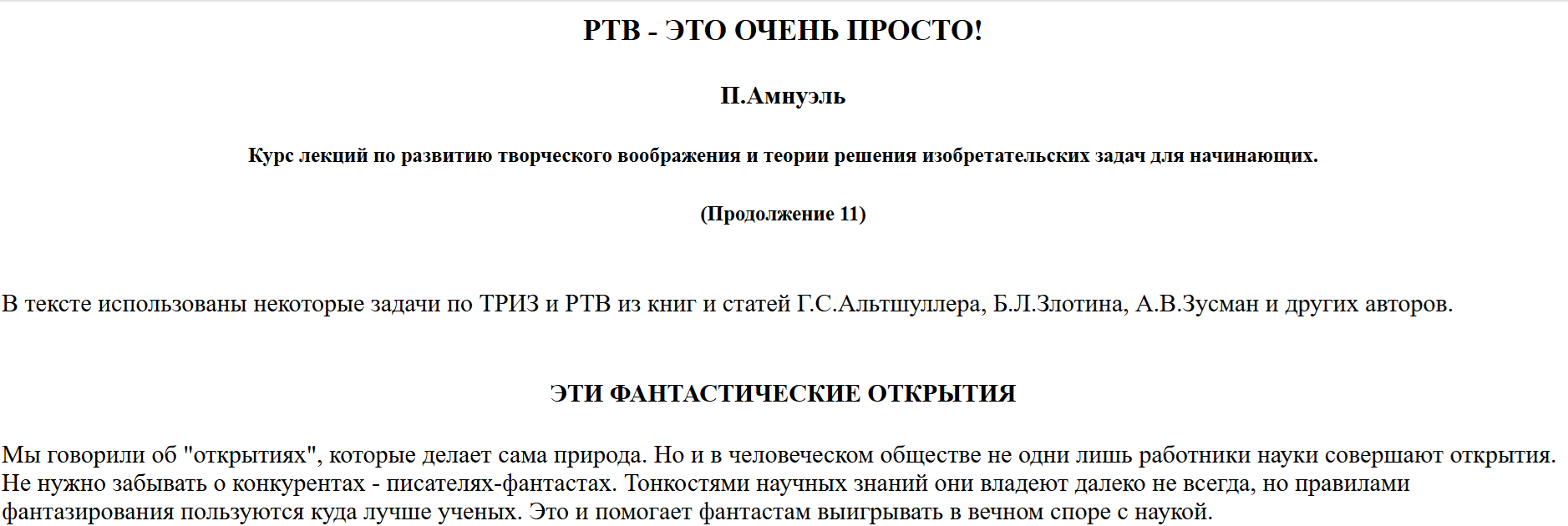
This is how the properly encoded version looks like
I’ve also notified the author about this issue, and hopefully, by the time you are reading this post it will be fixed already.
Bonus
One more thing, if you’ve noticed the link to Pavel Amnuel’s website opens that page in English. This is no coincidence. The page is originally in Russian, but Copilot helped me to discover that Google Translate allows to translate a web page into a specific language and get a link to that translated page. How neat is that?
prompt: I mean I need a link that I can share after it was translated response: Ah, got it! You want a sharable link to the translated version of the page. Here’s how to do that using Google Translate:
Can be shared with anyone — they’ll see the English version of the Russian page
Translates the page from Russian (sl=ru) to English (hl=en)
Automatically opens the translated version in Google Translate
By the way, while on that website you can right click on the mouse button and translate any of the articles into English. Nowadays, translations are of a very high quality. Also, I saw that when you navigate to a translated page link, other linked pages are translated automatically!
Summary
Here you have it Windows Copilot or any other similar tool can do wonders if you ask it to help.


 ScienceAppliedForGood