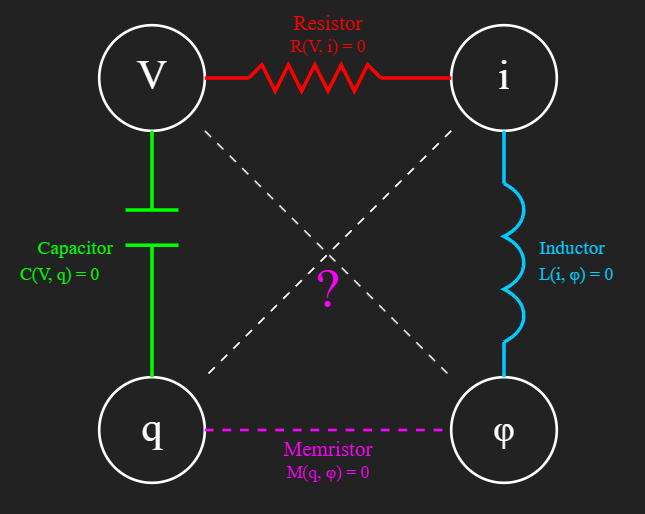
As it sometime happens to me while I was checking what’s new on YouTube the suggestions algorithm had a video about Memristorwhich was a forth basic electrical element that had a memory in it. While I was watching that interesting video that was created by prof. Giordano Scarciotti I saw the symmetry diagram that prof. Leon Chua came up with back in 1971. In that paper he proposed Memristor as a missing fundamental component in electrical circuit theory. So, what’s interesting about that diagram that it very much resembles diagrams in Category Theory.
Next, I’ve used Windows Copilot to elaborate on that idea. Chatting with it back and forth resulted in the blog post below:
Introduction
When we first learn electronics, we’re introduced to three fundamental passive elements: the resistor, the capacitor, and the inductor. Each one ties together two physical quantities:
Resistor: relates voltage V and current i.
Capacitor: relates voltage V and charge q.
Inductor: relates current i and magnetic flux φ.
But in 1971, Leon Chua predicted a missing fourth element — the memristor — which connects charge q and flux φ. This completed the symmetry among the four fundamental electrical quantities.
🔎 Constitutive Relations and the “=0” Notation
In advanced circuit theory, each element is defined by a constitutive relation: a constraint between two variables. Instead of writing explicit formulas like Ohm’s Law (V = R·i), theorists often use an implicit form:
Resistor: R(V, i) = 0
Capacitor: C(V, q) = 0
Inductor: L(i, φ) = 0
Memristor: M(q, φ) = 0
This doesn’t mean resistance is zero. It means: the pair of variables must satisfy some relation enforced by the element. For a linear resistor, that relation is V − R·i = 0. For nonlinear devices, the relation could be more complex. The implicit form is powerful because it generalizes to nonlinear, time-varying, and memory-dependent behaviors.
🔄 Symmetry and Completeness
Chua’s insight was that with four fundamental quantities (V, i, q, φ), there should be six possible pairings. Three were already realized by resistor, capacitor, and inductor. The missing link — charge to flux — was filled by the memristor. This symmetry is what makes the framework elegant: every pair of quantities is connected by a constitutive relation.
🧩 A Category-Theoretic Perspective
Here’s where the categorical flavor comes in. The symmetry looks a lot like category theory:
Objects: The four quantities (V, i, q, φ).
Morphisms: The four elements (resistor, capacitor, inductor, memristor).
Composition: Just as morphisms compose in category theory, circuit elements combine to form networks.
Commutativity: The square diagram commutes: L ∘ R = M ∘ C meaning that whether voltage is mapped to flux via current (resistor → inductor) or via charge (capacitor → memristor), the structural mapping is consistent.
🖼️ ASCII Diagrams
Fundamental Square of Relations
   V ──R──▶ i
   │        │
   C        L
   │        │
   ▼        ▼
   q ──M──▶ φ
R : V → i (Resistor)
C : V → q (Capacitor)
L : i → φ (Inductor)
M : q → φ (Memristor)
Commutative Diagram
        V
       / \
      R   C
     /     \
    i       q
     \     /
      L   M
       \ /
        φ
Here, the two paths from V to φ are equivalent: L ∘ R = M ∘ C
✨ Why This Matters
Thinking categorically opens new doors:
Circuits can be modeled as categories of physical quantities.
Functorial translations could connect circuit categories to computational categories (logic, automata).
Neuromorphic computing, where memristors play a central role, might benefit from categorical semantics.
The memristor isn’t just a missing device — it’s the morphism that makes the diagram commute, completing the symmetry both physically and mathematically.
🧠 The Main Idea
By reframing Chua’s symmetry in categorical terms, we see circuits not just as physical devices but as mathematical structures. The memristor completes not only the physics of passive elements but also the mathematics of a commutative square.
This perspective — born from blending electronics with category theory — is a fresh, original way of thinking about circuit theory. It shows how abstract mathematics can illuminate engineering, and how symmetry drives discovery.
In this post I’d like to share useful information on how to use LLMs and in particular Windows Copilot powered by GPT-4o (most probably) and GPT-5 models to assist in reverse engineering electronic boards.
So far, I was able to use these models to successfully reverse engineer software projects at work. And over the weekend I was able to apply Windows Copilot to help me reverse engineer a Switched-Mode Power Supply (SMPS) Board from a cheap DVD player I bought a couple of years ago.
The background for this hardware reverse engineering effort was that I bought a DVD player at Amazon to watch a couple of DVDs and listen to CDs I had. I used it a number of times and then didn’t use it for a while. When I tried to power it on a couple of years later it didn’t work. The debugging showed that the capacitor in the SMPS board was leaked. So, I found a similar capacitor (1000 uF, but 10 V max) in one of the old mobile phone charges and replaced it. The DVD started to work again. I’ve documented this process in the YouTube video. The main issue was that I didn’t check what was that capacitor’s maximum voltage. And as I’ve mentioned, it was 10 V. But other capacitors that were filtering the ripple before output were 16 V. I didn’t notice this at the time. So when I tried to use that DVD player later it didn’t start again. I already wanted to throw it into garbage, when I gave it a chance and opened it again. What I saw that the same capacitor that I replaced before leaked too. It turns out there is a need to use a 16 V maximum rated capacitor to account for potential voltage spikes.
This time I was more systematic and started to use Windows Copilot to query for what capacitor I could use in place the leaked one. I had a couple of old mobile phone charges left that I disassembled while looking for a 1000 uF capacitor which I didn’t found in the end. I only had 470 uF ones. But LLM reasonably suggested to use 1000 uF cap, since you can’t replace a capacitor without considering what was its purpose in the circuit. So, I understood that I must follow an advice from the Debugging Rules! book by Dave Agans, first I needed to Understand the System!
Since, I am an electrical engineer by education, I had some background to understand what various components were on the board and what some of them were responsible for. For example, I could see a rectifier bridge (it is used to convert AC current to DC), transformer, resistors, capacitors, chips and more. Which was helpful. If you have no such background, then before attempting a hardware reverse engineering project, you can use LLMs to learn the basics of electronics.
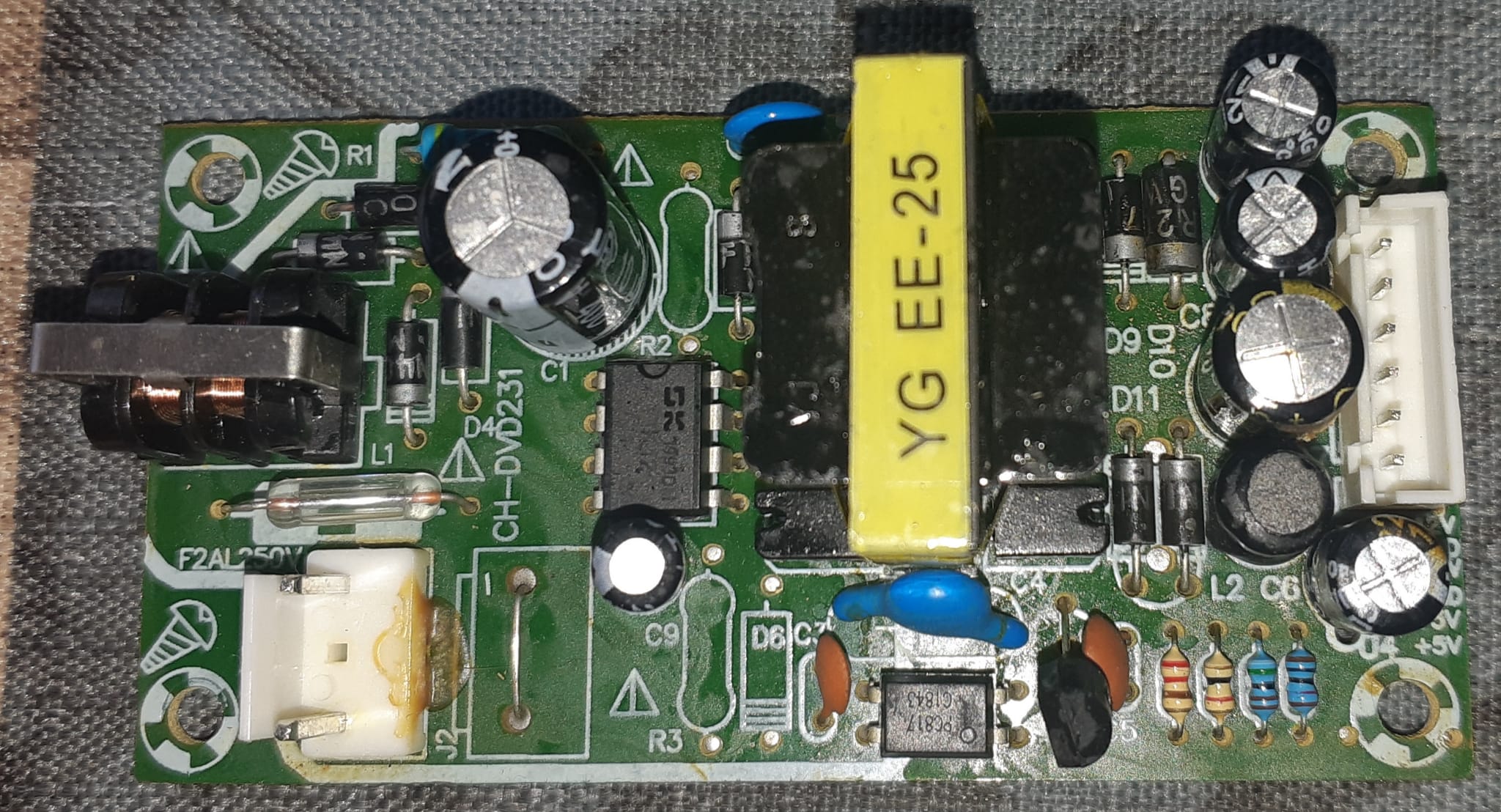
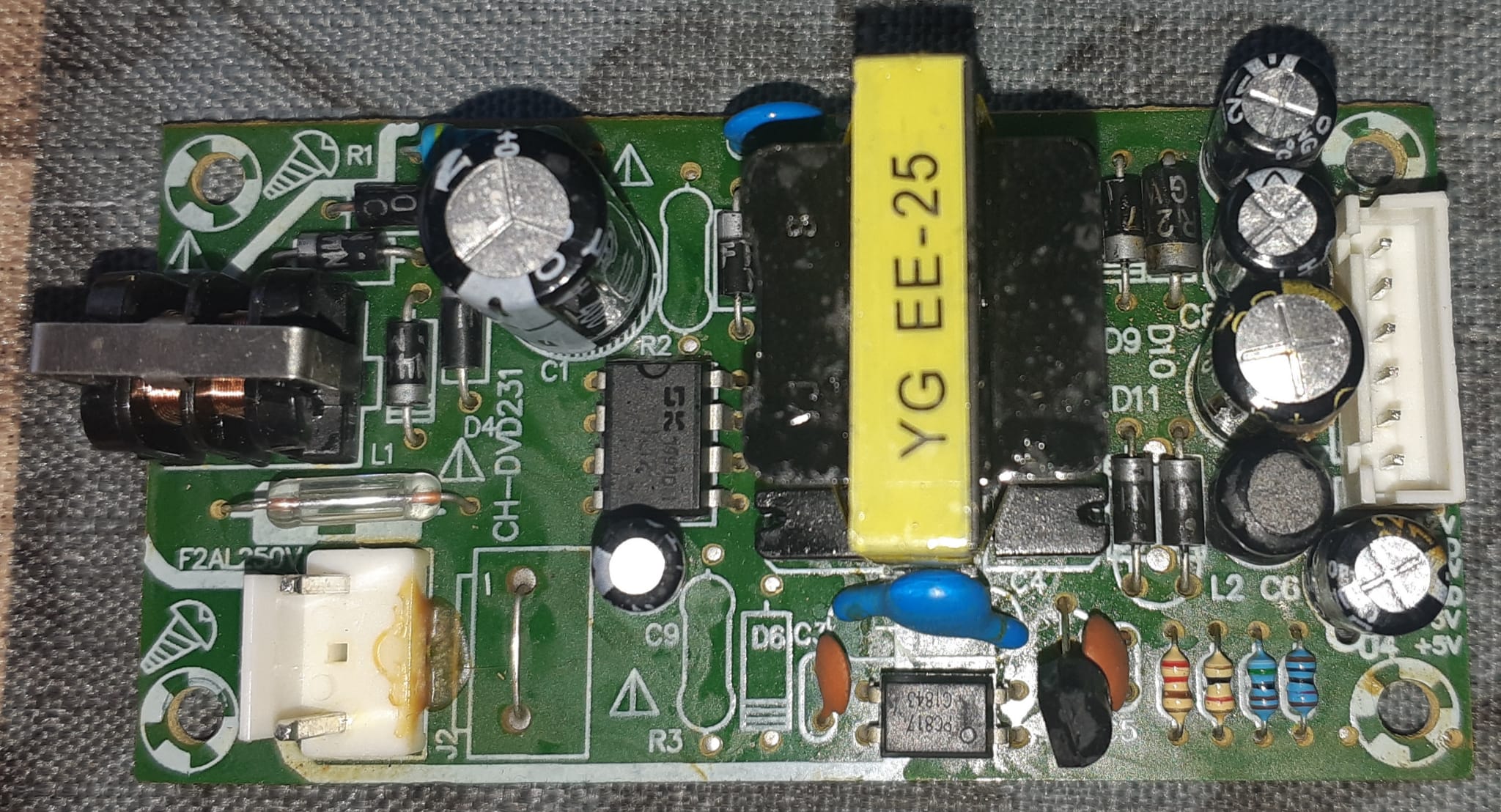
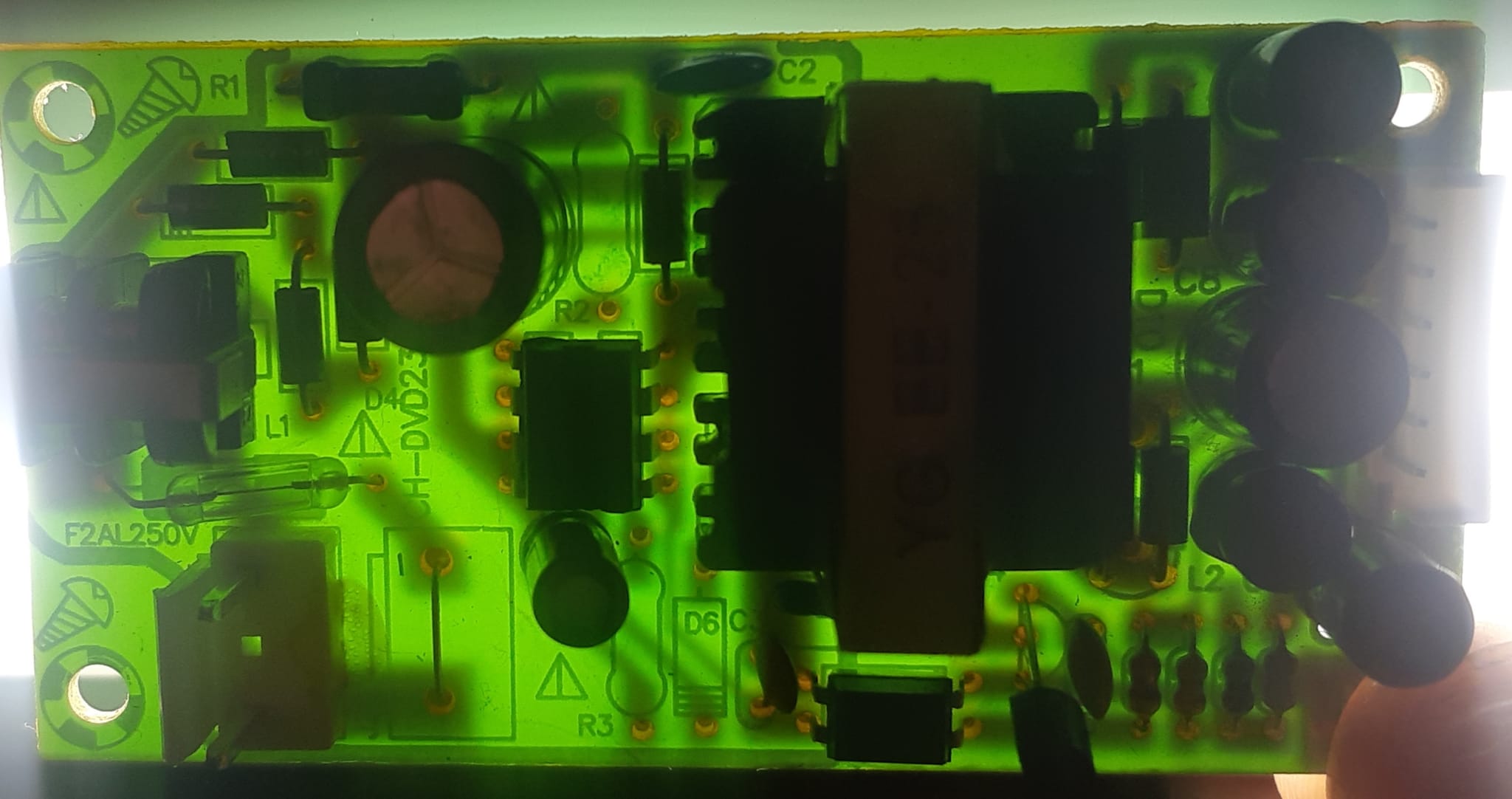
So, the board in question looks like below. First image shows the board from the top, and second image shows the board when it is placed on the lamp and it looks transparent to see the traces (wires) on the back side of it.
So, when you look at the left-hand side part of the left image you can see a white connector which connects to the AC power cord. Then it goes through the fuse just above it and connects to the black choke coils. It in turn connects to a bridge rectifier. Then it goes to a capacitor. After this I didn’t know what the circuit was doing exactly, though I could see a 8 pins Integrated Circuit (IC), a transformer with a yellow tape around it. More diodes, resistors, caps and a white output connector.
What was helpful was that the board had good markings explaining various components. This is a standard engineering practice. For example, R stands for Resistor, L stands for Inductor, C stands for Capacitor, D stands for a Diode, U stands for an Integrated Circuit (chip), Q stands for Transistor, J stands for a Connectors, F stands for Fuse.
I had an idea to upload an image of the board on the left in Windows Copilot and I did just that. GPT was able right away to tell that fuse was there, the transformer was there and it could recognize other parts too. It was also able to understand that it was a Switched-Mode Power Supply of a flyback type. So I started to provide it with information about the capacitor I wanted to replace, in particular that it was connected to the GND output pin. I also provided it with the pinout of the output connector and it was able to infer from it that there were two +5 V pins connected together which was correct.
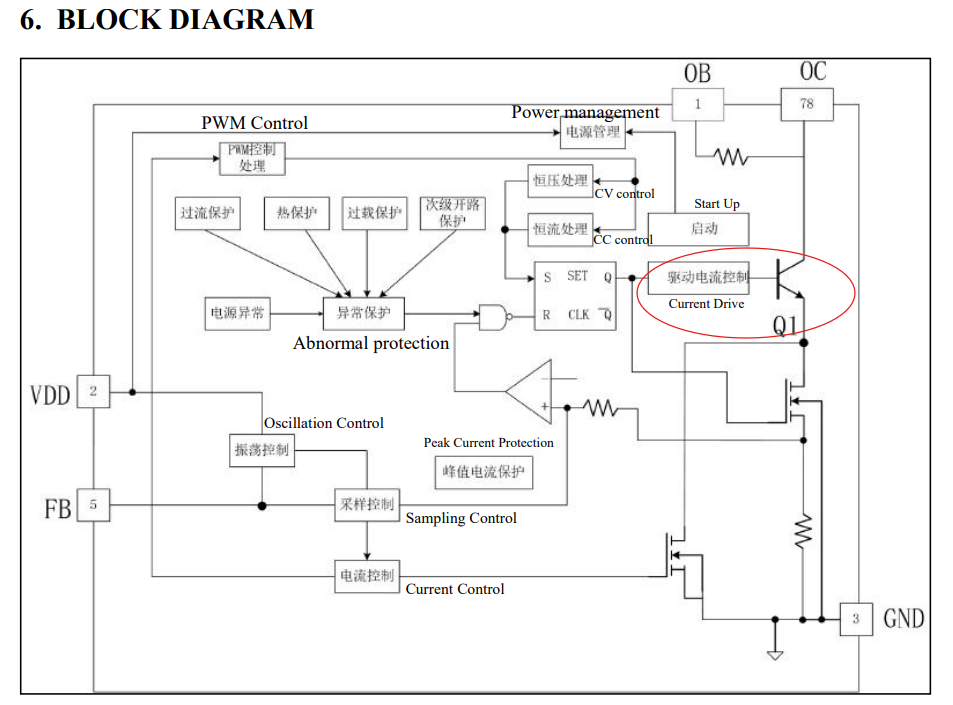
But the most surprising part was that GPT was able to infer that there should have been a feedback loop implemented with optocoupler marked as PC817, which I was able later to identify on the board. Then it was able to infer that the 8 pin chip was most probably Pulse Width Modulation (PWM) controller and that it should have been connected to power transistor. Looking at the specification of that DM1203 chip I was able to confirm that it came with power transistor built-in shown in the diagram for the spec below.
In the end GPT taught me that the output from the PWM controller should be connected to the snubber capacitor
In the end after back end forth with the GPT it was able to provide me with the description of the schematics of the board. Since I don’t have a history of my prompts at this time I tried to recreate in a concise manner my interaction with LLM. In the case below I provided two images and not one, and a detailed description of the board. LLM was able to exhibit very detailed understanding of what were the components on the board and how it worked.
Prompt: I have the Switched Mode Power Supply board with following components PWM controller DM1203, optocoupler PC817, transformer with 12V and 5V output, smoothing capacitors at the output and the following pinout of the connector: -12V, GND, 12V, GND, +5V, +5V. Also attached come two images of the board: one front and one transparent that shows traces on the board. How about you provide me with the description of this board
Response from GPT-5 Board Overview
This is a flyback switched-mode power supply (SMPS) built around the DM1203 PWM controller IC. It takes AC mains input, rectifies and filters it, then uses a transformer to generate isolated DC outputs: +5V, +12V, and –12V. Regulation is achieved through an optocoupler (PC817) and a TL431 reference.
⚡ Input Stage
Fuse (F2AL250V): Protects against overcurrent.
NTC thermistor: Limits inrush current when first powered on.
Bridge rectifier (D9–D12): Converts AC mains to high-voltage DC.
Bulk capacitor (large electrolytic, ~220µF/400V): Smooths the rectified DC.
EMI filter (C1, C2, L1): Reduces conducted noise back into the mains.
Transformer (EE-25 core): Stores energy during switch ON time, releases it to secondary when OFF.
Snubber network: A 10nF/1kV capacitor (103) in series with a 47kΩ resistor across the primary winding — absorbs voltage spikes caused by leakage inductance.
Startup/VCC capacitor: Provides supply to the DM1203 once oscillation begins.
⚙️ Secondary Side (Low Voltage Outputs)
Rectifier diodes: Fast recovery or Schottky diodes on each secondary winding.
Filter capacitors: Large electrolytics (e.g., 470µF/16V) smooth the DC outputs.
Inductors/ferrite beads: Further reduce ripple and noise.
Outputs provided:
+5V (two pins)
+12V
–12V
Ground (two pins)
🔁 Feedback & Regulation
Voltage divider (resistors): Scales the +5V output down to 2.5V.
TL431 shunt regulator: Compares scaled voltage to its 2.5V reference.
PC817 optocoupler: Transfers the error signal across isolation barrier to the DM1203’s FB pin.
FB pin capacitor (1nF–10nF): Stabilizes the feedback loop.
This ensures the +5V rail is tightly regulated, while the ±12V rails are “cross-regulated” (their accuracy depends on transformer design and load balance).
🧠 Functional Summary
AC mains → rectified to ~300V DC.
DM1203 chops this DC at ~65kHz into the transformer.
Transformer provides isolated secondary voltages.
Diodes + capacitors filter into smooth DC rails.
TL431 + PC817 feedback loop keeps +5V stable.
Snubber protects the switch from voltage spikes.
👉 In short: this board is a multi-output flyback SMPS designed for small electronic equipment, giving you isolated +5V, +12V, and –12V rails with the +5V as the regulated “master” output.
Would you like me to redraw this description into a clean block diagram (showing input → primary → transformer → secondary → feedback) so you can visualize the flow more easily?
You can tell that it’s quite amazing what LLM was capable of looking at the description above.
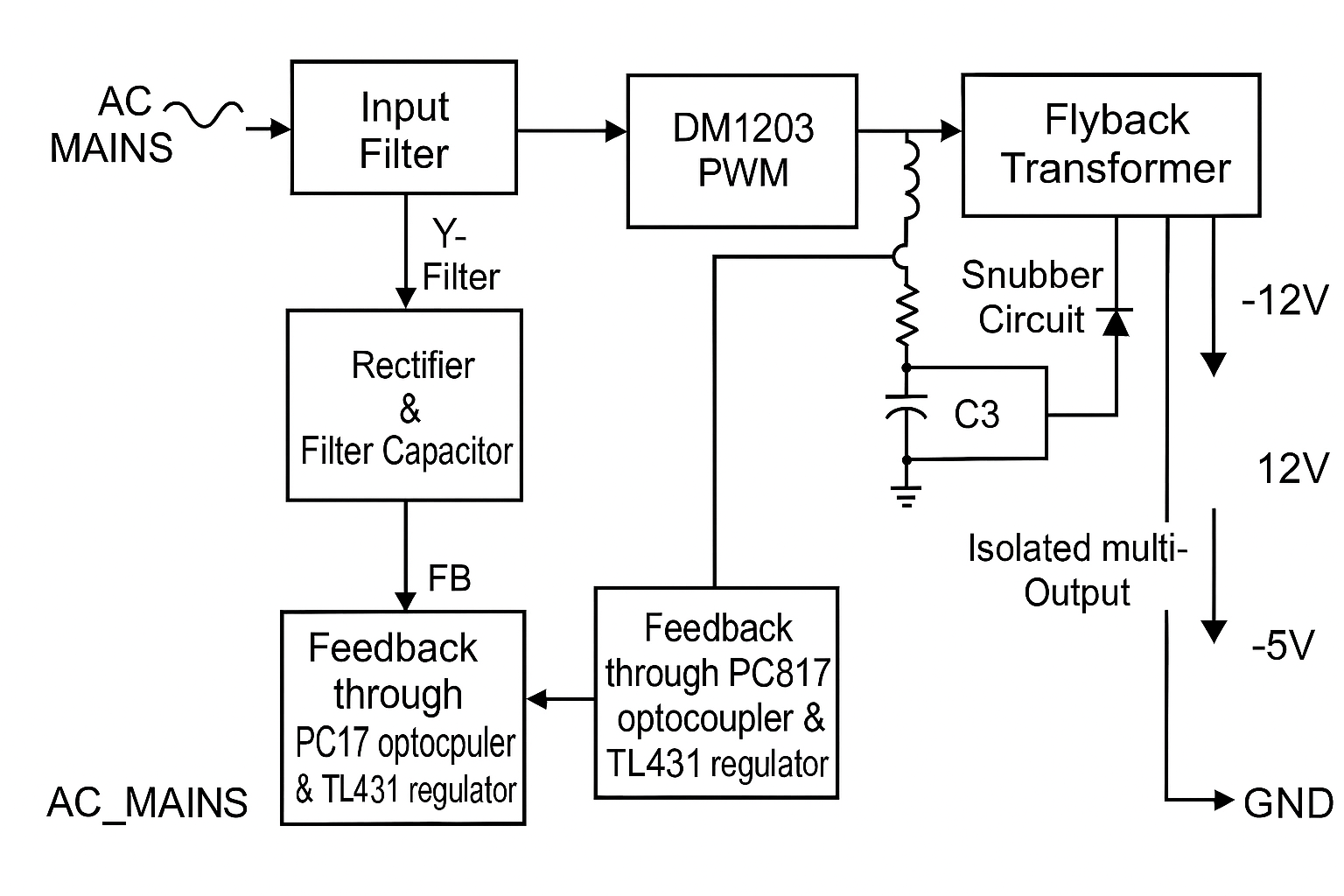
I’ve followed up and asked it to provide a block diagram too:
Prompt: sure block diagram is good
Response from GPT-5:
Parting thoughts
So there you have it Windows Copilot using GPT-5 model in particular is capable of being a patient super skillful engineer that could help you with hardware reverse engineering on demand. You only need some basic understanding of the subject you’d like to explore and a curiosity to try new things.
Bonus
After I’ve replaced the leaked capacitor with a new one and the DVD player works again.
 ScienceAppliedForGood